Posted on 12/28/2025 9:18:41 PM PST by SeekAndFind
NOTE: This post is very long, and the videos included are even longer. If you choose to watch only one, I would suggest the third one that specifically covers the Trump class.
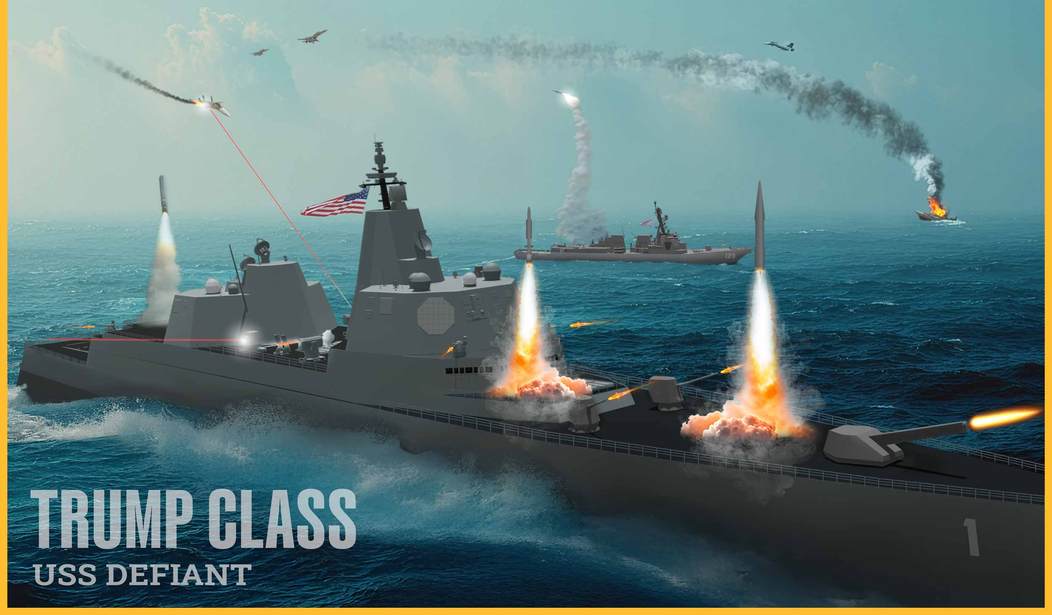
A lot of people instantly hated the new Trump-class Battleship because it has the name "Trump" attached to it, and especially hated it because Trump wants to have a hand in the design for "aesthetic" reasons.
After all, if Trump likes something, it must be a bad idea.
But of course, that's a terrible reason to have an opinion about whether a weapons system, which would likely be in service for half a century or more, would be worth building and using. Few people doubt that America needs to have the most powerful Navy in the world, and one specifically suited to worldwide power projection.
No other country in the world has naval requirements remotely similar to ours, and the closest any country came was Great Britain at the height of its empire. Our strategic requirements as the world's defender of freedom of navigation mean that we need to have the capability to project power in the Atlantic, Pacific, Indian Ocean, Persian Gulf, Mediterranean, South China Sea...basically everywhere.
Naval power is so vital to our security and economy that there is a legal requirement that we maintain 11 active-duty aircraft carriers in service at all times, just to ensure we have enough to deploy where they are needed. Given their maintenance requirements, which are enormous, at most half of them can be deployed at any given moment, and usually fewer. Generally speaking, a third are deployed, a third are preparing, and a third are in maintenance for refit.
Carriers are part of strike groups, meaning they are not deployed alone but with an array of other ships, including destroyers, cruisers, and attack submarines.
Obviously, the carrier strike groups are the heavy hitters in power projection, and what most people tend to think of as the core of our Navy. And they are not wrong, but not exactly right either. Carriers are the big sticks of power projection, but outside of wars or active conflicts, they actually are not doing the most important work of the Navy, which is defending the sea lanes and ensuring the free flow of trade against piracy and other lower-level threats.
Currently, that job rests largely with our destroyers, which are extremely formidable in their own right, and we have about 75 of them. They can both project power and serve as superb air defense platforms. The destroyers aren't nearly as sexy as an aircraft carrier, but they form the backbone of US naval power.
Think of the Red Sea crisis, in which the Houthis essentially shut down the vital transit route through the Red Sea. While people caught snippets of the action on the news, few understand the scope of the effort and risk involved in suppressing the Houthis' attacks. By many measures, the Red Sea battles were the largest naval engagements since World War II, and it was the Arleigh Burke-class destroyers that led the way. (The video is long, and not vital to the post, but it is still cool).
The US did use its carrier assets in the conflict, but as it was the destroyers that defended the airspace for the most part. And in terms of deterrence—preventing aggressors from threatening sea lanes around the world—only destroyers can be deployed in all the potential hotspots. Carriers can't be everywhere at once, but with enough destroyers, and hopefully frigates, which are smaller and cheaper but still capable ships of which the US is woefully underequipped (we just canceled yet another program for a modern frigate and are replac ing it with a barely-armed version of the coast guard frigate), the Navy can't do the job that it conducts every day.
Carriers are for the higher-end fights; smaller ships deter pirates and smaller actors who could disrupt world commerce. And we don't have enough. And the smaller ships are able to operate close to shore in a way that carriers, and in some cases even destroyers and cruisers cannot. (This video, too, is long, but it does go into why the lack of frigates is a problem, and why Navy procurement policies are really really REALLY broken.)
As for cruisers, which are larger than destroyers and capable of even more power projection, the US is about to retire them, along with many of our conventional missile carrying submarines.
Which gets us to the problem with building the Trump-class battleships, and why they are likely a bad idea to fill our strategic needs. With the retirement of the cruisers and the modified missile-carrying submarines in the next few years, the US is about to lose nearly 20% of its non-carrier striking power, and hence our ability to project power outside the very limited number of carrier strike groups.
That is a non-trivial problem. Carrier strike groups are expensive, extremely limited in number, and not ideal for protecting sea lanes of communication. Using them would be similar to using tanks and SWAT teams to police the streets on a normal day. You need to have cheaper and more numerous policemen on the streets to prevent and deal with crime, not massive military force capable of leveling a city block for every robbery.
And, given the changing nature of warfare, even carrier strike groups and large naval engagements benefit from what is called "distributed lethality," which is a fancy way of saying you want many rather than few targets in even a high end battle. Unlike some people, I believe carriers will remain relevant for the foreseeable future, but if we get into a peer conflict, you would prefer to have many ships capable of striking and striking back rather than fewer, since ships (other than carriers) are relatively fragile. It's not just that they are easier to sink, but almost as importantly, they are much easier to take out of the battle, such as what happened with the USS Cole. One or two hits could render a ship useless for battle, even if it is repairable over time.
Lots of small ships can also carry much more striking power than one or a few large ships. As large and capable as a Trump-class battleship would be, it actually wouldn't be able to put much more ordinance on target than a destroyer, despite a much higher cost and vulnerability due to being one ship rather than 10.
A single Arleigh Burke-class destroyer has 90-96 VLS cells, which carry the ordinance that would be used in a higher-end (or air defense) battle. A single Trump-class "battleship" would carry 128 cells that include the same capability, plus 12 for hypersonic missiles.
All at a cost of $10-15 billion, which is the same cost as a Ford Class carrier. (This video explains why the Trump class battleship is probably a bad idea.)
Even if the Trump class would be harder to sink, it wouldn't be THAT much harder to sink than a destroyer. Let's say it takes 5x as many missiles to destroy it or put it out of action, China certainly has the missiles to do so. And once it is gone, it is gone. Putting 10 destroyers out of action is a much harder task, especially since they can support each other in air defense creating a web of defense. Overwhelming the air defense capabilities of multiple destroyers is a much tougher nut to crack than overwhelming the slightly more capable single ship.
The real game changer on the Trump Class ship is the yet-to-be fully developed railgun, but the question is 1) whether it can be made fully mission capable in a reasonable period of time, and 2) whether the added capability is worth the trade-offs, which include much higher cost and far fewer ships. Would 10 railgun-equipped ships over the next 30 years be of equal value to building 70 or so destroyers or an even larger number of frigates, each with anywhere from 26 to 96 VLS cells depending on design?
In other words, the Trump Class ships would be easier to kill than a much larger number of nearly as capable ships, which can also be many more places at once.
It's not that the Trump Class ships wouldn't add to our capacity to project power than we have now, but are they worth the added cost, the greater vulnerability for each unit of firepower, and lower ability to be in many places at once?
The answer is likely "No."
They are a cool idea, but an impractical solution to our current needs, which are really to have more pretty capable ships in more places at once.
Trump is right that our destroyers are relatively fragile when struck than an older World War II battleship, but the US only ever built four Iowa-class battleships for a reason. Their capabilities were tailored to a specific time, and they were not even fit for the World War II battlefield.
For the moment, navies use missiles and airplanes for striking power, and adding VLS cells (where missiles are fired from) in large quantities and distributed among a fairly large number of ships is the best way to complete the missions our Navy is used for.
Lots of slightly less capable ships distributing our firepower and capabilities just makes more sense than concentrating fewer VLS cells in a few ships.
If a Trump Class ship cost twice as much as a destroyer, it would not be a horrible decision to have a few ships that look more impressive than a destroyer and which carry a fully-functional railgun. But given our budgets, the always-overoptimistic timelines for development and construction, and how long it takes to get a new ship design to actually function properly, it seems to be a bad bet.
A future administration will surely cancel the program, after spending many billions on design, or we will wind up with a situation similar to the Zumwalt (which also tried to pack more capability into a new ship class, and which failed miserably), or perhaps the Littoral Combat Ship, which again was a cool concept and if it had worked well would have been a significant addition to our capabilities.
The Navy has been horrific at designing and deploying new ships, which is why the Navy is shrinking both in size and capability. We need more combat capable ships, not fewer and slightly more capable (in some fights) ships that may or may not work as intended.
The Arleigh Burke destroyers keep getting built (25 more are planned) because they are proven, the bugs have been mostly worked out, and they are no longer subject to the provably failed ability of the Navy to design, build, and deploy new classes of ships. We can't even build new frigates more capable than the ones we use for drug interdiction, even when we start with the basic designs that work for our allies.
We need the equivalent of building a lot of F-15EX-equivalent ships. Updated and more capable proven versions of what we know works, and we need it quickly for a potential high-end fight with China, which is as a practical matter our only near-peer or peer Naval adversary. That means destroyers and frigates. We should, frankly, just buy slightly modified versions of a ship already designed by Italy or Norway. The Constellation class was supposed to be that ship, but the Navy screwed it up with mission creep and gold plating that made it untenable.
We took ships that were good enough with slight modifications, and turned them into...expensive black holes.
The Navy has two pressing—and I do mean pressing—needs: a significant number of capable but not gold-plated ships, and a longer-range strike aircraft to keep our carriers out of missile range as they engage in a high-end peer-on-peer battle. The range of our current strike aircraft is just not sufficient to the task, increasing the risk to our most powerful and expensive assets.
That aircraft was supposed to be the F/A-XX, which was just cancelled, and of course the Constellation class frigate was just cancelled and replaced with one that doesn't include VLS cells. In other words, there is no current plan to fulfill the most desperate needs of the Navy. Arguably, the Trump administration made the wrong choice between building the F-47 and the F/A-XX, since the Navy's needs for an updated strike aircraft were much more pressing than the Air Force's.
Originally both aircraft were to be produced simultaneously, but the administration, perhaps rightly, judged that building two new advanced stealth fighters at once was too heavy a lift for our industrial base. I am in no position to judge, but that makes sense. Yet the choice of going forward with the F-47 over the F/A-XX as the first aircraft to be deployed seems to be...odd, at least to me and many others. The Navy's needs are more pressing for a long-range strike aircraft that can strike deeper than the aging F-18 or the F-35C. (Again, long video, but if you want to understand how and why carriers can still be highly relevant with a longer-range aircraft, it is well worth it.)
The F-47 will be a great capability to have, of course, and should be built. But the F/A-XX is a necessary capability ASAP, and it is stalled.
So...no capable frigate, no long-range strike aircraft, fewer VLS missile cells in total, and much less distributed lethality just seems to make no sense.
If we had infinite resources and shipbuilding capabilities, the Trump class ships would be a "nice to have" addition to the fleet. But given resource constraints, the money and effort should go to less sexy but more capable choices.
A really stupid plan and I hope it dies soon.
Maybe they’ll lay ‘em down as battleships and then pull a “Shinano:” finish ‘em as super-carriers.
We still don’t have a reliable way of reloading VLS cells at sea, though we’re working on it.
But we’ve been working on it for decades.
AIUI, the Navy’s new frigate design doesn’t have VLS cells, but will accept containerized mission packages.
One of these is four VLS cells packaged into a standard shipping container. My guess is that swapping out containers will be easier than reloading vertical cells.
I hate the idea because there was a fundamental contradiction between what Trump said these ships would be, and what the Navy descriptions said they would be. It's like they're talking about two completely different projects, and the President is just clueless.
So who's description of these proposed ships is correct? The P Navy's, or the President's?
If it is the Navy's, then it appears the President simply does not listen to what his senior advisors tell him about projects. And yet, President Trump will be in the critical position to influence/control how these projects move forward despite having a crap understanding of what these ships actually are. So that doesn't strike me as a good idea.
But if it is Trump's description of these ships that is correct, then the Navy apparently was not kept informed of what the Presdient wants for these ships. They're going ahead with designs that don't match what the President is demanding, which again does not bode well for the efficient development and construction of what is an immense new ship-building program.
In short, the President and the Navy not being on the same page as to what these ships actually will be is a really bad sign.
No drones in the concept(s).
Another never-Trump clown that is way too predictable. Every time you post, it’s a forgone conclusion that it’s another piss and moan festival about everything Trump does. You may be a lifelong “Republican”, but we need something better now. We need people that aren’t just in office to play games. Go vote for a Bush.
Someone has to get this fat egomaniac to FOCUS.
Can you explain in a few simple sentences the difference between a battleship, destroyer, frigate, and cruiser?
When I was a kid, I played Battleship, but apart from some of the ships being different sizes, I didn't know what was the difference.
I only understood what made a ship a carrier or a submarine. Those were easy so figure out.
Looks cool, but is it just too big a target?
Can you explain in a few simple sentences the difference between a battleship, destroyer, frigate, and cruiser?
They are defined by the size of the captain’s balls.
https://www.slashgear.com/1335354/types-of-military-war-ships-explained/
Corvettes are smaller vessels, intended for coastal defense and limited deployments to neighboring countries. They aren’t designed for open-ocean warfare. But yeah, tiny is good overall descriptor. The Israeli SAAR 5 class is a great example of what you can do with a corvette.
Frigates are intended for open ocean duty, but with lighter armament and smaller size than a destroyer. Mainly, you want frigates for escort duty. A lot of countries focus on frigates now for most of their navies and ignore destroyers.
Destroyers-workhorse of the Navy. Ocean-going, do a variety of missions, and fill your classic Mahanian “sea-control” role.
Cruisers-larger, heavier vessels. Originally, were the workhorses of the fleet, but now, are restricted in usefulness since they got so big. Are mainly used for escort of capital ships (unless your fleet considers in
I’ll be honest that in US terminology, there’s no real difference between a cruiser and a destroyer. Just the hull designators. Oh, and by law, new cruisers must be nuclear-powered, which is why we don’t build anymore, but we make 10,000 ton “destroyers”.
Battlecruiser-originally the idea for CBs was that they could have the speed of a cruiser while combining the firepower of a battleship. They did this by leaving off the battleship armor and protection, which turned out to be what was bloody wrong with their ships that day (to paraphrase the old quote) at the Battle of Jutland. People stopped building CBs after that, although the US put together a class with a different idea in World War II.
Reminds me of what they said about the Star-Wars system Reagan planned—too expensive, can’t work, Reagan’s a fool.
Same can be said of the Trump Battleship.
In fact he is right about the use of steel in Naval ships and we need a platform for the rail guns—Other nations are working on them as we speak—one being Japan. We know they work and they can be a devastating weapon system. What if China builds a rail gun battleship? No, an impressive BB can be a useful tool in diplomacy as the Russians did with their Peter the great cruiser. Yes, in a world war they will be a target—but so will every one of our carriers-—an armored battleship with every anti-drone, anti-rocket system built in might be better at surviving. I say extend the flight deck and make her able to launch fighters and bombers.
That being said—we could use two of these—but we also need more smaller ships Frigates and also drone carriers, like fast jeep carriers that would launch only copters and drones, unmanned fighters and observation drones. We need them. We also need a four masted windjammer for the US Naval academy—We have the Eagle for the Coast Guard that was a trophy we got from Germany at the end of WW I. We need a big impressive ship for the USA—name her the USS United States. We could also use a presidential Yacht. USN 1— a cool world class yacht to hold parties on and impress foreign states. I was hoping Bush would seize Saddam’s yacht as a prize but he let it be looted and torched by Iraqis. It should be large—armed to the teeth—a naval ship with a pool and dance hall. Maybe name her USS Dolly Madison. An impressive symbol of Americas power like the old HMS
Britannic was for England.
“Someone has to get this fat egomaniac to FOCUS.”
We really don’t know you well enough to know how to get you to focus.
Each ship class was meant to fulfill a niche as part of the design of the fleet of a large naval power. The various ship classes balanced size, cost, gun size, armor, speed, and range in specific naval roles.
The largest, most powerful, and best armed and armored ship class was battleships. Ideally, a country's battleships were intended to menace or carry out actions against enemy fleets, especially against enemy battleship formations. Battleships carried guns that were anywhere from 12 inch to 18 inches caliber.
Destroyers were originally known as "torpedo boat destroyers." Thinly armored and fast, they were originally intended to protect larger ships and fleets against enemy submarines and torpedo boats. Destroyers were escorts for larger ships and available for shore attack missions.
Cruisers were larger and more powerful than destroyers and designed to be able to carry out gun attacks against enemy ships and shore targets. Smaller and less powerful than battleships, cruisers had the range and speed to substitute for battleships in many missions, especially at distance from the homeland and major bases.
The ship class of frigate dates from the era of sailing ships. The term was revived in recent decades for small, potent warships that mostly conduct patrol missions relatively close to bases. Most modern frigates usually have a complement of missiles. European navies especially tend to find that modern frigates meet their core naval needs.
Nowadays, with massive battleships obsolete and confined to museum service, cruisers are the largest active gunship class. Yet, even here, cost and technology make them relatively rare. With missiles and more accurate guns, destroyers and frigates are the largest ship classes by numbers.
Well, I consider the new aluminum frigates really dumb instead. They can’t take any serious hits, and if they did the would catch on fire.
So I fully support battleships that can take incoming fire, made of 6 inch thick steel or thicker. The videos I have seen of aluminum ships being disabled from minor hits or collisions have been truly embarrassing, they useless in real battle.
I am neither for or against the new Trump ships.
War has changed in the last 4 years. Missile ships, and the entire Black Sea fleet, have become targets, not predators. The plane changed WWII in the pacific making it a carrier war. The drones have changed war again. In this setting, many more small capable ships makes more sense.
However, I think the next large ship should be stealthy, fast, and capable of carrying thousands of drones. Drone carriers don’t need long flight decks. They can arrive anywhere and release devastatingly accurate payloads as an advance strike force. They should carry laser defenses against missiles and drones, and have a kinetic weapon capable of long range hitting power. This ship should be capable of carrier speeds, capable to take a carrier like beating, and integrate with carrier and aircraft operation. Complements of submersible strike drones should be included. This is my perception for the next strike group addition. Potentially completely submersible for short periods, making hypersonic missiles cluster attacks useless.
.
“wouldn’t be able to put much more ordinance on target than a destroyer”
I stopped reading right there. It’s ordnance.
Trump is well known for his building construction and renovations, and these ships are like floating buildings, so I would like to be a fly on the wall to see how much of his input is being taken seriously.
Neither. All we have is the concept art of a sales brochure. The actual ships will be different, much like how a concept car at the car show is not what you will be able to buy at the dealer.
The published concepts have a few weakness as far as I am concerned (mostly it needs a lot more point defence). These ships are to fill two gaps in US capability currently, we need task force air defence with longer range (ability to travel from Pearl Harbor to Tokyo at useful speed without refueling), and fire support for amphibious operations that can stay on station for more than a day before it shoots it self dry is also needed.
In peacetime the ship will be a nice cruiser. Large enough to impress the citizens at ports, capable of performing several types of disaster relief, and the big hanger is a nice event space for foreign VIPs when the Ambassador wants to impress.
The trouble with rail guns is their line of sight limited range, while missiles do not have that limitation.
Disclaimer: Opinions posted on Free Republic are those of the individual posters and do not necessarily represent the opinion of Free Republic or its management. All materials posted herein are protected by copyright law and the exemption for fair use of copyrighted works.