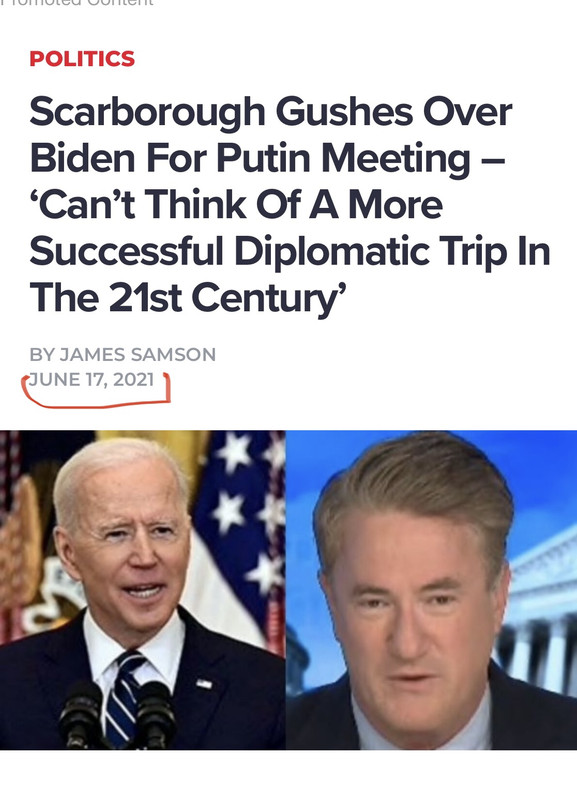
I can provide 50 examples. When Joe made nice with Putin, they said he was a Great Leader of men!
Posted on 02/25/2022 3:47:20 AM PST by tlozo
Russia's invasion of Ukraine has shocked the former Soviet satellite states of Central and Eastern Europe, drawing strong condemnation even from the region's most pro-Kremlin politicians.
For some of the countries that fled the Soviet bloc following a series of anti-communist revolutions more than 30 years ago, footage of tanks and troops rolling in to punish a nation trying to pursue its own independent course looks painfully familiar.
Two until now major pro-Russian voices in the European Union, Czech President Milos Zeman and Hungary's Prime Minister Viktor Orban, didn't mince their words in criticizing Moscow's most aggressive action since the Soviet invasion of Afghanistan in 1979.
Their countries experienced comparable brutality — the Czech Republic, as part of Czechoslovakia, in 1968 and Hungary in 1956.
Zeman called Thursday's invasion "an unprovoked act of aggression."
"Russia has committed a crime against peace," he said in an address to the nation.
Zeman had previously made news by calling Russia's 2014 annexation of the Ukrainian Crimean Peninsula "a fait accompli."
Many in the Czech Republic reviled Zeman as a "servant of Kremlin" after he sided with Russia and cast doubt on the findings of his own security and intelligence services on the alleged participation of Russian spies in a huge 2014 ammunition explosion.
Until just days ago, Zeman was insisting that the Russians wouldn't attack Ukraine because "they aren't lunatics to launch an operation that would be more damaging for them than beneficial."
"I admit I was wrong," he said Thursday.
Zeman has called for harsh sanctions against Russia, including cutting it out of the SWIFT financial system which shuffles money from bank to bank around the globe.
"It's necessary to isolate a lunatic and not just to defend ourselves by words but also by deeds," he said.
Czech Prime Minister Petr Fiala also voiced full support for the strongest possible sanctions for what he called "an absolutely unjustified act of aggression against a sovereign state."
Prague ordered the closure of two Russian consulates in the Czech Republic and stopped accepting visa requests from Russian citizens.
Pavel Rychetsky, the chief judge at the Constitutional court, the country's highest legal authority, suggested that a European arrest warrant should be issued against Russian President Vladimir Putin. He said Putin should be tried at the International Criminal Court for "an unprecedented unleashing of war on the European continent for the first time since World War II."
In Hungary, high ranking officials had for weeks avoided condemning Russia's actions directly. Under Orban, the country has pursued close ties with Putin, a point of concern for many of Hungary's western partners.
Hungary has historically deeply distrusted Moscow, which ordered the brutal repression of an anti-Soviet uprising in 1956. But Orban in recent years has pursued a diplomatic and economic strategy he calls "Eastern Opening," which favors closer ties with countries to the east, and in his frequent battles with the EU has called the 27-nation bloc an oppressive imperial power similar to Hungary's former Soviet occupiers.
But on Thursday, Orban was clear in his condemnation of the Kremlin.
"Russia attacked Ukraine this morning with military force," Orban said in a video on Facebook. "Together with our European Union and NATO allies, we condemn Russia's military action."
"Hungary's position is clear: we stand by Ukraine, we stand by Ukraine's territorial integrity and sovereignty," his Foreign Minister Peter Szijijarto said.
Bulgaria, Moscow's closest ally during the Cold War, followed suit.
"Having strategic bombers and missiles flying in Europe in the 21st century, assaults by air and sea against a sovereign state, is absolutely inadmissible," President Rumen Radev said.
Romania also stood staunchly with its western partners.
"Through today's cynical invasion, the Russian Federation is the architect of the worst security crisis since World War II," the ruling coalition leaders said.
Neighboring Moldova, a former Soviet republic and one of the few former communist Eastern European countries not to have joined NATO so far, echoed these views.
Moldovan President Maia Sandu stressed that Russia's attacks were launched "in violation of international norms," adding that the international community "unanimously condemns these military actions."
___
Czech President Milos Zeman has called for harsh sanctions against Russia: "It's necessary to isolate a lunatic and not just to defend ourselves by words but also by deeds,"
What does Pootie-Poot care.
He and his Western European allies both feel the same way about the Eastern Europeans.
I have this weird feeling that...Putin made a BIG mistake.
Things must be chilly on the International space station.Three of the seven crew are Ruski Cozmoknots.
https://www.nasa.gov/mission_pages/station/expeditions/index.html
Lori Klausutis was unavailable for comment.
‘
You can say that again!
Clinton's war in Serbia, Obama's creation of ISIS and destruction of Syria, Biden's capitulation in Afghanistan.
Whole areas of the globe left as cratered incubators of Islam. Just to swell Democrat coffers.
But I grant that the Czechs and Hungarians have excellent reason to fear a resurgent Russia and a defective US. At this rate another three years of Biden will leave the world with two Soviet Unions grinning at each other across the Atlantic.
Putin has screwed the pooch. If he had just done a soft takeover of the 2 separatist regions he would have gotten most of what he wanted. It is really surprising how ham fisted and stooopid the current operation is.
Bill Clinton signed the Budapest Treaty that the USA would protect them if they gave up their nukes...
And they did...
UK signed too.

The Budapest Memorandum on Security Assurances refers to three identical political agreements signed at the OSCE conference in Budapest, Hungary on 5 December 1994 to provide security assurances by its signatories relating to the accession of Belarus, Kazakhstan and Ukraine to the Treaty on the Non-Proliferation of Nuclear Weapons. The memorandum was originally signed by three nuclear powers: the Russian Federation, the United Kingdom and the United States. China and France gave somewhat weaker individual assurances in separate documents.
Russia also signed it saying they would respect Ukrainian independence and sovereignty in the existing borders and refrain from the threat or the use of force against Ukraine.
I think I’d hold off on any spacewalks for a while.
Not a Treaty in fact.
Sad how the Hells Angels have more integrity in their membership than does the US or these countries. If one gets into a fight ALL will unhesitatingly and immediately join the fight.
Putin is well aware before and after his decision to do this how Europe, and for that matter the world , would see him or he would not have endeavored such great a risk. He had been down this road before and for years now taken the criticism and blame for everything leaders chose to blame him for.
How he sees his efforts and how the world leaders see his efforts to be included with world affairs and respected is and always will be diametrically opposites. Russia has to be the enemy otherwise there’s no reason for Nato, the Un and all the other Institutions, think tanks etc. which benefit from that.
On the other hand China is the economic enemy and so these two have joined hands....frankly positioned..... for all that we will see in the future.
The EU, the ChiComs, and Putin are all allied with our Deep State.
For now.
That would depend on how you’d define that today....and these are shifting pretty much daily....the undertow is distinct.
The Budapest Memorandum on Security Assurances refers to three identical political agreements signed at the OSCE conference in Budapest, Hungary on 5 December 1994 to provide security assurances by its signatories relating to the accession of Belarus, Kazakhstan and Ukraine to the Treaty on the Non-Proliferation of Nuclear Weapons. The memorandum was originally signed by three nuclear powers: the Russian Federation, the United Kingdom and the United States. China and France gave somewhat weaker individual assurances in separate documents.
Disclaimer: Opinions posted on Free Republic are those of the individual posters and do not necessarily represent the opinion of Free Republic or its management. All materials posted herein are protected by copyright law and the exemption for fair use of copyrighted works.