Posted on 04/22/2021 7:11:29 AM PDT by Kaslin
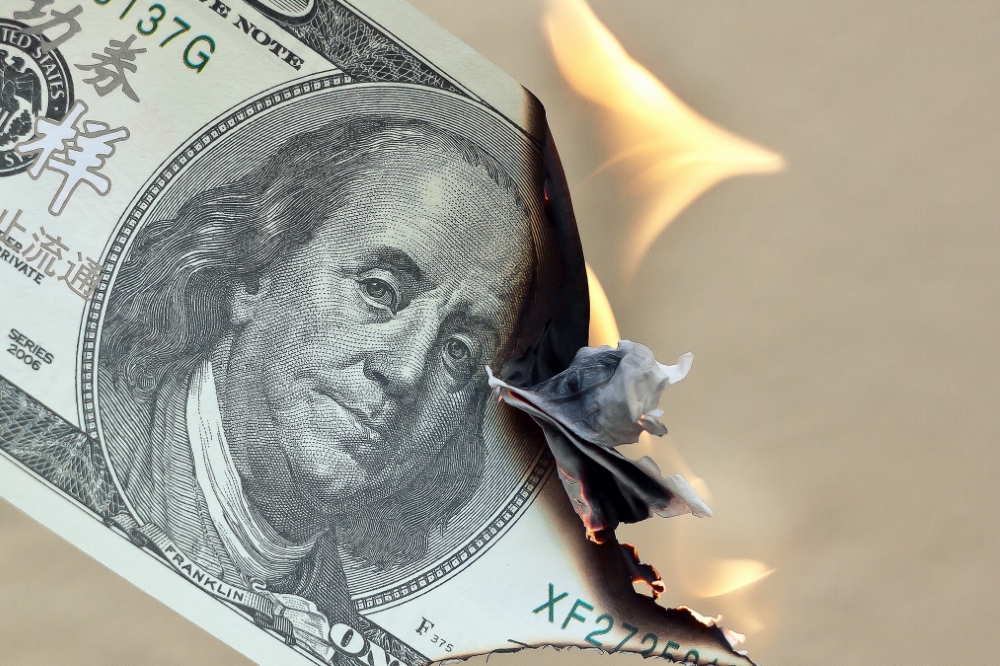
Since inflation is a process and not an end-state, it never seems too bad at the start. Unfortunately, Americans should prepare to buckle up for the future.
As the COVID-19 panic slowly recedes across America, you’ve probably noticed that you’re paying more at the pump. Indeed, the national average for regular-grade gas price has risen more than 34 percent, from less than $2.00 a year ago to $2.68 lately. There are several reasons the gas price has spiked up, including the production problem caused by the harsh winter, increasing consumer demand as the country reopens, and one other sinister culprit: inflation.
Inflation is an economic phenomenon that sees a steady rise of prices for goods and services eroding purchasing power — or you can buy less with the same amount of money. Economists usually pay close attention to the inflation rate, or the rate general prices increase. In the United States, the inflation rate is usually measured by the Consumer Price Index, a mathematical tool that measures the prices change for a selected basket of goods and services.
Since inflation is a process and not an end-state, it doesn’t seem too bad in the beginning. As prices for goods and services gradually rise, those who are employed demand higher wages in turn. Employers will usually comply because the early stage of inflation is often associated with booming economic activities and a tightened labor market. So, while workers will usually get the higher wages they demanded, they will typically also have to pay higher prices for things they need or enjoy as businesses find various ways to pass the cost of wage hikes unto consumers.
When consumers notice their money is losing value, it gives them an incentive to spend more and buy more stuff now rather than holding cash. As a result, both consumer spending as well as business investment will increase. Such increases will, in turn, stimulate further economic growth.
In the long run, however, inflation is a bad thing. As consumers and businesses are motivated to spend more now, they drive up prices of goods and services, the economy finds itself with an abundance of cash no one wants, and money quickly decreases in value.
To combat inflation, a nation’s central bank usually has to increase interest rates, meaning higher borrowing costs for consumers and businesses. When businesses become less likely to invest, expand, and grow, these factors combine to increase the likelihood of an economic recession, which in turn leads to scarcity in various sectors of the economy.
In the later stage of inflation, there is too much money chasing too few goods and services. At this point, the economy enters a vicious cycle: as the nation’s currency depreciates, incentive increases for consumers and businesses to spend and get rid of their cash; demand drives up the prices of goods and services; central banks increase interest rates higher to combat inflation, driving up borrowing costs while depressing businesses investments and incentives to produce; and the value of the nation’s currency drops further, creating even more incentive to spend. The cycle goes on and on.
Such a vicious sequence can eventually even lead to hyperinflation, an economic phenomenon in which prices of all goods and services rise effectively out of control. A good example is what happened to the Zimbabwean dollar (ZWD). Between 2007 and 2008, Zimbabwe experienced one of the worst hyperinflations in human history, with “prices doubling approximately every day at its peak.”
The Zimbabwe government kept re-evaluating ZWD by issuing notes with a large denomination. During the third revaluation of ZWD, the Zimbabwean government issued a ZWD note of 1,000,000,000,000, which couldn’t even pay for a loaf of bread. Predictably, the hyperinflation devastated Zimbabwe’s economy.
Venezuela provided a more recent example of hyperinflation as years of failed socialist economic policies and corruption drove its economy to the ground. By the end of 2018, Venezuela’s annual inflation rate reached 80,000 percent and the Venezuelan bolivar became so worthless thieves refused to steal it.
As Milton Friedman famously said, “Inflation is always and everywhere a monetary phenomenon,” meaning it is caused by excessive money supply as the result of expansionary monetary and fiscal policies. Let’s not forget the great inflation Americans had to endure between the 1970s and early 1980s.
Among other things, the Federal Reserve increased the money supply to help finance the Nixon administration’s continuation of the War in Vietnam as well as its expansion of Social Security. As such, the U.S. inflation rate reached 14 percent in 1980, and the U.S. dollar devalued sharply.
Under the Reagan administration, it took Federal Reserve Chairman Paul Volker to impose harsh monetary policies, including increasing the interest rate to 22 percent, to eventually defeat the inflation, with the inflation rate dropping to less than 3 percent within two years. Still, Americans paid a steep price for Volker’s medicine. The U.S. economy plunged into recession, the unemployment rate reached 10 percent, and many companies, small and large, were driven out of business.
Although today, the inflation rate in the United States is still at a historical low, it’s the trend of the record-setting increase in the nation’s money supply that should be the greatest concern.
There are several ways to measure the size of the money supply, and economists name them with the letter “M” (such as M0, M1, and M2). The M2 is used most often because it includes cash, checking deposits, savings, and money market securities.
As of February 2021, the U.S. M2 has increased close to 40 percent on a year-over-year basis due to our fiscal and monetary policies. In comparison, right before the great rise in inflation took off in the 1970s, the M2 had increased nearly 13 percent, from $710 billion in 1971 to $802 billion in 1972.
I’m paying $4.24 for Premium in Orange County California.
Would love to see $2.68.
Thank You for posting.
So stock up on
Nonperishable items?
Price of milk was over $4 a gallon yesterday at Publix
You’re in CA. It’s about $2.60 here.
I haven’t seen anyone out of work. The economy has been tootling along just like always. Constuction is booming. Decent houses are being bought, bulldozed, and mcmansions are being built in their place. All this with lumber prices skyrocketing. Can’t get the neighborhood handyman anymore because he is making big time $$$$ bulldozing. The houses not being bulldozed are getting remodeled and additions added. Lots and lots of money is being spent.
The tourists haven’t slowed down one bit during this past year. In fact, they’ve kept coming and coming during the low season. People have money and are spending like there’s no tomorrow. Or maybe they’re using their freebie covid checks.
“Let’s not forget the great inflation Americans had to endure between the 1970s and early 1980s.”
I was there. Did fine. 10-14 years ago people were in a panic over deflation, now it’s inflation again.
Fear always sells.
“Would love to see $2.68.”
C’mon over to SC. Right now it’s $2.59 and rightnacross the border into NC it can be $.15 less.
Thanks for posting this well-written article. Too bad the people who need to make use of this information have no desire to consider it.
Right now what’s left of my home mortgage looks like a steal....
It is here now. I just saw the price increases at the grocery store. Well up over last week.
We buy milk at Walmart, it’s $2.40 a gal for whole milk. Why spend a gal. You think that’s better milk?
“We buy milk at Walmart, it’s $2.40 a gal for whole milk. Why spend a gal. You think that’s better milk?”
What was the price yesterday at Walmart? I think it went up overnight. I don’t buy milk every week.
“... sufficient to the day is the evil thereof...” words of my Savior Jesus Christ.
Matthew 6:34 is absolutely indispensable to every Christian. Jesus told us that we should NOT WORRY
Just check local Sam’s club. Whole Milk is $2.82 now...
“Thanks for posting this well-written article. Too bad the people who need to make use of this information have no desire to consider it.”
What’s too bad is that people spend their lives and potential fortunes falling for fear-porn.
ZWD note of 1,000,000,000,000, which couldn’t even pay for a loaf of bread.
We’ll be on the same standard by the time all of Biden’s plans are implemented.
We are spending too much. It’s a short term boost to the economy until the long hangover follows a year or two later.
Always do that anyway. tagline
Yes, and this author deliberately doesn't mention one of the biggest reasons -- the massive damage via EOs & other measures that the current regime has inflicted on the U.S. Oil and Gas sector.
If Trump had been re-elected, pro-energy, pro-America policies would still be in place, and this article would not have been written.
Disclaimer: Opinions posted on Free Republic are those of the individual posters and do not necessarily represent the opinion of Free Republic or its management. All materials posted herein are protected by copyright law and the exemption for fair use of copyrighted works.