Posted on 11/02/2014 10:01:18 AM PST by Jack Hydrazine
The first sign of failure during Tuesday’s doomed launch of an Orbital Sciences Corp. Antares rocket from Virginia came from the booster’s first stage about 15 seconds after liftoff, according to engineers studying what triggered a fiery mishap that destroyed a commercial cargo craft heading to the International Space Station.
The rocket’s 13-foot-diameter first stage, containing tanks with more than 50,000 gallons of kerosene and liquid oxygen propellants, is made in Ukraine and powered by Soviet-era engines built in the 1970s for Russia’s moon program.
“Evidence suggests the failure initiated in the first stage after which the vehicle lost its propulsive capability and fell back to the ground impacting near, but not on, the launch pad,” Orbital Sciences said in a statement released Thursday.
The company’s acknowledgment that the failure occurred in the first stage is not a surprise, but it is the first detail to be revealed in the investigation into the cause of the rocket crash at NASA’s Wallops Flight Facility on Virginia’s Eastern Shore.
A range safety official triggered the Antares rocket’s self-destruct mechanism before it hit the ground, Orbital said.
In an update posted Friday to Orbital’s website, the company said workers are sifting through the debris field surrounding the Antares launch pad are focusing on identifying components of the rocket’s first stage propulsion system and clearing them before bad weather arrives this weekend.
“Yesterday’s focus was on clearing any potentially hazardous items,” Orbital said. “Current priorities are on finding, cataloging and securing any elements of the Stage 1 propulsion system that will be of particular interest to the AIB (accident investigation board), as well as any cargo that may be found at the site. The team’s goal is to complete that work today.”
The Antares rocket’s first stage is powered by two AJ26 main engines. The kerosene-burning engines each generate 338,000 pounds at sea level.
Supplied to Orbital by Aerojet Rocketdyne, the engines were built in Russia in the early 1970s by the Kuznetsov Design Bureau for the Soviet-era N1 moon rocket. Aerojet imported 43 of the NK-33 engines to the United States in the 1990s for use on American rockets.
According to its website, Aerojet Rocketdyne upgraded the engine with a gimbal block to help steer rockets in flight, new wiring harnesses and electrical circuitry, electromechanical valve actuators and instrumentation.
Orbital Sciences selected the engine for its efficiency — it produces more power for its weight than any other liquid-fueled engine ever built, save SpaceX’s Merlin 1D, which generates about half the thrust of an AJ26 engine. It also saved what some Orbital Sciences officials estimated was roughly $500 million in costs to develop a comparable engine from scratch in the United States.
See details of the AJ26 engine’s history on our story before the Antares rocket’s first launch in April 2013.
At the time it selected the AJ26, Orbital Sciences was locked out of buying the RD-180 engine from Russia. The engine flies on United Launch Alliance’s Atlas 5 launcher, and ULA said it had exclusive rights to the powerplant.
The first stage airframe, including its propellant tanks, are manufactured in Dnipropetrovsk, Ukraine, by Yuzhmash, an aerospace company which also builds the Zenit rocket and upper stages for Europe’s Vega launcher.
Engineers presented a first-look assessment of telemetry recorded from the rocket to Orbital’s accident investigation board Thursday. Investigators found no sign of problems during the countdown or the first few seconds of flight, according to the company’s statement.
Orbital Sciences is leading the inquiry into the rocket crash, which scattered debris hundreds of feet into the air as the launcher erupted in a blinding fireball, destroying an unmanned Cygnus cargo ship packed with equipment for the International Space Station.
The mission was part of a $1.9 billion contract Orbital has with NASA to delivery cargo the space station. Orbital Sciences and SpaceX won deals to resupply the orbiting research outpost after the retirement of the space shuttle.
NASA and the Federal Aviation Administration, which has oversight authority for commercial space launches, will assist Orbital in the mishap investigation.
Orbital appointed Dave Steffy, senior vice president and chief engineer of the company’s advanced programs group, to serve as permanent chairman of the board looking into the launch failure.
Steffy held engineering and management positions in Orbital’s development of the air-launched Pegasus rocket and the Antares program.
One of the first jobs of the investigation team will be the recovery of debris littering Wallops Island.
Orbital said in a statement “it is likely substantial hardware evidence will be available to aid in determining root cause of the Antares launch failure.”
Recovered rocket and spacecraft hardware will be transferred into storage bays for close-up assessments, the company said.
Sounds like SpaceX will be looking to fill the void. Didn’t Elon testify about the costs and dangers of generations old Russian rockets recently?
I think it was more about the engines coming from Russia in regards to what the Ruskies are doing to the Ukraine right now rather than the quality of them.
Meanwhile the only truly private space company is fixing to die a painful death.
Looks like there were lots of concerns being expressed about the Rocket used by Virgin for quite a while.
I still say that the exposed fluid lines on the outside of the first stage ‘skin’, sitting exposed, might just be part of the puzzle.
I would put my years of aviation maintenance, and aerospace manufacturing, with a ‘NASA cert’ on that. The ‘fire outside the exhaust flow’ started just above the engine exhausts on the skin of the first stage. Go watch a YouTube video of the whole launch, and you will see it flare.
Since it wasn't very high and didn't yet have any range, I wonder why this was necessary.
As a safety precaution. Probably more concerned about the Castor 30XL upper stage igniting which is a solid propellant. If any part of the rocket is going to landshark it’ll be that.
http://spaceflightnow.com/2014/10/27/antares-rockets-enhanced-upper-stage-debuts-monday/
http://www.nasaspaceflight.com/2014/10/orbitals-antares-loft-fourth-cygnus-iss/
I still don’t see that fluid lines no matter how many times I’ve watched the video.
Didn’t the Soviet launches wait until after it was successful to announce, just because they so many failures?
DK
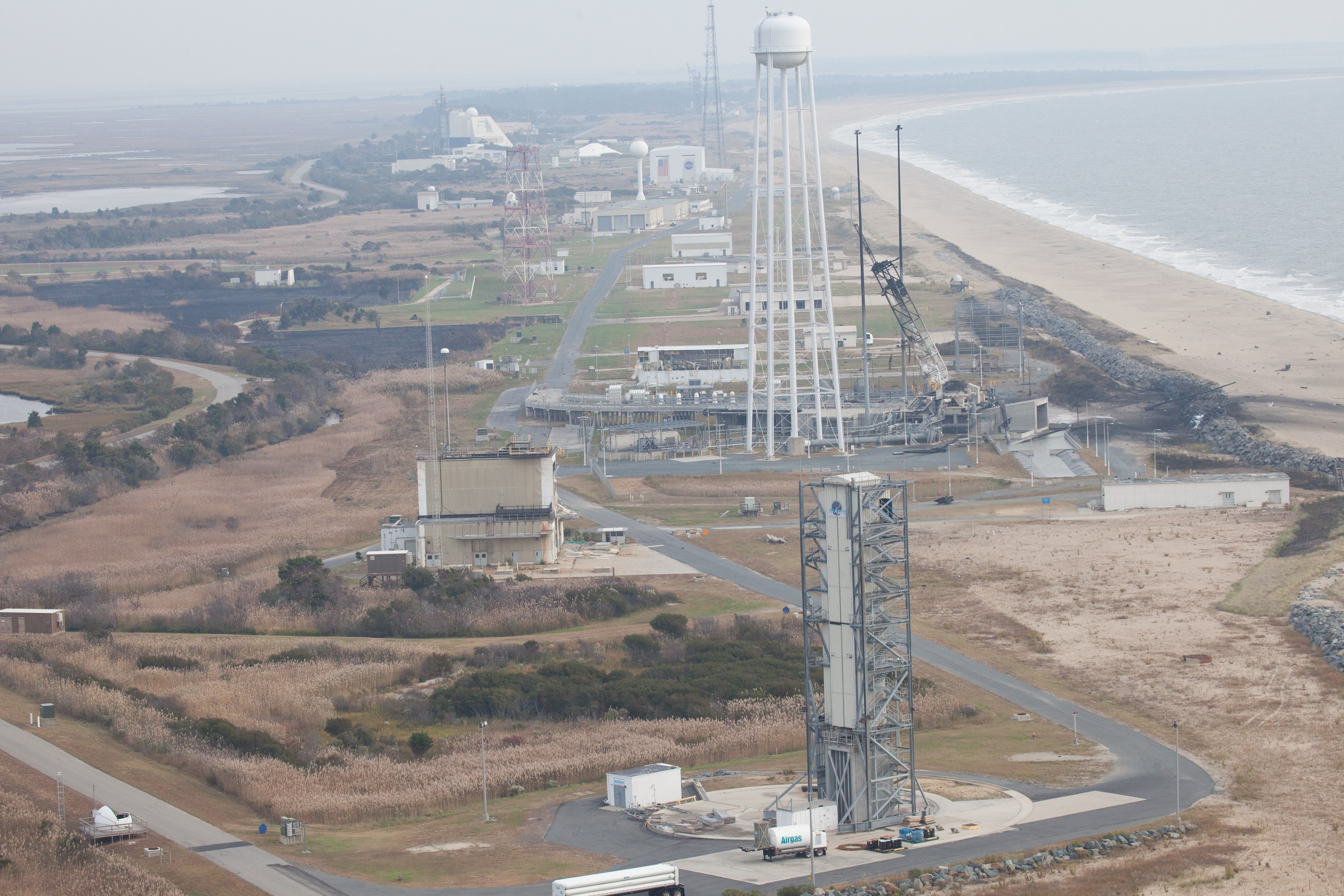
Here’s a hi-res pic of the launch site post-accident.
https://farm4.staticflickr.com/3942/15663755722_a5b7fd7139_o.jpg
Dear jack,
in the minutes before the launch, when they would show a shot of one of the restraining devices, to release upon ignition, the fluid lines were right there in the shot.
The fuel and oxidizer umbilical lines going to the rocket? Yeah, those are there, but they don’t have any fuel or oxidizer in them about a minute or so before liftoff.
From the photo in the article I do not see any external fuel/oxidizer lines on stage one or anywhere else. Is there another photo that shows these external lines?
Interesting - the photo was evidently taken on Wednesday (the day after the accident), but I’m not sure of the time when it was taken - I don’t see the volume of wreckage that I would have expected to see in the vicinity of the launchpad, nor do I see investigative or cleanup crews at first glance.
So, is the wreckage too widely scattered, or otherwise out of the field of view of the camera, or has some collection of wreckage already been done before the photo was taken, or... It’s also not clear to me whether certain areas are showing charred vegetation or something else, in an area far removed from the launchpad. A before and after comparison might be instructive.
Have no idea.
It's marvellous that we can watch everyone's rocket failures in slow motion on youtube. It gives a glimpse into the visceral appreciation of the intricacies of what can go wrong. You can't experience it with a simulation.
Hopefully the final report won't be an implicit indictment of the Orbital Sciences business model. I think Elon Musk was just trash-talking the competition. Even if he was probably right to invest in technology development for the future. We should always have some objective confirmation on those build-vs-buy cost tradeoffs. It's important to remember that financial projections are still just models that need to be tested in the real world for real world performance.
That’s giving the island a nice wallop!
Boo! Hiss! Bad pun!
I’m betting that the final report says that the engine failed in some manner.
Disclaimer: Opinions posted on Free Republic are those of the individual posters and do not necessarily represent the opinion of Free Republic or its management. All materials posted herein are protected by copyright law and the exemption for fair use of copyrighted works.