Posted on 04/26/2011 6:24:41 AM PDT by KeyLargo
New Study: Oil and natural gas companies provide strong support for public pension funds
Carlton Carroll |202.682.8114 | carrollc@api.org
WASHINGTON, April 25, 2011 – Oil and natural gas company holdings in state pension funds are providing disproportionately strong returns for retirees, according to a new study by Sonecon, commissioned by API. While oil and natural gas stocks make up an average of 3.9 percent of public pension holdings in four key states, they accounted for an average of 8.6 percent of the returns in these accounts from 2005 to 2008.
“During vigorous expansion or deep recession, oil and natural gas investments outperformed other public pension holdings by more than two times,” said Kyle Isakower, API vice president of regulatory and economic policy. “The oil and natural gas industry supports millions of jobs and a significant portion of our economy, and the retirement benefits of America’s teachers, police officers, and thousands of others with a pension or 401k.”
The preliminary data examines public pension funds in Michigan, Missouri, Ohio and Pennsylvania. The full study on the performance of oil and natural gas company holdings in state pension funds will be available this summer. Click here for a copy of the interim report.
The impact is even greater in the states’ two largest public pension funds: the fund for public teachers and other school employees and the fund for state government employees. Oil and natural gas holdings make up an average of 4.0 percent of these funds but contribute an average of 10.4 percent to the funds’ total gains from 2005 to 2009. Returns on oil and natural gas assets in these state funds averaged 46.5 percent, compared to 13 percent for all other assets, according to the Sonecon study.
“Millions of American retirees rely on the income and capital growth these companies provide,” Isakower said. "And all Americans benefit from the job creation and economic growth supported by the more than $2 trillion invested in U.S. capital projects over the past decade."
America’s oil and natural gas companies are owned by tens of millions of Americans, according to an earlier Sonecon study. More than 29 percent of shares are held in mutual funds; 27 percent are held in pension funds; 23 percent are owned by individual investors; 14 percent are held in IRAs. Five percent are held by institutions and only 1.5 percent of industry shares are owned by corporate management.
API represents more than 470 oil and natural gas companies, leaders of a technology-driven industry that supplies most of America’s energy, supports more than 9.2 million U.S. jobs and 7.5 percent of the U.S. economy, delivers almost $100 million in revenue to our government every day, and, since 2000, has invested nearly $2 trillion in U.S. capital projects to advance all forms of energy, including alternatives.
Those Nefarious and Evil Oil Speculators
As President Obama launches faux investigations of oil price-fixing (helpful tip for Democrats: pricing is dictated by a phenomenon called ‘supply-and-demand’, an economic principle that has guided pricing since the dawn of human trading activity), his Chavez-like rhetoric has targeted greedy “speculators”.
It turns out that in this matter, like so many others, the President must ignore facts, logic and reason. Because national oil companies control nearly 95% of all petroleum reserves.
It is easy to show that Obama’s attack on the oil companies is baseless. To begin with, what do “subsidies” have to do with high gas prices? I assume that by “subsidies” Obama means that there is still some oil company income that the government doesn’t tax. But the effect of a tax break is to lower prices, not raise them. On the other hand, the government does raise the price of gasoline, very significantly, by levying massive taxes on gasoline at both the federal and state levels. In fact, the government profits much more from the money you pay at the pump than any American oil company does...
http://directorblue.blogspot.com/2011/04/those-nefarious-and-evil-oil.html
Uh, who knew that?
Energy policy running on empty
STEVE HUNTLEY
shuntley.cst@gmail.com
Last Modified: Apr 26, 2011 02:09AM
To err is human; to forgive, divine, or so wrote the English poet Alexander Pope. The modern update on that is: Politics is unforgiving, so look for a scapegoat. Which is the approach President Obama has taken now that gasoline prices are a dollar a gallon more than a year ago and still climbing.
With the pump price north of $4 in Chicago and five bucks not out of the realm of probability, Obama is casting about for someone to blame. His first response was to order a Justice Department investigation into whether speculators and traders are engaging in dark plots to pick the driver’s pocket. Next, the president chose a typical target for Democrats in times of gas distress: the oil companies. They’re getting tax breaks at a time rising prices will ensure good profits, he noted.
None of this has anything to do with gas station grief. The drivers, no pun intended, of prices are rising demand around the globe, the weakening dollar, worry about the reliability of supplies because of Mideast turmoil, the administration’s clamp on new drilling and its lack of a rational energy policy.
Speculators and traders make investment decisions based on those realities. The facts point to higher prices. And U.S. oil firms control but a sliver of oil reserves. National oil companies, those owned by Iran, Saudi Arabia, Venezuela and other countries, hold 94 percent of the world’s petroleum reserves.
But oil companies, speculators and traders are loathed by much of what Howard Dean famously characterized as the Democratic wing of the Democratic Party. These left-wing ideologues are just as prone to conspiracy theories as the birthers. Politico recently reported on a 2006 poll by the University of Ohio that found half of Democrats believed the Bush administration either assisted the 9/11 attacks or took no action to stop them because it wanted war in the Middle East.
Though the 2012 presidential election is a year and a half away, Obama is in full campaign mode. He and his political advisers are nervous not just because of gas prices. They’re worried that Republicans, led by House Budget Chairman Paul Ryan (R-Wis.), have seized the high ground on issues about which the voters care — out-of-control spending, greater intrusion of the federal government in the economy and the failure of both to restore the economy and healthy job creation as liberals claimed they would.
It’s true that a president often has little dominion over escalating pump prices. Rising demand from global economic recovery is a good thing. Obama has no control over the Mideast uprisings. Saudi Arabia and other oil producers have an interest in keeping prices high to pay for reforms to appease restive populations and to finance military interventions like the Saudi one in Bahrain to put down protests there.
But it’s also true that Saudi Arabia, alienated by Obama abandoning former Egyptian President and Saudi ally Hosni Mubarak, feels no sympathetic urge to up production to help America. And it could be argued that swifter and more decisive U.S. military action in the early days of the Libyan uprising would have toppled Moammar Gadhafi and kept Libya’s oil in the pipeline.
The Federal Reserve’s easy monetary policies have weakened the dollar, the pricing currency for crude oil. While a weak dollar — now at its lowest point since the 2008 financial crisis — helps U.S. exports, it erodes a family’s economic well-being by fueling higher prices for commodities like oil and food.
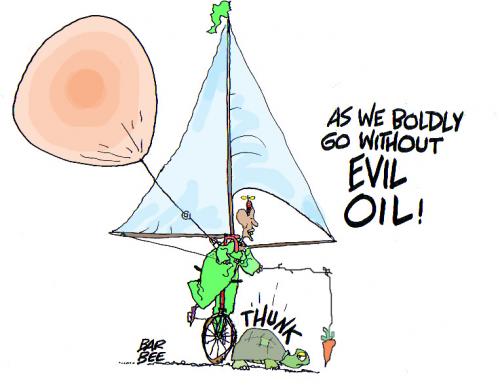
The administration’s moratoriums, drilling cancellations and slow permitting process since last year’s BP spill mean offshore oil production will be down 13 percent from last year. Rather than focus on a policy that would use U.S. resources of oil, natural gas and coal to pioneer new fuel sources like alcohol in flex-fuel cars, Obama promotes pie-in-the-sky goals for solar and wind that are decades away. All the while gas prices keep climbing and Obama looks for someone to blame.
http://www.suntimes.com/news/huntley/5012431-417/energy-policy-running-on-empty.html?print=true
Disclaimer: Opinions posted on Free Republic are those of the individual posters and do not necessarily represent the opinion of Free Republic or its management. All materials posted herein are protected by copyright law and the exemption for fair use of copyrighted works.