Too Late. At least we get to do something about it today!
Posted on 11/02/2010 6:29:46 AM PDT by Kaslin
Guess who said the following: "We have tried spending money. We are spending more than we have ever spent before and it does not work." Was it Sarah Palin? Rush Limbaugh? Karl Rove?
Not even close. It was Henry Morgenthau, Secretary of the Treasury under Franklin D. Roosevelt and one of FDR's closest advisers. He added, "after eight years of this Administration we have just as much unemployment as when we started. . . And an enormous debt to boot!"
This is just one of the remarkable and eye-opening facts in a must-read book titled "New Deal or Raw Deal?" by Professor Burton W. Folsom, Jr., of Hillsdale College.
Ordinarily, what happened in the 1930s might be something to be left for historians to be concerned about. But the very same kinds of policies that were tried-- and failed-- during the 1930s are being carried out in Washington today, with the advocates of such policies often invoking FDR's New Deal as a model.
Franklin D. Roosevelt blamed the country's woes on the problems he inherited from his predecessor, much as Barack Obama does today. But unemployment was 20 percent in the spring of 1939, six long years after Herbert Hoover had left the White House.
Whole generations have been "educated" to believe that the Roosevelt administration is what got this country out of the Great Depression. History text books by famous scholars like Arthur M. Schlesinger, Jr., of Harvard and Henry Steele Commager of Columbia have enshrined FDR as a historic savior of this country, and lesser lights in the media and elsewhere have perpetuated the legend.
Although Professor Schlesinger admitted that he had little interest in economics, that did not stop him from making sweeping statements about what a great economic achievement the New Deal was.
Professors Commager and Morris of Columbia likewise declared: "The character of the Republican ascendancy of the twenties had been pervasively negative; the character of the New Deal was overwhelmingly positive." Anyone unfamiliar with the history of that era might never suspect from such statements that the 1920s were a decade of unprecedented prosperity and the 1930s were a decade of the deepest and longest-lasting depression in American history. But facts have taken a back seat to rhetoric.
In more recent years, there have been both academic studies and popular books debunking some of the myths about the New Deal. Nevertheless, Professor Folsom's book "New Deal or Raw Deal?" breaks new ground. Although written by an academic scholar and based on years of documented research, it is as readable as a newspaper-- and a lot more informative than most.
There are few historic events whose legends are more grossly different from the reality than the New Deal administration of Franklin D. Roosevelt. And there are few men whose image has been more radically different from the man himself.
Some of the most devastating things that were said about FDR were not said by his political enemies but by people who worked closely with him for years-- Secretary of the Treasury Henry Morgenthau being just one. Morgenthau saw not only the utter failure of Roosevelt's policies, but also the failure of Roosevelt himself, who didn't even know enough economics to realize how little he knew.
Far from pulling the country out of the Great Depression by following Keynesian policies, FDR created policies that prolonged the depression until it was more than twice as long as any other depression in American history. Moreover, Roosevelt's ad hoc improvisations followed nothing as coherent as Keynesian economics. To the extent that FDR followed the ideas of any economist, it was an obscure economist at the University of Wisconsin, who was disdained by other economists and who was regarded with contempt by John Maynard Keynes.
President Roosevelt's strong suit was politics, not economics. He played the political game both cleverly and ruthlessly, including using both the FBI and the Internal Revenue Service to harass and intimidate his critics and opponents.
It is not a pretty story. But we need to understand it if we want to avoid the ugly consequences of very similar policies today.
Ping
I glad that more people are revisiting the FDR years. Amity Shlaes “The Forgotten Man” was a great read prior to 2008 election, and was good preparation for the things that have happened under the current regime.
I would like to see us roll back to pre-Wilson days, IMO. Everything from Wilson through FDR, then to LBJ, Carter and up to Obama has dragged this country further into the mire. Had the Wilson and FDR administrations not ever been in power, I’d bet this country would be radically different from its current state.
Too Late. At least we get to do something about it today!
bttt
It’s too bad that government and politicians refuse to learn the lesson.
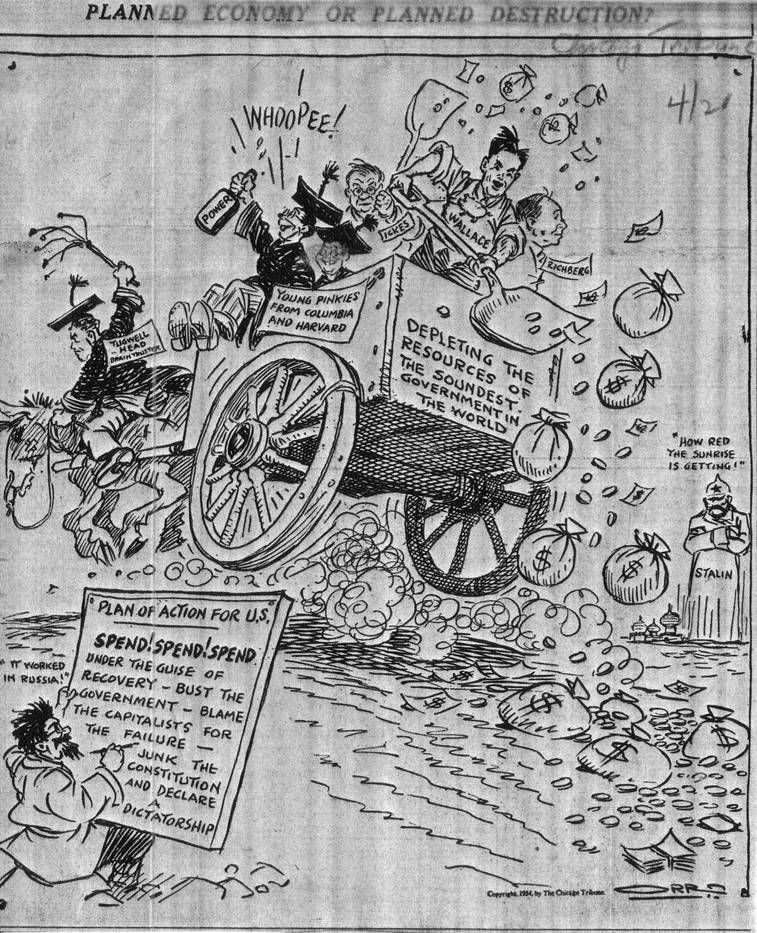
The SCOTUS of the 1870s, iirc, was pretty devestating to whatever remained of the idea that this government was federal, or that the states retained any true sovereignty. So I think you have to at least make it to 1865. It was a short run from the 1870s to the Progressive Era. Keep on peeling the onion; you'll be amazed how many layers there are.
I believe the Constitution set up a system where the states retain certain administrative duties, at the pleasure of the national government. That national government is slightly encumbered by Constitutional processes, but only to the extent that one branch is a potential threat to the others. All three remain on one side, with the states and the people on the other.
In short, I believe the Federalist Papers are a fairy tale, while the anti-federalist Brutus' essays tell the real story. So for me, I'd like to roll back to 1788, and deliver a NO vote on the Constitution, or maybe back to Philly in 1787, and see the delegates deliver an amended and improved Articles of Confederation to the states for ratification.
Meanwhile back in the real world, it's 2010, and it's election day. I've got to step out in a few minutes and help send Scott Garrett back to Congress. We'll all do the best we can.
It's a clear reflection on The People of the US, and probably an inherent flaw in democracy.(Republic, sure, I know.)
bump
And then FDR asked the voters to stick with him for four more years, because the problems he inherited from Herbert Hoover were just so massive. And according to Joe Biden he went on television to make that appeal.
The flaw is that people run for office thinking that government can be used to fix things or buy things for the people. Or at least buy votes and patronage.
Well-stated, Huck. Thank you for this most excellent assessment!
Hookers think sex is for making money. It's a wicked world.
I saw the earlier ping to this, but the article felt like it stopped before the end. This repost from "Toenhall" supplies the missing final line:
It is not a pretty story. But we need to understand it if we want to avoid the ugly consequences of very similar policies today.
I wonder why JWN didn't post the end?
The progressive think is that the only reason it does not work is that they did not spend ENOUGH.
Witness the Dept of Education.
Stimulus
Tarp
Number of weeks for unemployment checks.
Bank bailouts.
Foreign aid
Hundreds of examples and obummer care is the next.
The progressive think always is that the answer to failure is to spend more.
Yup, its time to really reform government.
ATTENTION SOWELL PING LIST
Last paragraph:
It is not a pretty story. But we need to understand it if we want to avoid the ugly consequences of very similar policies today.
TFTP!
Disclaimer: Opinions posted on Free Republic are those of the individual posters and do not necessarily represent the opinion of Free Republic or its management. All materials posted herein are protected by copyright law and the exemption for fair use of copyrighted works.