Free Republic
Browse · Search
News/Activism
Topics · Post Article

Skip to comments.

Going Nuclear with Terrestrial Power - The U.S. is an underdeveloped country when it comes to...
National Review Online ^ | April 17, 2009 | An NRO Q&A with William Tucker

Posted on 04/18/2009 11:56:14 PM PDT by neverdem


Going Nuclear with Terrestrial Power
The U.S. is an underdeveloped country when it comes to energy.

An NRO Q&A

Go nuclear! That’s not only William Tucker’s suggestion to scientists — it’s also the key to securing America’s energy future. In his latest book, Terrestrial Energy, Tucker argues that nuclear power has the potential to revitalize America’s industrial economy with cheap, clean electricity. Below, he answers questions from National Review Online.


NRO: The title of your book: Terrestrial Energy what’s that supposed to mean?

TUCKER: Terrestrial energy means nuclear energy comes from the earth, as opposed to the sun. We get 99 percent of our energy from the sun, but a small portion is also available from the heat of the earth. The internal temperatures of the earth reach 12,000 degrees Fahrenheit, hotter than the surface of the sun. No one is exactly sure of the figure, but at least 50 percent, maybe as much as 90 percent, of that heat comes from the radioactive breakdown of uranium and thorium atoms in the earth’s crust. It’s an amazing testament to the power of nuclear energy. Together they form only about 0.000012 percent of the earth’s crust, yet they produce all that heat. It has always aggravated me that people tend to group together geothermal and solar as “alternative and renewable.” Geothermal energy is actually nuclear energy. I thought the term “terrestrial energy” expressed this best.


NRO: What’s holding up nuclear now? Why is it so difficult to get anything done in this country, when places like France and Japan are moving ahead?

TUCKER: A lot of it has to do with a sense of necessity. When the French went nuclear in the 1970s, they had a slogan: “We don’t have any oil, but we’ve got ideas.” Our slogan was, “We don’t have any ideas, but we’ve got lots of coal.” Pres. Jimmy Carter made a deliberate decision to abandon nuclear and promote coal. After all, we were the “Saudi Arabia of coal.” He promised we would double coal consumption to a billion tons a year by 2000, which is exactly what we did. At the time, nobody even thought of worrying about carbon dioxide.

The Japanese faced the same decision. They have no coal or oil and knew they needed something else. At the time, anti-nuclear people were arguing that nuclear power was a bastard technology of the bomb, and the only reason we were developing it was a sense of guilt over Hiroshima. Japan now gets a greater portion of its electricity from nuclear than we do, so you can see how legitimate that argument was. South Korea also has a very large nuclear component. Right now, of the 44 reactors under construction in the world, 28 are in Asia.

As for why nuclear is still moving so slowly in this country, I think we have a tremendous sense of overconfidence about our place in the world right now. We don’t think we have to hustle to get ahead. I was at the Idaho National Laboratory in 2006 and the Chinese delegation came through looking for advice on picking a nuclear technology. They finally chose Westinghouse — which, by the way, was subsequently bought by Toshiba. Those reactors are now under construction. With the Nuclear Regulatory Commission’s glacial pace of review, and all the expected court challenges, it’ll be at least five years before we get shovels into the ground.


NRO: Is this all just bureaucracy or is there something particular about nuclear?

TUCKER: It’s both. With all the environmental and regulatory reviews, it’s hard to do anything anymore in this country – except, perhaps, put up a windmill. I’m amused when President Obama talks about rebuilding the electrical grid in order to bring wind and solar power from remote parts of the country. Utility companies say the only thing more difficult than trying to build a power plant in this country is trying to build a new transmission line. But the Nuclear Regulatory Commission is a special case. It’s under such pressure because of fear of nuclear, it has tremendous incentive to follow the classic bureaucratic tactic — ask for more data, delay, and delay. It has beefed up its staff and is making a good effort at keeping these licensing procedures moving, but it’s still going to take three years to get a license application through the mill, and then anti-nuclear activists are rubbing their hands with glee, waiting to take them to court.


NRO: What about the costs? Haven’t nuclear reactors become ridiculously expensive? Is Wall Street really going to invest? Why does the government have to help out on these projects?

TUCKER: Government has never subsidized the construction of new reactors. All those reactors built in the 1970s and 1980s were built free and clear by GE, Babcock & Wilcox, and Westinghouse, often at great loss. They thought they were fighting for the future. All the government spending for nuclear has been in research, and that research often had more to do with bombs than nuclear reactors. Critics always point to the Price Anderson Act as a government subsidy, but that only organizes the nation’s insurance companies so that they offer $300 million in coverage for reactors. In addition, each reactor can be assessed $100 million retroactively in case of a nuclear accident. With 104 reactors in operation, total coverage now exceeds $10 billion. The payout for Three Mile Island was only $70 million. The whole Price Anderson Act has never cost the government a dime. Does that sound like a subsidy?

Wind and solar have had a production tax credit since 1979. It is now at 1.8 cents per kilowatt-hour, which is about one-third the retail price of electricity. Every time Congress has failed to renew the subsidy, windmill construction has collapsed — which shows you how economically viable it is.

The Bush administration tried to give nuclear a push by attaching the same 1.8 cents per kilowatt-hour subsidy to the first 6,000 megawatts of new nuclear construction. It also provided “regulatory insurance,” which would guarantee loans if proposals became bogged down in endless lawsuits and regulatory delays. This was to reassure investors that we wouldn’t have a repeat of the 1980s, when it took 15 years to complete a reactor. Anti-nuclear groups are confident that Wall Street will never invest, and that no reactors will ever be built. The Nuclear Energy Institute contributes to this view by saying the industry won’t be able to build without more loan guarantees. But I think it’s going to happen, anyway. After all, currently operating reactors are making $1 million a day, sometimes close to $2 million. You’re not going to keep people away from that kind of return. The French and Japanese will probably invest if we don’t. We’re kind of an underdeveloped country right now, as far as nuclear is concerned.

NRO: Do you see a place for solar energy?

TUCKER: I do. I think it could go very far in providing peaking power on hot summer afternoons. This is one of the utilities’ biggest problems. They now meet it with gas turbines, but those are very expensive to fuel and may only operate a few weeks of the year. Solar meshes perfectly with peak demand. But neither wind nor solar is ever going to provide base-load electricity. The choice is either coal or nuclear. Larry Kazmerski, director of photovoltaic research at the National Renewable Energy Laboratory, agrees with this. When I interviewed him for the book, he said, “We’re big fans of nuclear out here at NREL.” Thomas Friedman interviewed him the same day and he completely missed that. I think a lot of people probably find it hard to believe.

NRO: One of the premises of your book is that global warming is really a problem and we need nuclear to deal with it. Isn’t the evidence getting a little thin on that?

TUCKER: It is. I can’t argue that. The hardest chapter of my book to write was the one on global warming, because the evidence is so tenuous. I’ve actually gotten more flak so far from people who don’t believe in global warming than those who don’t want nuclear power. I don’t believe the dangers of global warming are one-tenth what Al Gore does, but I do think there’s some reason for concern. We can’t go on throwing 10 billion tons of carbon dioxide into the air every year without having some impact, somewhere.

As Charles Krauthammer recently suggested, there are a lot of reasons why a flat tax on carbon with the proceeds refunded directly to taxpayers wouldn’t be a bad thing. It would help reduce our oil consumption, it would ease us away from coal – which, by the way, kills about 24,000 people a year by causing lung diseases. These are the “externalities” that Milton Friedman said we should incorporate in the price if we wanted to solve environmental problems with a free market. I don’t have any problem with a reasonable carbon tax. Best of all, it would reward nuclear power, and solar and wind, for their lack of carbon emissions. Wind and solar would still be expensive but, when you factor in carbon emissions, nuclear becomes the cheapest way of producing electricity.

NRO: What about nuclear waste? Isn’t that a significant problem for a revival of nuclear?

TUCKER: As I say in my book, “There is no such thing as nuclear waste.” I wrote this in a Wall Street Journal op-ed in March and, so far, nobody has disputed it. Waste is a concept carried over from the carbon era. Carbon dioxide is indeed a waste, because there are such gargantuan amounts of it and there’s nothing to do with it. It has no use. But there’s nothing useless in a spent fuel rod. Plus, instead of being scattered into the environment, it’s all sitting right there waiting to be reprocessed. 


The French went ahead with reprocessing when we abandoned it under Carter. They now get 78 percent of their electricity from nuclear. They now get 30 percent of their fuel from recycling, and all their long-term waste is stored beneath the floor of a single room at Le Hague. That’s the “nuclear waste,” when you tackle it sensibly.


NRO: What about plutonium? Doesn’t that constitute a threat for nuclear proliferation?

TUCKER: I have never been able to understand where we got the idea that abstaining from nuclear power in this country would head off the proliferation of nuclear weapons. The idea that terrorists were going to build bombs by stealing plutonium from American reprocessing plants is like worrying that they’re going to steal gold from Fort Knox. If other countries want to build a bomb, they’ll build their own uranium-enrichment facilities or plutonium-producing reactors. That’s what Iran and North Korea have done. If terrorists want plutonium, they’ll go to Dr. A. Q. Khan in Pakistan — they won’t come here. All we’ve done by abjuring nuclear recycling is to give the lead to other countries. Russia is now building a reactor for Hugo Chávez in Venezuela. Do you think they might look the other way if he purloins a little plutonium to build a bomb, to protect himself from the Great Gringo of the North? Is there a possibility here of another Cuban Missile Crisis? Could we have avoided this if we took the international lead in providing other countries with nuclear reactors, instead of sitting on our hands with our eyes closed, hoping it would all go away? You tell me.


NRO: Are you saying we’ve lost our technological lead on nuclear?

TUCKER: We sure have. We’re losing lots of business as well. The French are selling reactors to China. The Russians are building in South America. We can’t even build here. The only company in the world that can cast a reactor vessel is Japan Steel Works, and they’re backed up three years. We barely have the labor force to build anything nuclear in this country anymore. The specialty welders have all retired, and there are very few nuclear engineers under age 55. If we’re going to catch up, we’ve got to get started right now.


NRO: Do you have anything optimistic to offer?

TUCKER: How’s this? I think President Obama will buy my book on Amazon. I think he’ll read it in one night and become convinced that nuclear is the only way to go. He’ll tell Carol Browner and John Holdren to can it, instruct the NRC to get a move on those license applications, and, in a few years, we’ll have hundreds of thousands of people building new nuclear plants. In ten years we’ll have cheap energy, a revived industrial economy, a clean environment, and we won’t have to listen to any more jeremiads about global warming. Al Gore will be practicing commercial law in Nashville.


TOPICS: Business/Economy; Culture/Society; Editorial; Politics/Elections
KEYWORDS: energy; nuclear; nuclearenergy; williamtucker
Navigation: use the links below to view more comments.
first 1-2021-25 next last

1 posted on 04/18/2009 11:56:14 PM PDT by neverdem
[ Post Reply | Private Reply | View Replies]

To: neverdem
TUCKER: How’s this? I think President Obama will buy my book on Amazon.

Tucker...you be smoking dope!

2 posted on 04/19/2009 12:07:23 AM PDT by occamrzr06 (I was nice during the Clinton Administration)
[ Post Reply | Private Reply | To 1 | View Replies]

To: neverdem

I don’t have a problem with coal, except that it releases more radiation (from trace elements of radium) than nuclear.

I don’t have a problem with nuclear. I don’t think highly of oil because it gives too much money to our enemies in Venezuela, and the Middle East. The Fischer Tropp process converts coal to usable oil (with a higher aromatic content) at reasonable rates, but there is no sense in that process if we are not willing to drill. Coal is environmentally more invasive and expensive per BTU than oil.

There is little need to conserve energy resources. By the time we use up the oil, Fischer Tropp will be there with more fuel at a slightly higher cost. By the time that coal and Fischer Tropp oil prices go up, we will have derived economical ways to use nuclear fission, and eventually nuclear fusion.


3 posted on 04/19/2009 12:12:30 AM PDT by donmeaker (You may not be interested in War but War is interested in you.)
[ Post Reply | Private Reply | To 1 | View Replies]

To: neverdem

Thanks for this one!


4 posted on 04/19/2009 12:15:20 AM PDT by NoLibZone (Because I am against Abortion - The DNC Controlled Fed Says I am terrorist.)
[ Post Reply | Private Reply | To 1 | View Replies]

To: donmeaker
By the time that coal and Fischer Tropp oil prices go up, we will have derived economical ways to use nuclear fission

Nuclear fission is already economical!

5 posted on 04/19/2009 12:16:16 AM PDT by ColdWater
[ Post Reply | Private Reply | To 3 | View Replies]

To: ColdWater

I agree. You can tell what makes sense by the number of lawyers and eco-crazies that protest it. The more nuts and vultures, the more sure you are that it is a good idea.


6 posted on 04/19/2009 12:18:47 AM PDT by donmeaker (You may not be interested in War but War is interested in you.)
[ Post Reply | Private Reply | To 5 | View Replies]

To: neverdem
Al Gore will be practicing commercial law in Nashville.

Good read. Worth getting to this gem on the last line.

7 posted on 04/19/2009 12:22:12 AM PDT by douginthearmy (Until I get the proper order at the drive-thru, the unemployment rate is too LOW!)
[ Post Reply | Private Reply | To 1 | View Replies]

To: wardaddy; Joe Brower; Cannoneer No. 4; Criminal Number 18F; Dan from Michigan; Eaker; Jeff Head; ...
Clean, Safe, and Secure - A Gulf of Mexico gas rig shows the way to greater energy independence.

Speaking Truth to Muslim Power. Obama does no favors to Islam by ignoring its internal debates

Lightweight Armor Is Slow to Reach Troops

No Appeal of Court Ruling on Guns in Parks

Some noteworthy articles about politics, foreign or military affairs, IMHO, FReepmail me if you want on or off my list.

8 posted on 04/19/2009 12:34:49 AM PDT by neverdem (Xin loi minh oi)
[ Post Reply | Private Reply | To 1 | View Replies]

To: donmeaker
I don’t have a problem with coal, except that it releases more radiation (from trace elements of radium) than nuclear.

Because existing coal-fired power plants vary in size and electrical output, to calculate the annual coal consumption of these facilities, assume that the typical plant has an electrical output of 1000 MW. Existing coal-fired plants of this capacity annually burn about 4 million tons of coal each year. Further, considering that in 1982 about 616 million short tons of coal was burned in the U.S. (from 833 million short tons mined, or 74%), the number of typical coal-fired plants necessary to consume this quantity of coal is 154. Using these data, the releases of radioactive materials per typical plant can be calculated for any year. For the year 1982, assuming coal contains uranium and thorium concentrations of 1.3 ppm and 3.2 ppm, respectively, each typical plant released 5.2 tons of uranium (containing 74 pounds of U-235) and 12.8 tons of thorium that year. Total U.S. releases in 1982 (from 154 typical plants) amounted to 801 tons of uranium (containing 11,371 pounds of U-235) and 1971 tons of thorium. These figures account for only 74% of releases from combustion of coal from all sources. Releases in 1982 from worldwide combustion of 2800 million tons of coal totaled 3640 tons of uranium (containing 51,700 pounds of U-235) and 8960 tons of thorium. The main sources of radiation released from coal combustion include not only uranium and thorium but also daughter products produced by the decay of these isotopes, such as radium, radon, polonium, bismuth, and lead. Although not a decay product, naturally occurring radioactive K-40 is also a significant contributor. According to the National Council on Radiation Protection and Measurements (NCRP), the average radioactivity per short ton of coal is 17,100 millicuries/4,000,000 tons, or 0.00427 millicuries/ton. This figure can be used to calculate the average expected radioactivity release from coal combustion. For 1982 the total release of radioactivity from 154 typical coal plants in the U.S. was, therefore, 2,630,230 millicuries. Thus, by combining U.S. coal combustion from 1937 (440 million tons) through 1987 (661 million tons) with an estimated total in the year 2040 (2516 million tons), the total expected U.S. radioactivity release to the environment by 2040 can be determined. That total comes from the expected combustion of 111,716 million tons of coal with the release of 477,027,320 millicuries in the U.S. Global releases of radioactivity from the predicted combustion of 637,409 million tons of coal would be 2,721,736,430 millicuries.

from:Coal Combustion: Nuclear Resource or Danger? by Alex Gabbard

Regards,

9 posted on 04/19/2009 1:48:43 AM PDT by alexander_busek
[ Post Reply | Private Reply | To 3 | View Replies]

To: ColdWater

>>Nuclear fission is already economical!

Not for transportation energy, which is the point of Fischer-Tropsch oil.


10 posted on 04/19/2009 4:08:08 AM PDT by FreedomPoster (Obama: Carter's only chance to avoid going down in history as the worst U.S. president ever.)
[ Post Reply | Private Reply | To 5 | View Replies]

To: FreedomPoster

I recently visited a coal fired plant and one feature I noted they used to cut down pollutants was a constant fine spray of sugar water through the gases escaping the stacks. Supposedly brought down the level of said pollutants / minerals like mercury etc , the parts per million (ppm), to very very low amounts.


11 posted on 04/19/2009 4:29:57 AM PDT by Squantos (Be polite. Be professional. But have a plan to kill everyone you meet)
[ Post Reply | Private Reply | To 10 | View Replies]

To: neverdem

bookmark for later reading


12 posted on 04/19/2009 4:45:55 AM PDT by Puddleglum (Obama's just another word for nothin' left to lose)
[ Post Reply | Private Reply | To 1 | View Replies]

To: neverdem

Obama will continue to push windmills and solar plants, kill off coal as a source of power and make electricity almost unaffordable all in the name of saving the planet from non existent global warming. I fully expect that many of us will in the near future be shivering or sweltering in our darkened homes because we cannot afford our electric bills.


13 posted on 04/19/2009 6:09:33 AM PDT by The Great RJ (chain.)
[ Post Reply | Private Reply | To 1 | View Replies]

To: neverdem
With the Nuclear Regulatory Commission’s glacial pace of review, and all the expected court challenges, it’ll be at least five years before we get shovels into the ground.

Southern Nuclear has given notice to its main contractors to proceed towards two new reactors at Vogtle. Permissions already in place allow some construction work to begin.

How Vogtle 3 and 4 could look
The reactors in question are two Westinghouse AP1000 units which Southern's subsidiary Georgia Power contracted Westinghouse and Shaw to build in April exactly one year ago. That contract was submitted to the Georgia Public Service Commission and gained approval in mid March - including permission for Georgia Power to begin recovering the cost of the new reactors from ratepayers bills.

The engineering procurement and construction (EPC) contract with Westinghouse and Shaw will see the companies supply and construct the entire facility with the exception of 'certain items' provided by the plant's co-owners, although exact contract terms, conditions and value have not yet been released.

"We are poised to break ground on one of the first new US nuclear construction projects in more than 30 years."

J M Bernhard Chairman, president and CEO of Shaw


Southern's application to the US Nuclear Regulatory Commission(NRC) reached a certain point in February at which limited construction work would be permitted at the site when the NRC released the final safety evaluation related to Southern's application for an Early Site Permit. The full result of the ESP application should be known by the end of this year.

Full construction, however, can only start once a combined construction and operating license is issued for the project, expected in mid-2011.


14 posted on 04/19/2009 6:12:31 AM PDT by sefarkas (Why vote Democrat Lite?)
[ Post Reply | Private Reply | To 1 | View Replies]

To: Squantos
Supposedly brought down the level of said pollutants / minerals like mercury etc , the parts per million (ppm), to very very low amounts

It's got to go somewhere...

http://www.treehugger.com/files/2008/12/tennessee-coal-ash-slurry-spill-48-times-bigger-than-exxon-valdez-spill.php

An environmental disaster of epic proportions just happened in Tennessee. Monday night 2.6 million cubic yards (the equivalent of 525.2 million gallons, 48 times more than the Exxon Valdez spill by volume) of coal ash sludge broke through a dike of a 40-acre holding pond at TVA’s Kingston coal-fired power plant covering 400 acres up to six feet deep, damaging 12 homes and wrecking a train.

According to the EPA the cleanup will take at least several weeks, but could take years. Officials also said that the magnitude of this spill is such that the entire area could be declared a federal superfund site.
Toxic Sludge Got Into Tributary of Chattanooga Water Supply
Apart from the immediate physical damage, the issue is what toxic substances are in that sludge: Mercury, arsenic, lead, beryllium, cadmium. Though officials said the amounts of these poisons in the sludge could not be determined on Monday, they could (at the mild end) irritate skin or trigger allergies or (longer term) cause cancer or neurological problems.

This toxic sludge got into the Emory River, a tributary of the Clinch and Tennessee Rivers: The water supply for Chattanooga, Tennessee as well as millions of people living downstream in Alabama, Tennessee and Kentucky. TVA says that as yet the spill (which they are characterizing as a mudslide or landslide, but frankly it's still toxic...) has not affected the water quality in the Emory River.

15 posted on 04/19/2009 6:43:36 AM PDT by HangnJudge
[ Post Reply | Private Reply | To 11 | View Replies]

To: neverdem

Thanks for the ping!


16 posted on 04/19/2009 7:03:14 AM PDT by Alamo-Girl
[ Post Reply | Private Reply | To 8 | View Replies]

To: neverdem

Mini nuclear power plants, for a mere $25 million, for 25-30 megawatts, are already available.

Start putting many of these now where a single plant can serve a single industrial requirement, watch the growth and use of the technology move to eliminating the need for “the grid” to serve remote areas at all and in the first decade of their adoption we would probably eliminate the need for massive additions of massive (and massively expensive) power plants on “the grid”.

The grid will always represent an element of “systemic” risk. Mini nuc plant technology could make “the grid” simply the “backup” power source, with energy being produced largely where ever it is needed, at a scale it is needed, locally.

http://www.associatedcontent.com/article/1192756/hyperion_power_generation_and_the_nuclear.html

http://www.hyperionpowergeneration.com/

http://nextbigfuture.com/2008/11/update-on-hyperion-power-generation.html


17 posted on 04/19/2009 7:32:05 AM PDT by Wuli
[ Post Reply | Private Reply | To 1 | View Replies]

To: donmeaker; alexander_busek
The amount of radiation in coal gas is extremely small. Nearly all of the radiation is concentrated in the "fly ash" from the power plants. YES! IT IS more radiation represented that way than in nuclear - Oh my gosh!

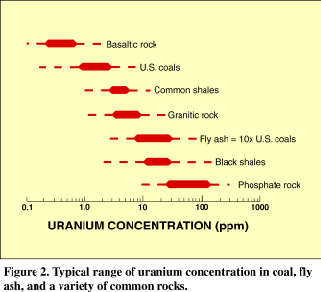
Here is a good USGS fact sheet: http://pubs.usgs.gov/fs/1997/fs163-97/FS-163-97.html

Virtually 100 percent of the radon gas present in feed coal is transferred to the gas phase and is lost in stack emissions. In con-trast, less volatile elements such as thorium, uranium, and the majority of their decay products are almost entirely retained in the solid combustion wastes. Modern power plants can recover greater than 99.5 percent of the solid combustion wastes. The average ash yield of coal burned in the United States is approximately 10 weight percent. Therefore, the concentration of most radioactive elements in solid combustion wastes will be approximately 10 times the concentration in the original coal.

The result of this terrible concentration of radioactivity in the fly ash? Well, it raises the level of radioactivity to about the same level as is found in common shale, granite, or black shale. How terrible is that!

But what about all that dangerous radon from coal combustion! Look at where release of radon into the environment from coal burning ranks in the table here:

TABLE 4

Sources of Global Atmospheric Radon
Source (million Ci per year)
Emanation from soil 2000
Ground water (potential) 500
Emanation from oceans 30
Phosphate residues 3
Uranium mill tailings 2
Coal residues 0.02
Natural gas 0.01
Coal combustion 0.0009
Human Exhalation 0.00001
Source

18 posted on 04/19/2009 4:01:59 PM PDT by AFPhys ((.Praying for President Bush, our troops, their families, and all my American neighbors..))
[ Post Reply | Private Reply | To 3 | View Replies]

To: AFPhys

Thank you!

Your post shows how mimimal radiation emission is for nuclear.

We normally don’t think of burning coal as a radiation emitting process, because the amounts are so very small. Radiation emitted per BTU of nuclear power plants is even less.

In addition to “Drill Here, Drill Now” for oil related power, we should add, for nuclear and coal: “Build Here, Build Now” and “Dig Here, Dig Now”.


19 posted on 04/19/2009 5:28:30 PM PDT by donmeaker (You may not be interested in War but War is interested in you.)
[ Post Reply | Private Reply | To 18 | View Replies]

To: neverdem

Thanks for the ping.


20 posted on 04/19/2009 8:20:06 PM PDT by GOPJ (If Obama had been king of England, the Globe wouldn't have covered the American Revolution-Graham)
[ Post Reply | Private Reply | To 8 | View Replies]


Navigation: use the links below to view more comments.
first 1-2021-25 next last

Disclaimer: Opinions posted on Free Republic are those of the individual posters and do not necessarily represent the opinion of Free Republic or its management. All materials posted herein are protected by copyright law and the exemption for fair use of copyrighted works.

Free Republic
Browse · Search
News/Activism
Topics · Post Article

FreeRepublic, LLC, PO BOX 9771, FRESNO, CA 93794
FreeRepublic.com is powered by software copyright 2000-2008 John Robinson