Posted on 12/02/2007 7:19:51 AM PST by TigerLikesRooster
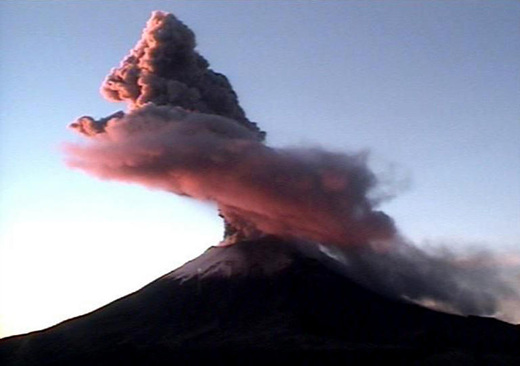
Mexican volcano Popocatepetl spews giant smoke cloud
Mexico City - Mexican volcano Popocatepetl on Saturday threw a large cloud of gas and ash into the air about 80 kilometres east of the capital, Mexico City. The cloud reached a height of up to two kilometres over the 5,400- metre mountain, the national disaster protection centre said Saturday.
Ash rained down on some areas near the volcano and an area of 12 kilometres around the mountain was blocked off.
The volcano has been active for some time, and steam cloud has become an ongoing sight over its peak.
so which clown is buying the offset carbon credits for this one
I wonder how many SUV’s it would take to equal that?
ah I remember this from the mcguffey reader:
A HARD WORD.
“P-o po, p-o po, Popo, c-a-t cat, Popocat—Oh dear, what a hard
word! Let me see, Po-po-cat-e-petl. I can never pronounce it, I
am sure. I wish they would not have such hard names in
geography,” said George Gould, quite out of patience. “Will you
please tell me how to pronounce the name of this mountain,
father?”
“Why, do you call that a hard word to pronounce, George? I know
much harder words than that.”
“Well, father this is the hardest word I ever saw,” replied
George. “I wish they had put the name into the volcano, and
burned it up.”
“I know how to pronounce it,” said Jane. “It is Po-po’
ca-ta’petl.”
“Po-po’ ca-ta’petl,” said George, stopping at each syllable.
“Well, it is not so very hard, after all; but I wish they would
not have any long words, and then one could pronounce them easily
enough.”
“I do not think so,” said his father. “Some of the hardest words
I have ever seen are the shortest. I know one little word, with
only two letters in it, that very few children, or men either,
can always speak.”
“Oh, I suppose it is borne French or German word; isn’t it,
father?”
“No: it is English; and you may think it strange, but it is just
as hard to pronounce in one language as another.”
“Only two letters! What can it be?” cried both the children.
“The hardest word,” replied their father, “I have ever met with
in any language—and I have learned several—is a little word of
two letters—N-o, no.”
“Now you are making fun of us!” cried the children: “that is one
of the easiest words in the world.” And, to prove that their
father was mistaken, they both repeated, “N-o, no; n-o, no,” a
great many times.
“I am not joking in the least. I really think it is the hardest
of all words. It may seem easy enough to you to-night, but
perhaps you cannot pronounce it to-morrow.”
“I can always say it, I know I can;” said George with much
confidence—”NO! Why, it is as easy to say it as to breathe.”
“Well, George, I hope you will always find it as easy to
pronounce as you think it is now, and that you will be able to
speak it when you ought to.”
In the morning George went bravely to school, a little proud that
he could pronounce so hard a word as “Popocatepetl.” Not far
frown the schoolhouse was a large pond of very deep water, where
the boys used to skate and slide when it was frozen over.
Now, the night before, Jack Frost had been busy changing the
surface of the pond into beautiful crystals of ice; and when the
boys went to school in the morning they found the pond as smooth
and clear as glass. The day was cold, and they thought that by
noon the ice would be strong enough to skate upon.
As soon as school was dismissed the boys all ran to the
pond,—some to try the ice, and others merely to see it.
“Come, George,” said William Green; “now we shall have a glorious
time sliding.”
George hesitated, and said he did not believe it was strong
enough, for it had been frozen over only one night.
“Oh, come on!” said another boy: “I know it is strong enough. I
have known it to freeze over in one night, many a time, so it
would bear: haven’t you, John?”
“Yes,” answered John Brown: “it did so one night last winter; and
it wasn’t so cold as it was last night, either.”
But George still hesitated, for his father had forbidden him to
go on the ice without special permission.
“I know why George won’t go,” said John; “he’s afraid he might
fall down and hurt himself.”
“Or the ice might crack,” said another; “and the noise would
frighten him. Perhaps his mother might not like it.”
“He’s a coward, that’s the reason he won’t come.”
George could stand this no longer, for he was rather proud of his
courage. “I am not afraid,” said he; and he ran to the pond, and
was the first one on the ice. The boys enjoyed the sport very
much, running and sliding, and trying to catch one another on its
smooth surface.
More boys kept coming on as they saw the sport, and soon all
thought of danger was forgotten. Then suddenly there was a loud
cry, “The ice has broken! the ice has broken!” And sure enough,
three of the boys had broken through, and were struggling in the
water; and one of them was George.
The teacher had heard the noise, and was coming to call the boys
from the ice just as they broke through. He tore some boards from
a fence close by, and shoved them out on the ice until they came
within reach of the boys in the water. After a while he succeeded
in getting the three boys out of the water, but not until they
were almost frozen.
George’s father and mother were very much troubled when he was
brought home, and they learned how narrowly he had escaped
drowning. But they were so glad to know that. he was safe that
they did not ask him any questions until he was warm and
comfortable again. But in the evening, when they were all
gathered together about the cheerful fire, his father asked him
how he came to disobey his positive command.
George answered that he did not want to go on the ice, but the
boys made him.
“How did they make you? Did they take hold of you, and drag you
on?” asked his father.
“No,” said George, “but they all wanted me to go.”
“When they asked you, why didn’t you say ‘No’?”
“I was going to do so: but they called me a coward, and said I
was afraid to go; and I couldn’t stand that.”
“And so,” said his father, “you found it easier to disobey me,
and run the risk of losing your life, than to say that little
word you thought so easy last night. You could not say ‘No.’”
George now began to see why this little word”No” was so hard to
pronounce. It was not because it was so long, or composed of such
difficult sounds; but because it often requires so much real
courage to say it,—to say “No” when one is tempted to do wrong.
After that, whenever George was tempted to do wrong, he
remembered his narrow escape from drowning, and the importance of
the little word “No.” The oftener he said it, the easier it
became; and in time he could say it, when necessary, without much
effort.
I don't know which clown is buying, but you can bet the clown selling them is Algore.
Popo is angry! Hopefully by the time the puff reaches Venezuela it will read “SURRENDER, HUGO.”
Less than you'd think.
This wasn't a particularly large eruption, but for larger eruptions the cooling from sulfur dioxide emitted into the upper atmosphere more than counterbalances warming from CO2 emissions.

This reminds me of stories from a book in my childhood (though printed much, much earlier) called, I think, Fireside Tales. It had LOTS of really great stories—one about some kid who went swimming when he wasn’t supposed to, came back and went down to the basement to hide out while his hair dried, fell asleep, was awakened when he heard a car arrive, heard his name called, stayed where he was, came up later claiming that he had been out and found: 1. it had been his favorite uncle unexpectedly coming for him to take him to his place to stay for a while, and 2. while he had been in the basement asleep, it had started raining so it became evident that he couldn’t have been out because he was completely dry! Ha ha ha. All the stories had good twists like that. But I’ve NEVER been able to find this book again. Oh, an the illustrations were pretty unique as well.
Ping to # 5.
ah yea, the old days when children were raised on proverbs and other little stories that taught them = gasp = values.
I'd love to see the news readers handle this one off the cuff.
I don’t suppose Beano would work on that particular Popo, would it?
IMHO this one is tougher, Iztaccíhuatl.
The other volcano
is that a tact swaddle? Yes, it is tact swaddle
its ah tact swaddle ?
Disclaimer: Opinions posted on Free Republic are those of the individual posters and do not necessarily represent the opinion of Free Republic or its management. All materials posted herein are protected by copyright law and the exemption for fair use of copyrighted works.