Skip to comments.
Intelligent Design
HughHewitt.com ^
| December 26, 2004
| Hugh Hewitt
Posted on 12/26/2004 11:35:30 AM PST by guitarist
"Intelligent Design" gets a close look from the Washington Post on Page A-1 of this morning's Sunday edition. An exercise in agenda journalism, it is an extremely poorly written article, with paragraphs like these:
"In October, the Dover school board passed this motion: 'Students will be made aware of gaps/problems in Darwin's theory and of other theories of evolution including, but not limited to, intelligent design. Note: Origins of Life is not taught.'
Several board members resigned in protest. When the remaining board members chose replacements, they subjected certain candidates to withering questions. 'I was asked if I was a liberal or conservative, and if I was a child abuser,' recalled Rehm, who was known as an outspoken opponent of intelligent design."
Observations: How many is "several?" Did any member of the school board confirm Rehm's account of his interview or dispute it? Is the "child abuser" question the routine question now asked of millions of workers with children as a protection against liability flowing from abuse cases?
As with other sections in the piece, these two paragraphs are crafted to put proponents of intelligent design into a box marked "snake-handling yahoos," and to elevate their opponents to the position of rational science enthusiasts. It is also just lousy reporting to use "several" instead of an exact number, and to avoid certain key facts like the number of applicants for the vacant positions and the candidates selected to fill them. Since the article is supposed to be about a school board's plunge into a controversial borderland between science and faith, nothing would be more indicative of the board's intentions than a detailed report on who was selected to replaced the resigning protesting board members. One such appointee is mentioned --John Rowand, identified only as an Assemblies of God pastor. If all three appointees were pastors who believed in the literal interpretation of Scripture, that would tell the reader one thing. If the other two appointees are simply community and school activists with long records of service, that tells us another thing. The key is the Post didn't tell us anything, except that one pastor was appointed and that the quoted Mr. Rehm is a former science teacher and father of four. This is supposed to be reporting? It is blatant agenda journalism, and the agenda is to discredit the Board's action by suggesting that theology won out over science in the appointments to the board.
Here's a Pittsburg Post Gazette story on the same controversy, from December 15. (Note to Washington Post editors: There's a little too much overlap between today's piece in your paper and this one from 11 days ago for my taste here, though no plagiarism. Isn't the Washington Post supposed to dig a little deeper and take a story a little farther than the second tier papers?) From this article we discover that the Board has nine members, that the vote to pass the offending resolution passed 6 to 3, and that the 3 dissenters resigned. No word on the replacements --again, a crucial gap as it will tell us a lot about the Board's make-up and openness to debate.
It isn't like it is hard to find out who is on the board. Here's the list of members, updated on December 8. Here's a November 19, 2004 story from the York Dispatch that tells us that in fact four members of the Board had resigned by that date --two because of the intelligent design controversy and two because they moved away-- and the selection process and the names of the new members and their backgrounds are sketched out:
"The current board interviewed candidates on four major issues: --- being fiscally conservative; --- withstanding attacks and misrepresentation from what board member William Buckingham said was a 'vocal minority in the community and left-wing media,' ---standing up for an unpopular issue that the board feels is right; ---and being a team player who won't quit if a vote doesn't go their way. The last two questions were apparently directed at the actions of former board members Jeff and Casey Brown, who quit last month in protest over the board's decision to require the teaching of intelligent design in the high school biology curriculum. Board members didn't refer directly to the issue, although several members asked questions about candidates' opinions on recent board actions, the 'current controversy' in the district, and being courageous in the face of opposition. Two supporters: However, two of the candidates selected, Short and Riddle, have been vocal supporters of the board's decision. Riddle, a superintendent at a stone quarry, has said at several previous board meetings that he is proud the board took a stand on the issue. He has also said that the lack of morality in public schools is part of the reason he and his wife home school his 8-year-old son and 5-year-old daughter. Short is a Harley-Davidson employee who has a daughter in Dover schools and another who has graduated from them. He's also stood up at meetings to back the board's decisions. Rowand, pastor at Rohler's Assembly of God pastor, commended the board's stance during his interview. 'Important decisions are not always popular, but you weren't elected to be popular,' he said. Rowand also said he believed it was his responsibility to teach his children about the origins of life and the Bible -- not that of school educators. (His son is one of the two high school representatives to the school board .) However, despite his personal beliefs, Rowand said he had no agenda and believed it would be his job to support rather than criticize the board. Sherrie Leber said she also had no agenda and was not seeking appointment to the board because of the recent controversy. A cost manager at Danskin Inc., mother of a district student and a former youth cheerleading coach, she added she had no real opinion on the issue and wanted more information, but she hoped to bring a new, objective opinion to the board."
The original two resigning Board members are husband and wife.
A fifth board member, who originally voted for the resolution, resigned later as the controversy mounted.
Thus the "resignation" controversy began when one family (with two members on a nine member board) resigned in protest over a new policy seeking to assure, it seems to me, parents that evolution would not be taught in such a way as to preclude religious belief. Hardly the stuff of Scopes II, but anti-intelligent design professionals and elite media journalists seem intent on making it such.
The York Dispatch's archive (subscription required) on the matter has scores of articles on this interesting debate, and even thirty minutes in those archives tells you the Washington Post was not interested in reporting the controversy this morning on its front page --it was interested in advancing an agenda that discredits "intelligent design" generally and this school board specifically, the better, perhaps, to warn off other local school boards from getting anywhere near this subject.
Here's The Dover School Board's statement --and it looks like a remarkable balanced and thoughtful one. Remarkably, it is not quoted in the Washington Post piece. It concludes with these paragraphs:
"The foregoing statements were developed to provide a balanced view, and not to teach or present religious beliefs. The Superintendent, Dr. Richard Nilsen, has directed that no teacher will teach Intelligent Design, Creationism, or present his or her, or the Board’s, religious beliefs. The Dover Area School District supports, and does not discriminate against, students and parents who have competing beliefs, especially in the area of the Origin of Life debate. The School Board has noted that there are opinions other than Darwin’s on the Origin of Life. School districts are forums for inquiry and critical discussions. The above statement and the District’s revised Biology curriculum together provide an opportunity for open critical discussion--the real heart of scientific practice.
Mr. Baksa and Dr. Nilsen will monitor instruction to ensure that religion is neither inhibited nor promoted."
It took me 45 minutes to research this much on this controversy --hardly a huge investment of time, though access to the York Dispatch archives did cost me $7. Given that this is a page one story in the Sunday Washington Post, didn't it deserve more effort and scrutiny from the writer and the editors?
Last week Jeff Jarvis and I and others engaged in a thoughtful conversation about the role of faith in public life, and whether the complaints by Christians of marginalization were well-founded or just more chronic carping. Today's Post article is another exhibit in my argument that elites generally and legacy media in particular are aggressive marginalizers of people of faith, and rarely miss an opportunity to debunk, mischaracterize, deride and ridicule people of faith. Today's Washington Post piece wasn't reporting, it was cheerleading for opponents of "intelligent design" theory. It is this sort of cheerleading that drives a lot of the complaints that Jarvis found so unpersuasive. But no fair surveying of the field of reporting on faith in the public square can conclude other than that big media long ago threw in with the arch-secularists and make little if any attempt to conceal their contempt for people of faith who express that faith in or near the public square.
Open source journalism is the short term antidote to this deep seated hostility, as hack jobs like the Post piece this morning don't take much to expose as one-sided ax-grinding. The long term solution --and one, as Blog explains, big media companies will have to adopt if they are to survive in the open source era-- is fundamental fairness assured by genuine intellectual diversity in newsrooms and studios. Subscribers and viewers no longer have to put up with content providers who not only disagree with their politics and worldviews, but who also advance agendas hostile to them on a daily basis.
UPDATE: After penning the above, I became interested in what sort of background Michael Powell, the author of this morning's Post piece, brings to his work. As usual, big media makes it very difficult to find out much about their employees --the better to disguise bias, I think. But Mr. Powell has been candid about journalists' objectivity and the baggage they bring with them to stories in the past. Here's one excerpt from Powell from an on-line discussion on a topic related to bias, the aftermath of 9/11 on journalism:
"Powell: At one level, the cult of objectivity always has struck me as fundamentally immature as an intellectual position. Subjectively, during the past few years, I've found it incredibly refreshing to read the British papers, where journalists make a cleaner breast of their politics. On the other hand, some of the deepest and best investigative reporting comes from the American tradition, in part because that tradition forces reporters to wrestle with conflicting points of view.
I worked as a tenant organizer for several years in the 1980s and a sense of political engagement carried me into journalism. I can't imagine not caring about the issues I cover. That said, in the course of time, I've learned that passions must be leavened with rigor. So we learn to challenge our biases, or so we hope, right?
An example: When I moved to Washington and began covering District politics in 1996, I found that liberals had nothing to say of interest. They had for complicated reasons simply abdicated. The only sustained critiques of the District's politics, economics and corruption came from conservative analysts, black and white. [ End e-mail exchange]"
Given Powell's endorsement of "journalists mak[ing] a cleaner breast of their politics," wouldn't it be useful for the Post to publish Mr. Powell's religious beliefs, his view of intelligent design, and his attitude towards political activism by people of faith? Those answers obviously would bear on the objectivity of Mr. Powell and his ability to write from the "fundamentally immature" intellectual position of objectivity. Did he care about this article and bring passion to it? Did he leaven his passion with rigor, and challenge his own biases? What are those biases, anyway?
I will e-mail Mr. Powell, and invite his response to my posts this morning.
TOPICS: Culture/Society; News/Current Events; Philosophy; Politics/Elections
KEYWORDS: creationism; crevo; crevolist; education; evolution; intelligentdesign; washingtonpost; wrongforum
Navigation: use the links below to view more comments.
first 1-20, 21-30 next last
Bombs Away.
1
posted on
12/26/2004 11:35:31 AM PST
by
guitarist
To: guitarist
The evo's feel that their side is "fact", and anything non-Darwinistic (doubts, contrary evidence, creationism or intelligent design) is pure fiction. Therefore they feel that they couldn't possibly be unfair to the other side, no matter how lopsidedly things are presented.
Just to clarify...
2
posted on
12/26/2004 11:39:28 AM PST
by
guitarist
(commonsense)
To: guitarist
Well, some people have obviously been designed (or implemented) less than intelligently. But that's all for the better, I guess. "The poor (and also the unintelligent) ye will always have with you"...
3
posted on
12/26/2004 11:52:19 AM PST
by
GSlob
To: GSlob
And the one who warned that the poor we would always have with us was?
To: guitarist
Sam Spade enters his office to find "Fingers" Finagle, a reformed safecracker, standing in front of his open safe holding the priceless artifact the Cretan Sparrow that Spade was looking after for a client.
"Fingers" insists he did not crack the safe, but merely spun the combination dial a few times idly, and it opened by itself.
Spade knows from the promotional literature that came with the safe when he bought it at the Chump end-of-season sale that is has over 10 billion (1010) possible combinations, and that only one of these will open it.
Moreover, he knows that the dial must be turned in alternating directions, not - as "Fingers" claims he did - in the same direction repeatedly.
What does Spade know about this situation? Is the safe open by design, or by accident?
5
posted on
12/26/2004 11:55:32 AM PST
by
G.Mason
("The foundation of morality is to have done, once and for all, with lying" — Thomas Henry Huxley)
To: WaspAmongRoses
"And the one who warned that the poor we would always have with us was?"
He has not been designed, IIRC, just revealed and manifested. Thus the argument is not applicable there.
6
posted on
12/26/2004 11:59:36 AM PST
by
GSlob
To: guitarist
As a non-believer, I cannot accept the idea that Intelligent Design is the alternative to Evolution. The Theory of Evolution may be incomlete and wrong in some respects. It's just one of many things in this world for which science has no certain explanation. So what? These exmples merely illustratesthat science has limitations. They don't prove that the system was designed by some higher being's intelligence. Intelligent design is essentially creationism, which should be left to the churches, but not taught in schools.
To: VadeRetro; Junior; js1138; Ichneumon
Ping list candidate? Lemme know.
8
posted on
12/26/2004 12:12:41 PM PST
by
PatrickHenry
(PatrickHenry's law: If each event in a causal chain is natural, the totality is natural.)
To: guitarist
'I was asked if I was a liberal or conservative, and if I was a child abuser,' recalled Rehm, who was known as an outspoken opponent of intelligent design."A teacher was applying for a position at a one-room school in the backwoods of Arkansas. He was asked by the school board president whether the world was round or flat. After a moment's thought, he replied "I can teach it either way".
To: december12
I don`t wish creation taught as fact either because it can`t be proven, it can only be believed.Your statement shows that the same applies to evolution.
Not wishing to argue,just stating my opinion and happy to civilly disagree.
10
posted on
12/26/2004 12:20:14 PM PST
by
carlr
To: guitarist
The evo's feel that their side is "fact", and anything non-Darwinistic (doubts, contrary evidence, creationism or intelligent design) is pure fiction. No we don't, but thanks *so* much for cartoonishly stereotyping us...
Therefore they feel that they couldn't possibly be unfair to the other side, no matter how lopsidedly things are presented.
Your conclusion is faulty.
Just to clarify...
That would be refreshing, please do.
To: guitarist
The words of Patrick Henry
"Bad men cannot make good citizens. It is impossible that a nation of infidels or idolaters should be a nation of free men. It is when a people forget God that tyrants forge their chains. A vitiated state of morals, a corrupted public conscience, are incompatible with freedom."
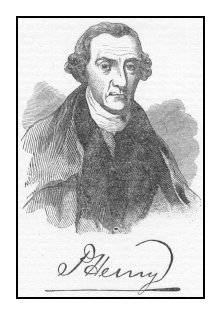
Patrick Henry ·1736-1799·
Virginia House of Burgesses
Born: May 29, 1736 in: Hanover County, Virginia.
Education: (Lawyer, Politician)
Work: Elected to Virginia House of Burgesses, 1765;
Admitted to the Bar of the General Court in Virginia, 1769;
Elected to the Continental Congress, 1774; Virginia Militia Leader, 1775; Governor of Virginia, 1776-1778, 1784.
Died: June 6, 1799.
And how now has this nation evolved?
12
posted on
12/26/2004 12:24:48 PM PST
by
BJungNan
(Did you call your congressmen to tell them to stop funding the ACLU? 202 224 3121)
To: G.Mason
What does Spade know about this situation? Is the safe open by design, or by accident? False dichotomy -- it could have been already open when "Fingers" entered the room, or the safe could be faulty, among other possibilities.
And this is a very poor analogy for evolution, since evolutionary processes are not constrained to brute force solutions or randomly tripping over a single one-in-ten-million workable solution.
For example, see my earlier FreeRepublic post:
Mathematical analysis of a case where simple evolutionary principles provide a speedup over random chance by a factor of 1,000,000,000,000,000,000,000,000,000,000,000,000,000,000,000
With that kind of multiplicative factor at work, one-in-ten-million events would be a piece of cake.
To: BJungNan
And this has what exactly to do with science education, please?
To: Ichneumon
And this has what exactly to do with science education, please?For some, nothing at all.
15
posted on
12/26/2004 12:31:41 PM PST
by
BJungNan
(Did you call your congressmen to tell them to stop funding the ACLU? 202 224 3121)
To: guitarist
Those who have read the work being done in this field understand that these are scientific questions, not religious questions. Which theory best fits the facts?
As a Catholic, I have no particular stake in whether or not evolutionary theory is true. But as a student of science, the more I look at evolutionary theory, the more it fails to explain the facts on the ground.
This is NOT the same thing as "creationism," which was religious disguised as science, and which arose mainly because the courts declared that religion could not be taught in the schools. (Otherwise, the logical thing would have been to teach schoolkids that materialists believe this, Christians believe this, and Jews believe this, or something of that sort.)
Intelligent design theory doesn't say anything about God, Jesus, or the Bible. What it says is that analysis of the facts and the probabilities suggests that intelligent design is a much likelier explanation for the way things are than random chance. It doesn't say who the designer or designers might be.
16
posted on
12/26/2004 12:38:28 PM PST
by
Cicero
(Marcus Tullius)
To: Ichneumon
Don't you read NY Times, the Guardian, Wash. Post, Time Magazine, BBC, NPR, etc.? Constantly you hear "experts" telling us that evolution is an already-established fact, and that it is a waste of time--and counter-productive--to entertain doubts. The cartoonishness is not my invention.
As far as saying that lopsided presentations are justified since evolution is "fact" and other ideas are fiction--haven't you been reading these threads here for the past five years?
17
posted on
12/26/2004 12:39:46 PM PST
by
guitarist
(commonsense)
To: Ichneumon
"And this has what exactly to do with science education, please?"
As a physicist and inquisitive non-religious person, I can see no necessary conflict with either THEORY. I can support either or both but cannot prove or disprove either!
18
posted on
12/26/2004 12:41:45 PM PST
by
lawdude
(Leftists see what they believe. Conservatives believe what they see.)
To: Ichneumon
"False dichotomy -- it could have been already open when "Fingers" entered the room, or the safe could be faulty, among other possibilities."Oh please, professor Dudley Do Right.
It was meant for humor!
19
posted on
12/26/2004 12:56:55 PM PST
by
G.Mason
("The foundation of morality is to have done, once and for all, with lying" — Thomas Henry Huxley)
To: guitarist
The evo's feel that their side is "fact", Exactly. And what do we call such axiomatic faith but - religion? or at least base superstition.
This 'fact' apparently amounts to admitting of cross-breeding, the creation of lap dogs and war horses, and the like. That's evolution. So - you see - everyone's always believed in evolution, they say. But that's not what they mean. And when pressed for a definition beyond this general area of 'micro-evolution', I doubt more than a few could ever agree with each other over notions of chance, environment, mutation, and the rest.
So the 'fact' is trite. And no theory is forthcoming. But we must BELIEVE - you shall, BALIIIEEVEE, I SAY! YESS-A!
20
posted on
12/26/2004 12:59:33 PM PST
by
sevry
Navigation: use the links below to view more comments.
first 1-20, 21-30 next last
Disclaimer:
Opinions posted on Free Republic are those of the individual
posters and do not necessarily represent the opinion of Free Republic or its
management. All materials posted herein are protected by copyright law and the
exemption for fair use of copyrighted works.
FreeRepublic.com is powered by software copyright 2000-2008 John Robinson