|
"No man in this war has so well told the story of the American fighting man as American fighting men wanted it told. He deserves the gratitude of all his countrymen."
President Harry S. Truman |
|
|
|
| Ernie Pyle was born on Aug. 3, 1900, in a little white farmhouse near Dana, Ind., the only child of William and Maria Taylor Pyle. They were simple people, content to spend their lives in the little white house on the dusty Indiana country road, as William Pyle's parents had spent their lives. Ernest--they always called him that, and never "Ernie"--seemed destined to plod along in much the same way, except that he was restless, and his thoughts strayed from the family acres to far horizons. |
 "There was nothing macho about the war at all. We were a bunch of scared kids who had a job to do." |
| Ernie was shy in the country school house, apt to sit apart from classmates during games, and later, in high school and in Indiana University, went off for lonely walks. He worked on The Indiana Daily Student in the one-story brick building where the paper was put together, and sometimes he strayed down to the Book Nook, the Greek candy kitchen on the campus, but not often. He took journalism, incidentally, not because he had any burning desire for a career in it, but because it was rated then as "a breeze." He had no flaming ambition for anything. Ernie quit college in 1923, a few months before graduation, to work as a cub on The La Porte (Ind.) Herald-Argus and moved on a few months later to a desk job on The Washington (D. C.) News. |
|
If any one thing inspired him, during this period, it was Kirke Simpson's news story on the burial of the Unknown Soldier in Arlington Cemetery. Simpson was an Associated Press reporter. "I cried over that," Pyle told friends later, "and I can quote the lead or almost any part of the piece." Ernie stayed on at The Washington News as copy editor from 1923 to 1926, had a year in New York on The Evening World and on The Evening Post and did aviation for the Scripps-Howard papers from 1928 to 1932. |
 |
|
|
|
|
|
|

"Suddenly out of this siesta-like doze the order came. We didn't hear it for it came to the tanks over their radios but we knew it quickly for all over the desert tanks began roaring and pouring out blue smoke from the cylinders. Then they started off, kicking up dust and clanking in that peculiar "tank sound" we have all come to know so well.They poured around us, charging forward. They weren't close together - probably a couple of hundred yards apart. There weren't lines or any specific formation. They were just everywhere. They covered the desert to the right and left, ahead and behind as far as we could see, trailing their eager dust tails behind. It was almost as though some official starter had fired his blank pistol. The battle was on." Listen to this column read by Owen V. Johnson, Associate Professor, School of Journalism, Indiana University |
|
|
|
|
|
|
|
 |
Ernie was managing editor of The Washington News from 1932 to 1935, when he wearied of desk work and started a roving assignment, writing pieces as he went. Ernie traveled to Canada and wrote of the Dionnes. He visited Flemington, N. J., and recalled the Hauptmann trial there; toured through drought-throttled Montana and the Dakotas, and pictured all he saw. |
|
In 1937 he was in Alaska, writing of simple folk and of their labors, their hopes, their desires. He went 1,000 miles down the Yukon, sailed Arctic seas with the Coast Guard. Each day's experience was material for a column--a letter home to farm-bound or pavement-bound poor people and invalids who could never hope to make such journeys. He wrote simple, gripping pieces about five days spent with the lepers at Molokai, and put his feeling on paper: "I felt unrighteous at being whole and clean," he told his readers when he came away. He wrote of Devil's Island, of all South America, which he toured by plane. He covered some 150,000 miles of Western Hemisphere wearing out three cars, three typewriters; crossed the United States thirty-five times. |
|
|
|
|
|
|

"The way to have a nice ditch is to dig one. We wasted no time.Would that all slit trenches could be dug in soil like that. The sand was soft and moist; just the kind children like to play in. The four of us dug a winding ditch forty feet long and three feet deep in about an hour and a half. The day got hot, and we took off our shirts. One sweating soldier said: 'Five years ago you couldn't a got me to dig a ditch for five dollars an hour. Now look at me. "You can't stop me digging ditches. I don't even want pay for it; I just dig for love. And I sure do hope this digging today is all wasted effort; I never wanted to do useless work so bad in my life. Any time I get fifty feet from my home ditch you'll find me digging a new ditch, and brother I ain't joking. I love to dig ditches.'"Listen to this column read by Owen V. Johnson, Associate Professor, School of Journalism, Indiana University |
|
|
|
|
|
|
|
|
In the fall of 1940 he started for unhappy London. "A small voice came in the night and said go" was the way he put it, and his writings on London under Nazi bombings tore at his readers' hearts. He lived with Yank troops in Ireland and his descriptions of their day-by-day living brought wider reception. When he went into action with the Yanks in Africa, the Pyle legend burst into flower. |
 |

"...the thing I shall always remember above all the other things in my life is the monstrous loveliness of that one single view of London on a holiday night - London stabbed with great fires, shaken by explosions, its dark regions along the Thames sparkling with the pinpoints of white-hot bombs, all of it roofed over with a ceiling of pink that held bursting shells, balloons, flares and the grind of vicious engines. And in yourself the excitement and anticipation and wonder in your soul that this could be happening at all.These things all went together to make the most hateful, most beautiful single scene I have ever known." Listen to this column read by Owen V. Johnson, Associate Professor, School of Journalism, Indiana University
|
 |
Ernie's columns, done in foxholes, brought home all the hurt, horror, loneliness and homesickness that every soldier felt. They were the perfect supplement to the soldiers' own letters. Though he wrote of his own feelings and his own emotions as he watched men wounded, and saw the wounded die, he was merely interpreting the scene for the soldier. |
|
In one of his first columns from Africa he had told how he'd sought shelter in a ditch with a frightened Yank when a Stuka dived and strafed, and how he tapped the soldier's shoulder when the Stuka had gone and said, "Whew, that was close, eh?" and the soldier did not answer. He was dead. Ernie never made war look glamorous. He hated it and feared it. Blown out of press headquarters at Anzio, almost killed by our own planes at St. Lo, he told of the death, the heartache and the agony about him and always he named names of the kids around him, and got in their home town addresses. By September, 1944, he was a thin, sad-eyed little man gone gray at the temples, his face seamed, his reddish hair thinned. "I don't think I could go on and keep sane," he confided to his millions of readers. He wrote, "I am leaving for just one reason . . . because I have just got to stop. I have had all I can take for a while." |

When our troops made their first landings in North Africa they went four days without even blankets, just catching a few hours sleep on the ground.Everybody either lost or chucked aside some of his equipment. Like most troops going into battle for the first time, they all carried too much at first. Gradually they shed it. The boys tossed out personal gear from their musette bags and filled them with ammunition. The countryside for twenty miles around Oran was strewn with overcoats, field jackets and mess kits as the soldiers moved on the city. Arabs will be going around for a whole generation clad in odd pieces of American Army uniforms. Listen to this column read by Owen V. Johnson, Associate Professor, School of Journalism, Indiana University |
 |
Ernie's books "Here Is Your War" and "Brave Men," made up from his columns, hit the high spots on best-seller lists, made Hollywood. He was acclaimed wherever he dared show himself in public. He loafed a while in his humble white clapboard cottage in Albuquerque, but the front still haunted him. He had to go back. Fortune had come to Ernie Pyle -- something well over a half- million dollars the past two years -- and his name was a household word. He might have rested with that. |
|
He journeyed to Hollywood to watch Burgess Meredith impersonate him in the film version of his books and in January he left for San Francisco, bound for the wars again--the Pacific this time. He had frequent premonitions of death. He said: "You begin to feel that you can't go on forever without being hit. I feel that I've used up all my chances, and I hate it. I don't want to be killed." "But I can't," he wrote. "I'm going simply because there's a war on and I'm part of it, and I've known all the time I was going back. I'm going simply because I've got to--and I hate it." |

"Jack is only twenty-two. He has two younger sisters. He went to Texas A & M for two years, and then to the University of Houston, working at the same time for the Hughes Tool Company. He will soon have been in the Army two years.It is hard to conceive of his ever having killed anybody. For he looks even younger than his twenty-two years. His face is good-humored. His darkish hair is childishly uncontrollable and pops up into a little curlicue at the front of his head. He talks fast, but his voice is soft and he has a very slight hesitation in his speech that somehow seems to make him a gentle and harmless person. There is not the least trace of the smart aleck or wise guy about him. He is wholly thoughtful and sincere. Yet he mows 'em down." Listen to this column read by Owen V. Johnson, Associate Professor, School of Journalism, Indiana University |
| Ernie journeyed to Iwo on a small carrier and wrote about the carrier crew. Then he moved on to Okinawa and went in with the Marines. He had post-war plans. He thought he would take to the white clean roads again and write beside still ponds in the wilderness, on blue mountains, in country lanes, in a world returned to peace and quiet. And these were the dreams of the soldiers in the foxhole as much as they were his own. |
 |
|
|
|
|
|
|
|

"Now to the infantry - the God-damned infantry, as they like to call themselves. I love the infantry because they are the underdogs. They are the mud-rain-frost-and-wind boys. They have no comforts, and they even learn to live without the necessities. And in the end they are the guys that wars can't be won without." Listen to this column read by Owen V. Johnson, Associate Professor, School of Journalism, Indiana University |
|
|
|
|
|
|
|
 |
But Ernie knew that death would reach for him.
The slight, graying newspaper man, chronicler of the average American soldier's daily round, in and out of foxholes in many war theatres, had gone forward early morning to observe the advance of a well-known division of the Twenty-fourth Army Corps.
He joined headquarters troops in the outskirts of the island's chief town, Tegusugu. Our men had seemingly ironed out minor opposition at this point, and Mr. Pyle went over to talk to a regimental commanding officer. |
| Suddenly enemy machine gunners opened fire at about 10:15 A.M. (9:15 P.M., Tuesday, Eastern war time). The war correspondent fell in the first burst. |
|

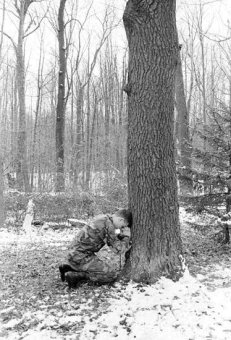
"It is only when I sit alone away from it all, or lie at night in my bedroll recreating with closed eyes what I have seen, thinking and thinking and thinking, that at last the enormity of all these newly dead strikes like a living nightmare. And there are times when I feel that I can't stand it and will have to leave.
But to the fighting soldier that phase of the war is behind. It was left behind after his first battle. His blood is up. He is fighting for his life, and killing now for him is as much a profession as writing is for me. He wants to kill individually or in vast numbers. He wants to see the Germans overrun, mangled, butchered in the Tunisian trap. He speaks excitedly of seeing great heaps of dead, of our bombers sinking whole shiploads of fleeing men, of Germans by the thousands dying miserably in a final Tunisian holocaust of his own creation. In this one respect the front-line soldier differs from all the rest of us. All the rest of us - you and me and even the thousands of soldiers behind the lines in Africa - we want terribly yet only academically for the war to get over. The front-line soldier wants it to be got over by the physical process of his destroying enough Germans to end it. He is truly at war. The rest of us, no matter how hard we work, are not." read by Owen V. Johnson, Associate Professor, School of Journalism, Indiana University |

1943
Bob Hope with Ernie Pyle at Palermo, Sicily |
 Click the pic for more of Ernie Pyle's Columns Click the pic for more of Ernie Pyle's Columns |
|