Posted on 11/16/2026 6:45:47 AM PST by MtnClimber
Among the states of the Northeast, Pennsylvania has so far been a laggard in pursuing the dream of generating electricity from the wind and sun. In substantial part, that has been because throughout the three decades of climate hysteria from the mid-1990s to date, at least one house of the Pennsylvania legislature has been controlled by members of the Republican Party.
Well, that is about to change. In the recent election, the Democrats took control of the State Senate for the first time since 1993. They also maintained control of the State House of Representatives (which they have held since 2023) and of the Governorship (which they have held since 2015). So now they have the famous “trifecta.” What can we expect on the energy front?
First, let’s review where Pennsylvania is today:
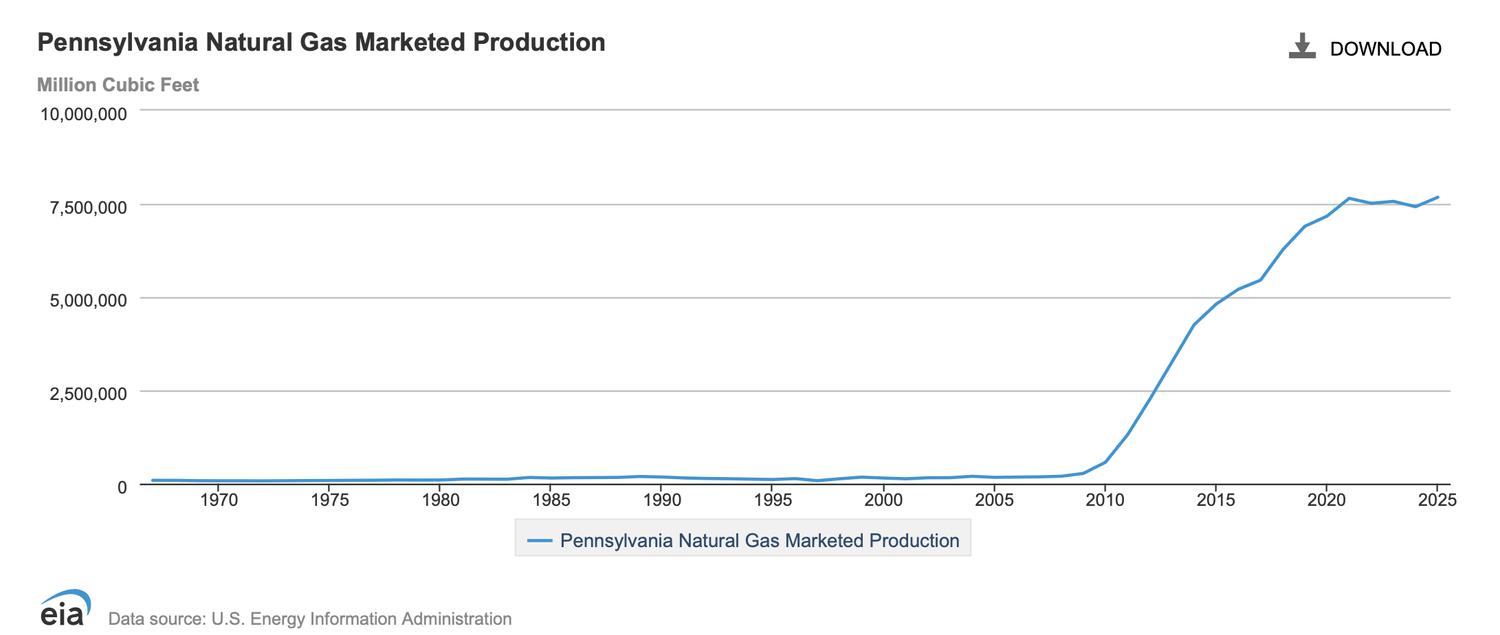
- Production of natural gas. Pennsylvania is a major producer of natural gas from the Marcellus shale formation that lies under much of the state. Production from that formation had just gotten started in 2010 (approx. 572,000 MMcf) when the Republicans took control of all three branches of government, which they then held for the next four years. During those four years, production soared up to 4,813,000 MMcf in 2015. Since then, production has continued to increase, reaching 7,676,000 MMcf in 2025. (All data from the EIA.). Here from the EIA is a chart of Pennsylvania’s natural gas production by year going back to 1970:
(Meanwhile, New York, sitting atop the same shale formation, obstructed production in the early years, and then banned it entirely in 2014; and that ban has remained in place since. Today, with fracking banned entirely, New York produces from all sources about 9,000 MMcf of natural gas per year, which is about 0.1% of Pennsylvania’s production.)
- Electricity generation from wind and sun. Compared to other states, Pennsylvania is far toward the low end with respect to the generation of electricity from wind and sun. With average electricity demand of about 17 GW, Pennsylvania has about 1.5 GW of generation capacity from wind, and about 2 GW capacity from solar, for a total of about 3.5 GW. So the total nameplate capacity of Pennsylvania’s wind and solar fleet is only about 20% of its average electricity demand, sometimes referred to as a 0.2x “build” of wind and solar capacity. (For comparison, New York currently has about a 0.7x “build” of wind/solar capacity; California has a 1x “build,” and world champion Germany has almost a 4x “build” of wind/solar capacity.). In 2025, Pennsylvania got about 3% of its electricity from wind and sun. (This compares to about 11% in New York, 35% in California, and 44% in Germany.).
- Regional Greenhouse Gas Initiative. Alone among the states of the Northeast, Pennsylvania is not a member of the Regional Greenhouse Gas Initiative, or RGGI. RGGI is a “cap and trade” program to force utilities to purchase greenhouse gas allowances and thereby intentionally drive up the price of electricity. There is a long and contentious history to how Pennsylvania has so far mostly avoided RGGI. In 2020, Democrat Governor Tom Wolfe purported to join RGGI on his own initiative, without approval from the then fully Republican-controlled legislature. The Republicans fought that with lawsuits and legislative actions, and finally in 2025 forced official withdrawal from RGGI via a state budget compromise with the Democratic Governor (now Josh Shapiro).
- Price of electricity to consumers. The EIA puts out a monthly chart of electricity prices, broken down by state. The most recent data are from August 2026. According to that chart, the average residential electricity price in the U.S. in August was 18.16¢/kWh. Pennsylvania had the lowest residential electricity prices of any of the nine states of New England or the Middle Atlantic, at 21.77¢/kWh. That means that consumers in New Jersey (24.61¢/kWh) paid 13% more than Pennsylvanians, consumers in New York (28.65¢/kWh) paid 32% more, consumers in Massachusetts’ (30.48¢/kWh) paid 40% more, and those in Maine (32.11¢/kWh) paid 48% more. (To be fair, three RGGI states to the South of Pennsylvania — Delaware, Maryland and Virginia — have somewhat lower consumer electricity rates than Pennsylvania. However, all of those have very low wind/solar penetration in electricity generation, plus access to inexpensive fracked natural gas by pipeline.)
To give us an idea of the outlook for Pennsylvania going forward, incoming Chair of the Pennsylvania House Energy Committee, one Elizabeth Fiedler, has been actively since the election doing interviews and posting on Instagram. Here is a picture (from something called the Governors’ Wind and Solar Energy Coalition) of Ms. Fiedler taken back in June.
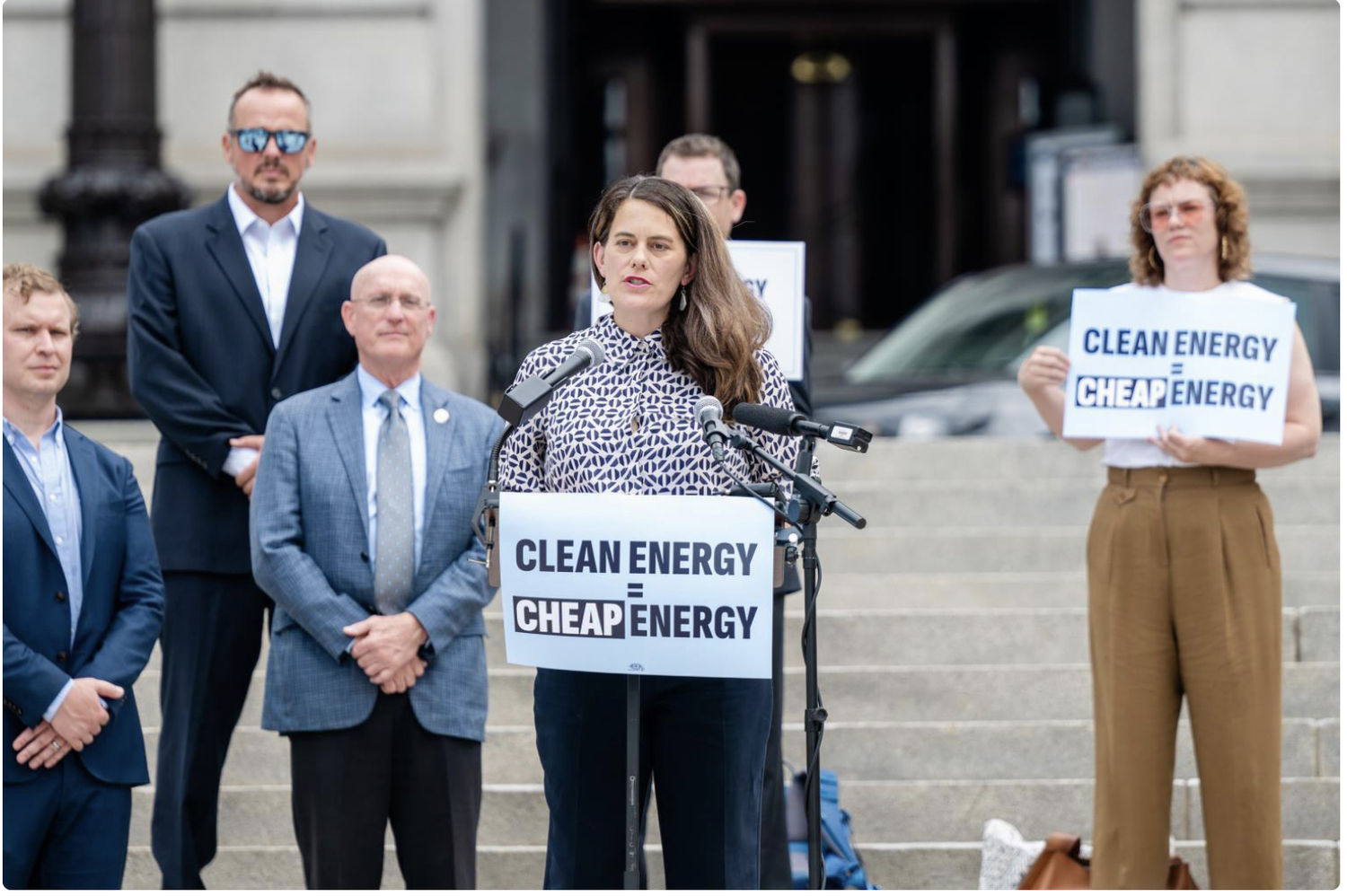
So I guess we know where she stands. On November 12 Ms. Fiedler gave an interview to Ben Seal of Inside Climate News (reposted here). Excerpts:
The trifecta in Harrisburg represents “a huge opportunity and a huge responsibility” for Democrats, Fiedler said in an interview a few days after the dust settled. “We’ve got to act quickly,” she said. “What we saw in the results of Tuesday’s election made clear that people are not happy with the status quo. People want to see change. People do not want excuses.” . . . “At the very top of the list is affordability. We have to find a way to lower people’s bills. . . . We’ve got to take a careful look at everything we can do right now to help people. And that definitely includes lowering the cost of energy, lowering utility bills and getting more renewable energy online. . . . I’m all for bold and ambitious ideas. Now is a great time to go on the offense on renewable energy and, in particular, solar.”
And from Ms. Fiedler’s November 6 Instagram post:
We have an opportunity to accelerate the development of new, renewable energy projects. . . .
You would think that Ms. Fiedler might take some time investigating why states like California and New York that have built much more wind and solar generation than Pennsylvania somehow have much higher consumer electricity prices. But that doesn’t appear to be how it works. Pennsylvanians will just need to learn from experience. Of course, by the time they figure out that a mostly wind/solar grid costs much more and doesn’t work very well, they will have committed to decades of payments to well-connected developers and will have no way to back out.
Dear FRiends,
We need your continuing support to keep FR funded. Your donations are our sole source of funding. No sugar daddies, no advertisers, no paid memberships, no commercial sales, no gimmicks, no tax subsidies. No spam, no pop-ups, no ad trackers.
If you enjoy using FR and agree it's a worthwhile endeavor, please consider making a contribution today:
Click here: to donate by Credit Card
Or here: to donate by PayPal
Or by mail to: Free Republic, LLC - PO Box 9771 - Fresno, CA 93794
Thank you very much and God bless you,
Jim
Manhattan Contrarian ping
All I can say this is... “LOL”.
Lol “lower costs”... bahahahaha... good one! They will more than make them pay MORE via other raises like “cost to run electric cars on roads” or “building cost increases to offset electric use in all electric new homes” or some such “law” or whatever. While the electric bill might be slightly reduced, look to pay more somehow!
Title says Pennsylvania will become the “next state” to reduce costs
Didn’t mention the name of the first state to do it
Yup….its gonna work this time for sure!
Voters will likely be very disappointed.
Very few places do .
They are bold, they are motivated, and they are retarded.
No. Pennsylvania so far has been sane and has not joined the procession of lunatics spending a fortune to drive up utility prices for its consumers. But I guess the Blue Wave changed all that.
It would be interesting to see a test where they put large battery storage on every home in a neighborhood to capture energy when its being “wasted.” Then when demand is high, the homes can draw off the batteries to level the usage.
I bet that would have a better pay off than putting up more windmills.
Yeah, because those “green” policies have worked out so well in California, right?
Where we pay double the national average:
“National Comparison: California’s prices are 88% to 103% higher than the U.S. average, making it the most expensive state in the contiguous 48 states.”
A lot of it due to “green energy” policies:
“Structural and policy factors elevate costs in California, including ambitious clean energy mandates (SB 100) requiring 100% clean electricity by 2045”
Disclaimer: Opinions posted on Free Republic are those of the individual posters and do not necessarily represent the opinion of Free Republic or its management. All materials posted herein are protected by copyright law and the exemption for fair use of copyrighted works.