Posted on 11/11/2026 11:33:47 AM PST by MtnClimber
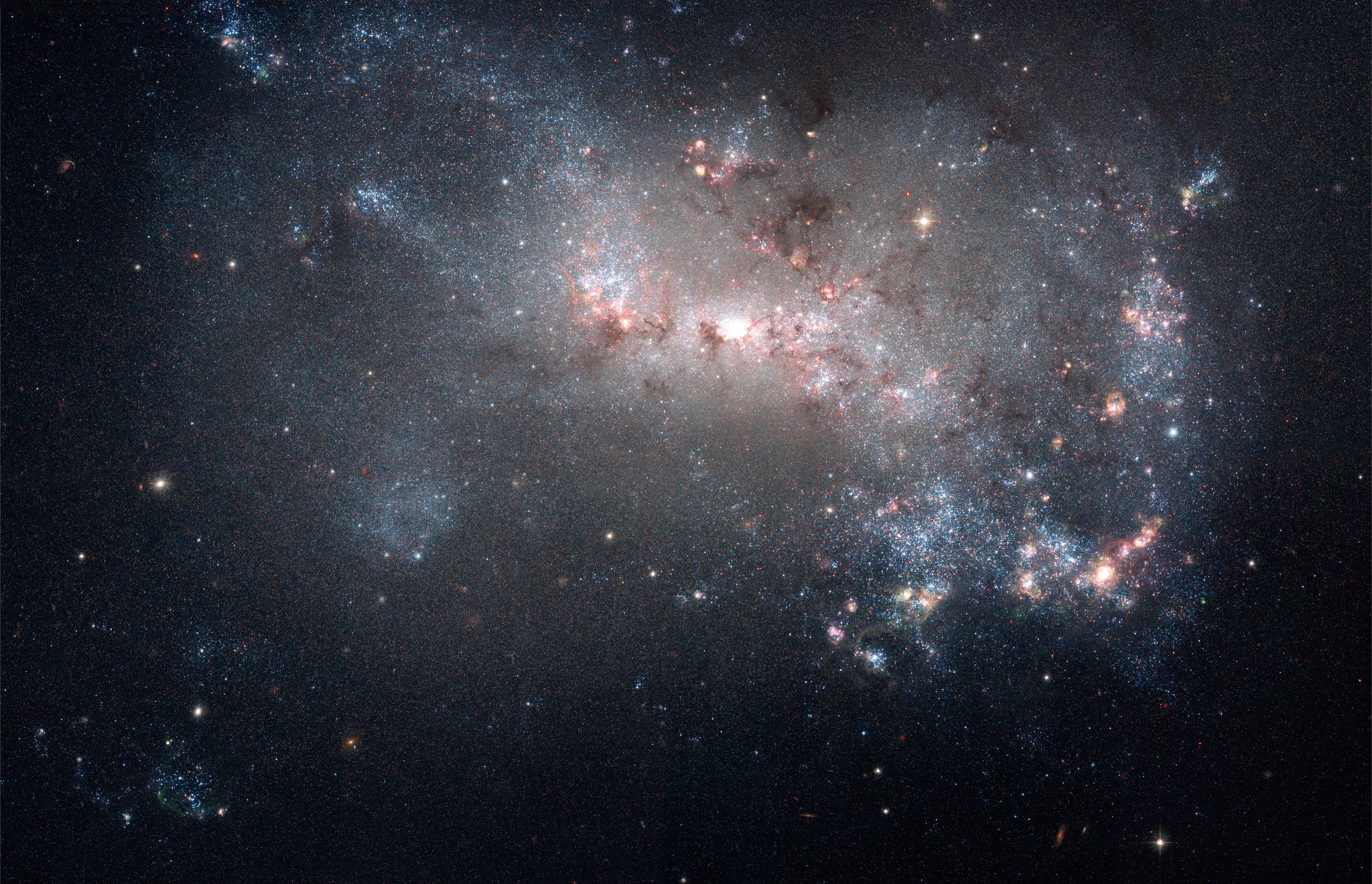
Explanation: Don’t judge a galaxy by its size. Our home galaxy, the Milky Way, is about 100,000 light years across. This huge expanse of space contains hundreds of billions of stars! The smallest galaxies, called dwarf galaxies, are about 1/10th the size of the Milky Way and only contain a few billion stars. They are also the most common type of galaxy in the whole universe. Today’s image shows one such dwarf galaxy, NGC 4449, captured by the Hubble Space Telescope. NGC 4449 and similar dwarf galaxies are missing more oxygen than models predict. This suggests their stellar winds and supernovae are surprisingly effective at blowing away oxygen and other heavy elements. Turns out these tiny galaxies may play a big role in spreading heavy elements — the building blocks of stars, planets, and life — throughout the universe!
Dear FRiends,
We need your continuing support to keep FR funded. Your donations are our sole source of funding. No sugar daddies, no advertisers, no paid memberships, no commercial sales, no gimmicks, no tax subsidies. No spam, no pop-ups, no ad trackers.
If you enjoy using FR and agree it's a worthwhile endeavor, please consider making a contribution today:
Click here: to donate by Credit Card
Or here: to donate by PayPal
Or by mail to: Free Republic, LLC - PO Box 9771 - Fresno, CA 93794
Thank you very much and God bless you,
Jim
For more detail go to the link and click on the image for a high definition image. You can then move the magnifying glass cursor then click to zoom in and click again to zoom out. When zoomed in you can scan by moving the side bars on the bottom and right side of the image.
🪐 🌟 🌌 🍔
Great background image for my computer.
Wow.
Well said.
must be pretty boring there... there is only 2 colors in their light spectrum. Pink and blue...
Some estimates are up to a trillion galaxies in the universe but I don't know what the median size of a galaxy is. Has anyone tried to estimate how many stars there are in the universe? Probably some multiple of a septillion.
It’s a binary galaxy. The pink stars are girls and the blue stars are boys.
Disclaimer: Opinions posted on Free Republic are those of the individual posters and do not necessarily represent the opinion of Free Republic or its management. All materials posted herein are protected by copyright law and the exemption for fair use of copyrighted works.