This video explores the careers of three of the Roman Empire's strangest celebrities.Three Forgotten Roman Celebrities | 11:08
toldinstone | 653K subscribers | 1,874 views | November 6, 2026
Posted on 11/09/2026 6:06:33 AM PST by SunkenCiv
This video explores the careers of three of the Roman Empire's strangest celebrities.
Three Forgotten Roman Celebrities | 11:08
toldinstone | 653K subscribers | 1,874 views | November 6, 2026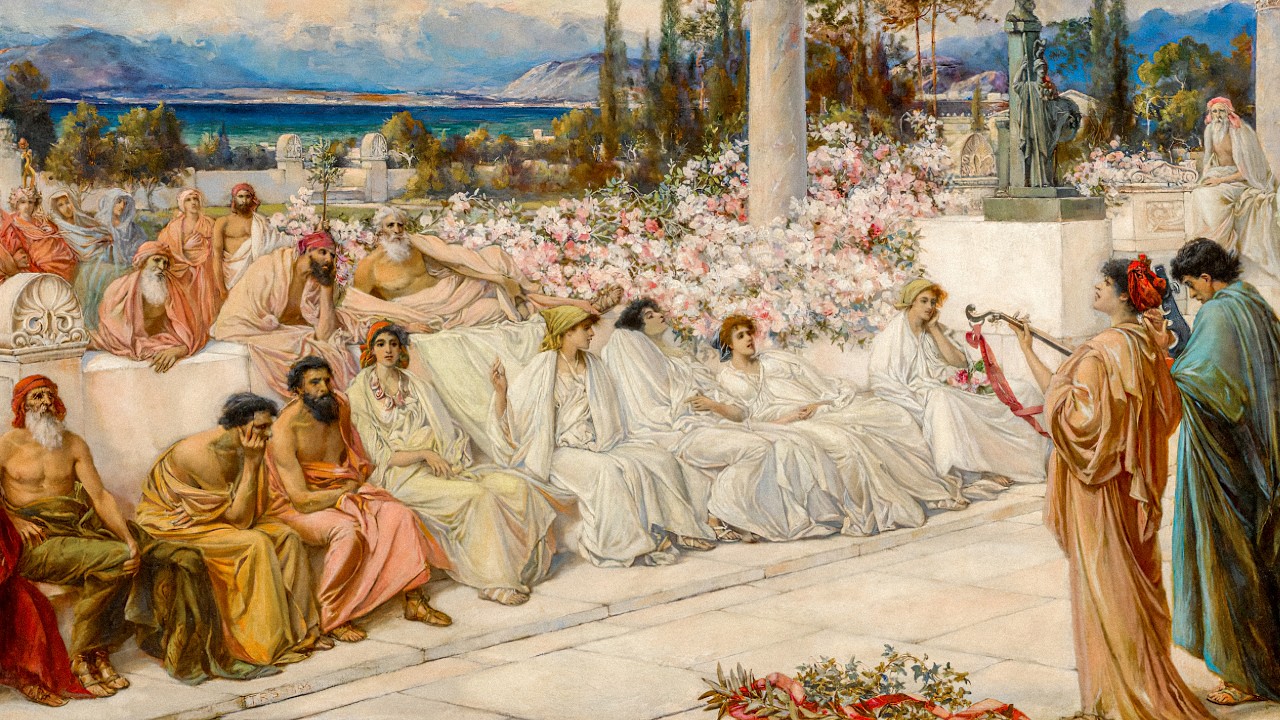
(Excerpt) Read more at youtube.com ...

|
Click here: to donate by Credit Card Or here: to donate by PayPal Or by mail to: Free Republic, LLC - PO Box 9771 - Fresno, CA 93794 Thank you very much and God bless you. |
Chapters
0:00 Introduction
0:31 Polemon of Laodicea
2:43 Apollonius of Tyana
5:36 Wolfmilk!
6:30 Apollonius, part deux
7:20 Simeon Stylites the Younger
And not one of them had a TV show.
Transcript
Chapter 1: Introduction
Celebrity culture is probably as old as civilization. As long as we’ve lived in societies, some people have been famous — though very few have remained famous for long. Today’s video explores the careers of three ancient Romans who, though almost forgotten today, were once known to millions.
Chapter 2: Polemon of Laodicea
Number three. The Lecturer In the second and third centuries, the cultural revival that we call the Second Sophistic swept through the eastern provinces of the Roman Empire. Although it touched every aspect of Greek culture, it had an especially electrifying effect on oratory. To a degree unprecedented in classical history, rhetoric became a spectator sport. The branch of oratory most cultivated by the era’s star speakers was declamation, a kind of virtuosic rhetorical exercise that involved addressing a historical audience or arguing a fictional legal case. Talented declaimers became celebrities, honored by cities and emperors.
Trajan is supposed to have told one such luminary that he didn’t understand of his elaborate Greek, but loved him all same. The king of declamation was Marcus Antonius Polemon. Born in what is now western Turkey, he moved to the flourishing city of Smyrna, where he established a reputation as a brilliant speaker. In recognition of his talents, Trajan granted the Polemon the right of free travel by land and sea. Hadrian made him a member of the Museum at Alexandria. These honors fed an already monumental ego. Polemon once refused to see the King of the Bosporus until the hapless monarch paid him the vast sum of ten talents.
On another occasion, he evicted the future emperor Antoninus Pius from his house. In the words of his ancient biographer, Polemon spoke to cities as his inferiors, to emperors as anything but rulers, and to the gods as his equals. Progressively crippled by arthritis, Polemon had to be carried to his final speaking engagements. At last — we are told — he ordered his slaves to bury him alive, shouting that the Sun should never see him reduced to silence. As the tomb was sealed shut, he is said to have cried out “Give me another body, and I will declaim again!”
Chapter 3: Apollonius of Tyana Number two.
The Guru The Roman elite had a complicated relationship with Greek philosophy. It was perfectly acceptable to dabble in one or another of the mainstream schools. Stoicism, in particular, came to be almost completely naturalized. There was a subversive edge, however, to any philosophical commitment, and the social and political critiques of the more extreme sects prompted several emperors to expel all philosophers from Rome. Such bans only enhanced the allure of those philosophers who operated on the fringes of society.
Some of these men came to be renowned not only for their wisdom, but also as miracle-workers. Of these, the most famous was Apollonius of Tyana. A century after the sage’s death, when his exploits had already become legendary, the orator Philostratus wrote a lengthy biography of Apollonius. Purportedly based on the memoirs of one of Apollonius’ disciples — who may or may not have existed — it is assumed to be largely fictional. Likewise, few if any of the philosophical treatises transmitted to us under Apollonius’ name are genuine. We can, however, glimpse at least the outline of Apollonius’ life.
Born on the eastern edge of the Roman Empire, his mother tongue was probably Aramaic. In early adulthood, he adopted an ascetic lifestyle associated with the philosophy of Pythagoras. He became a vegetarian, and swore off wine and women. He refused to wear anything but linen and bark. No razor ever touched his chin. Apollonius established himself in a temple of Asclepius, where he gained a reputation as a healer. Then — Philostratus tells us — he spent five years wandering around Asia Minor in absolute silence. In the course of later travels, he visited and learned the ancient philosophies of Persia, India, Ethiopia, and Egypt. This was possible, again according to Philostratus, because Apollonius knew all languages, including those of the birds and animals. He could also remember his past lives, and sensed the death of Emperor Domitian from hundreds of miles away.
Apollonius spent most of his later years wandering through the cities of the Greek east, railing against the evils of animal sacrifice, providing moral advice, and working wonders. Philostratus presents Apollonius as the confidant and critic of emperors from Nero to Nerva. Although this is unlikely to have historical basis, it reflects the assumption that a holy man of Apollonius’ stature would be invariably drawn to Rome.
Chapter 4: Wolfmilk!
[ad text redacted]
After his death, if not before, Apollonius of Tyana came to the attention of the imperial family.
Chapter 5: Apollonius, part deux
Julia Domna, the wife of Septimius Severus, commissioned Philostratus to write his biography; we are told that her son Caracalla was devoted to Apollonius’ works. Alexander Severus reportedly kept a statue of Apollonius in his personal shrine. Later, at the end of the third century, pagan polemicists presented Apollonius as a sage who had worked more and greater miracles than Jesus. Christian authors retorted that Apollonius had been, at best, a conjurer of demons. The debate raged well into late antiquity, and Apollonius even found his way into Arab folklore.
Chapter 6: Simeon Stylites the Younger Number one.
The Stylite In late antiquity, after the Roman world converted to Christianity, holy men became celebrities. Among the most famous were stylites — hermits who lived on top of pillars. Exposed to every extreme of the weather, poised between heaven and earth, they were seen as almost angelic figures, able to transmit the prayers of the faithful and elicit the blessings of God.
Symeon, the first stylite, built his pillar to escape the droves of pilgrims drawn by his reputation for holiness. When the crowds only grew, he increased the pillar’s height to 40 cubits — about 20 meters. Eventually, however, he realized that his literally elevated fame would allow him to “wake the world from its torpor,” a phrase that makes him sound like the Byzantine equivalent of a performance artist. Symeon had monks stationed at his pillar’s base to receive visitors. He received petitions, harangued crowds, and even met the emperor’s sisters.
In the decades after his death, however, his reputation was eclipsed by that of another stylite, also named Symeon, known to history as Symeon Stylites the Younger. Symeon became a stylite at the tender age of seven. As a young man, he moved to a pillar on a rugged hill south of Antioch, which soon came to be known as the Mountain of Miracles. There, he established a reputation for healing the sick and foretelling the future. Even his image was said to have medicinal powers. Symeon addressed the crowds that gathered beneath his pillar — 30 of his sermons are still extant — wrote letters to emperors, and composed a hymn still used by the Greek Orthodox Church today.
Symeon’s personal life remained austere. We are told that he ate nothing besides the berries of a single bush. Around his column, however, a vast ecclesiastical complex was constructed, its three churches gleaming with marble and gold. Tiers of stone benches were built around the column’s base, so that petitioners could sit and gaze up at the living saint. Today, few venture up the Mountain of Miracles, situated perilously close to the Turkish-Syrian frontier. The monastery at the summit was destroyed in the thirteenth century. Only ruins and the stump of the stylite’s column survive.
One suspects that Symeon would have appreciated the moral about the transience of fame.
I visited Symeon’s column last spring, when I led a small group into eastern Turkey. Next April, I’m leading another group to Tunisia, where we’ll explore Carthage, Dougga, El Jem, and many other sites. In June, I’m going to Romania, to see some of the Roman world’s most spectacular and seldom-visited ruins. And in October, I’m going to Greece, to visit some of that country’s many historical highlights. Learn more about these and my other upcoming trips by following the links in the description.
My new book — Leaky Aqueducts, Battle Pigeons, and Mystery Cults — is now available in both print and audio. You’ll find additional content — including the next episode in my epic review of HBO’s Rome — on the Toldinstone Patreon. Finally, don’t forget my other channels, Toldinstone Footnotes and Scenic Routes to the Past. Thanks for watching!
Disclaimer: Opinions posted on Free Republic are those of the individual posters and do not necessarily represent the opinion of Free Republic or its management. All materials posted herein are protected by copyright law and the exemption for fair use of copyrighted works.
