Transcript
Intro
When in Trier, you just might run into a Roman. After all, the city was founded by the Romans more than 2,000 years ago. Join us as we dive into the history of Germany’s oldest city. Hi, my name is Florian. I’m 21 years old. I’m one of the youngest tour guides in Trier. And today I’m going to show you the highlights and the secrets of what claims to be the oldest city in Germany. Trier is located in western Germany, in the state of Rhineland-Palatinate. This city on the Moselle River has a population of about 113,000 people. It was founded in 17 BC by the first Roman emperor, Augustus and named “Augusta Treverorum,” meaning “City of Augustus in the land of the Treveri.” Today, it’s a vibrant university town.
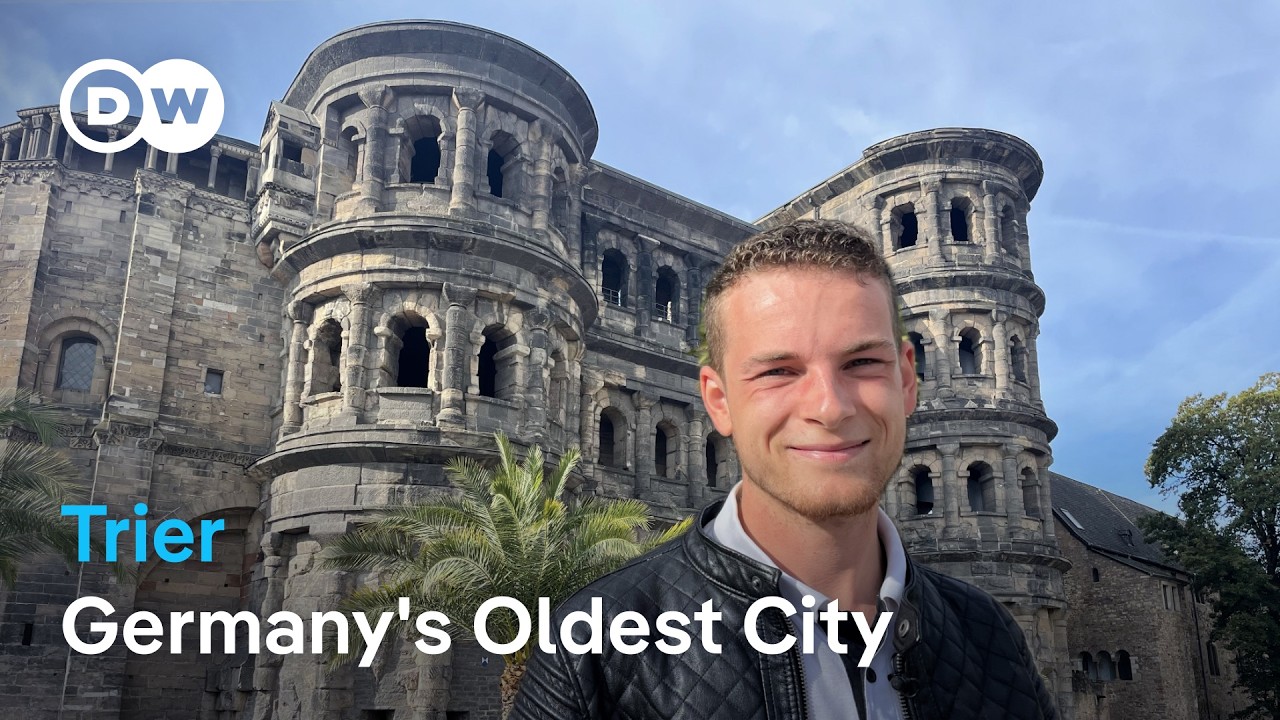
Porta Nigra
Connecting the past and present is one of the city’s landmarks: the Porta Nigra. When the Porta Nigra was built in the second century AD, Rome was in trouble. For the first time in about 250 years, it had to deal with enemy intruders on northern Italian ground again. That’s about the time in which the movie “Gladiator” is playing, for example. And in this time many cities started to fortify and build protective walls, so did Trier. But here we have to mention that this was one of the largest infrastructure projects ever realized here in the entire city’s history. “Porta Nigra” is Latin for “Black Gate.” This imposing city gate, a Unesco World Heritage Site, served primarily as a defensive structure. In the 3rd century AD, Trier was one of the four capitals of the Roman Empire. And at times, the entire northwestern part of the empire was governed from here. And you can also tour this gate from the inside.
Trier Cathedral
The Trier Cathedral also dates back to Roman times. It’s the oldest cathedral in Germany, and an architectural masterpiece that blends elements from many eras. Don’t miss the cloister in the peaceful inner courtyard. It’s especially picturesque and a hit with tourists. One part of it, namely what you can see with the brickwork and the red sandstone, is still from the 4th century AD. And the special thing about this church is that it connects the old with the new. We have Romanesque elements here, Gothic elements, baroque elements. And so this is a living book of art history from the last 1,700 years.
Basilica of Constantine
If you’re a fan of Roman history, you’ll be sure to check out the monumental Basilica of Constantine. It was built in 310 AD under Emperor Constantine the Great to demonstrate the power of the Roman Emperor. The former throne room is the largest surviving column-free space of the ancient world and is now a Protestant church. This is my favorite Roman monument. Trier used to be one of the most important cities in the entire Roman world. Because it was an imperial capital Where the altar is right now used to be the seat of the Emperor. If the Senate in Rome wanted anything to be discussed with the ruler of their empire, they needed to send a commission to Trier. That’s how powerful our city had become.
Konstantinplatz
Here at Konstantinplatz Roman emperors once watched their subjects parade before them. These days, it’s a popular spot for skaters.
Imperial Baths
But back to the Romans. The Imperial Baths show just how opulent life was in ancient Trier. The Romans came here to relax and enjoy the baths. The enormous complex was designed for thousands of visitors — but was never completed. Roman bath complexes weren’t only places to go clean yourselves or do sports. These were public spaces that were meant to see and be seen. Poor people came here. Rather wealthy people came here as well.
Wine - Wirtshaus zur Glocke
But the Romans didn’t just leave behind architectural monuments. Wine production also continues to shape Trier today. Thanks to its location on the Moselle Trier was once an important center of the wine trade. At the Wirtshaus zur Glocke, the city’s oldest inn, you’ll find a selection of wines alongside German specialties. You’ll also find traces of the Roman era in the inn’s cellar.
Kornmarkt
After all that history, it’s time to see a completely different side of Trier. Thousands of students keep the city young and lively. Trier, having a university, is inhabited by many young residents, of course. And some of them like to meet here at the Kornmarkt, the grain market of Trier, a historical square attached to the pedestrian zone with many tiny little cafés where you can have a drink or two with your friends and enjoy your evening.
Roman Bridge
Our final highlight is the Roman Bridge. This bridge has spanned the Moselle River for almost 2,000 years. Where Roman legionaries and merchants once traveled, traffic now flows across Germany’s oldest bridge. One of the most impressive facts about the Roman monuments of Trier is their durability. And the bridge behind me is still a Roman one. Well, I have to admit that the superstructure, the vaults, are from early modern times, but the pillars are still from the 2nd century AD, which makes this the oldest monument of Trier that’s still in its original use.
In Trier you’ll encounter history at every turn. Yet Germany’s oldest city feels anything but out of date. Trier is a lively university city where you can explore Roman monuments while enjoying the vibrant atmosphere of a modern city.