MSN repost of Smithsonian Article on an Italian Farmer growing an Ancient form of wheat.
"Sometime in the early 1990s, Claudio Grossi, a 40-year-old farmer in Parma, in northern Italy, was cleaning his attic when he turned up an old sack full of seeds that he couldn’t identify. The bag, he was sure, had been left by his late great-grandfather, who’d started the farmstead around 1915. Grossi had no idea how long the seeds had been sitting there, deprived of water, soil and sun. Dry and cracked, the kernels looked so old in the palm of his hand that he doubted anything would ever sprout from them. He carried the bag down the stairs, shook the seeds out into a pile of manure and then forgot about them.
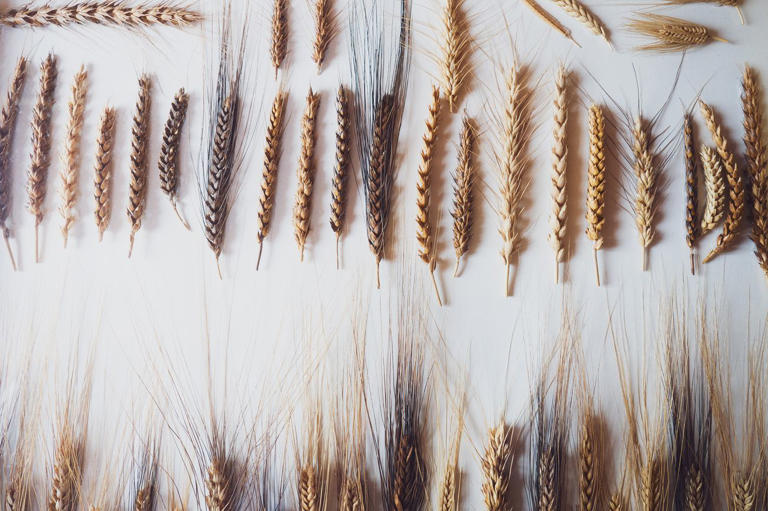
To his surprise, the seeds soon sprouted a few different types of wheat. One was particularly striking: At six feet high, its plants were about twice as tall as commercial wheat. But the most remarkable feature came when it developed ears—the grain-studded parts at the top of the plant. All of the wheat types Grossi had previously seen grew only one such ear. But the tall wheat grew a full seven ears, always in the same pattern: a long one with six shorties bunched up around it like little fingers. Even the kernels themselves were bigger than those of average wheat. And unlike the typical pale-yellow wheat kernels, they came in a rainbow of colors—yellow, black, red, white and even green, sometimes all on the same stem.
Grossi, a grain farmer his whole life, had never seen anything like it. “I thought it was a freak of nature,” he says. He couldn’t find a mention of it in agricultural books. ...snip....Working with the lab of Teofilo Vamerali, then a professor at the University of Parma, Perobelli determined that the grain was Triticum turgidum—literally “swollen wheat” in Latin. Known in English as “poulard wheat,” it had originally evolved in what today are Turkey, Egypt and other nearby Mediterranean countries. And searching agricultural references, Perobelli found that it had been grown in Italy, too, until farmers shifted toward higher-yield commercial varieties. That solved the mystery of the seed bag stashed away in the attic: It had survived because Grossi’s grandfather saved some of the heritage grains........snip......more at link in cluding how it bakes up in bread!
(Going out now to get a bag of Jovial all purpose einkorn flour! Yes, different from the above!)