Posted on 10/17/2026 4:50:34 PM PDT by E. Pluribus Unum
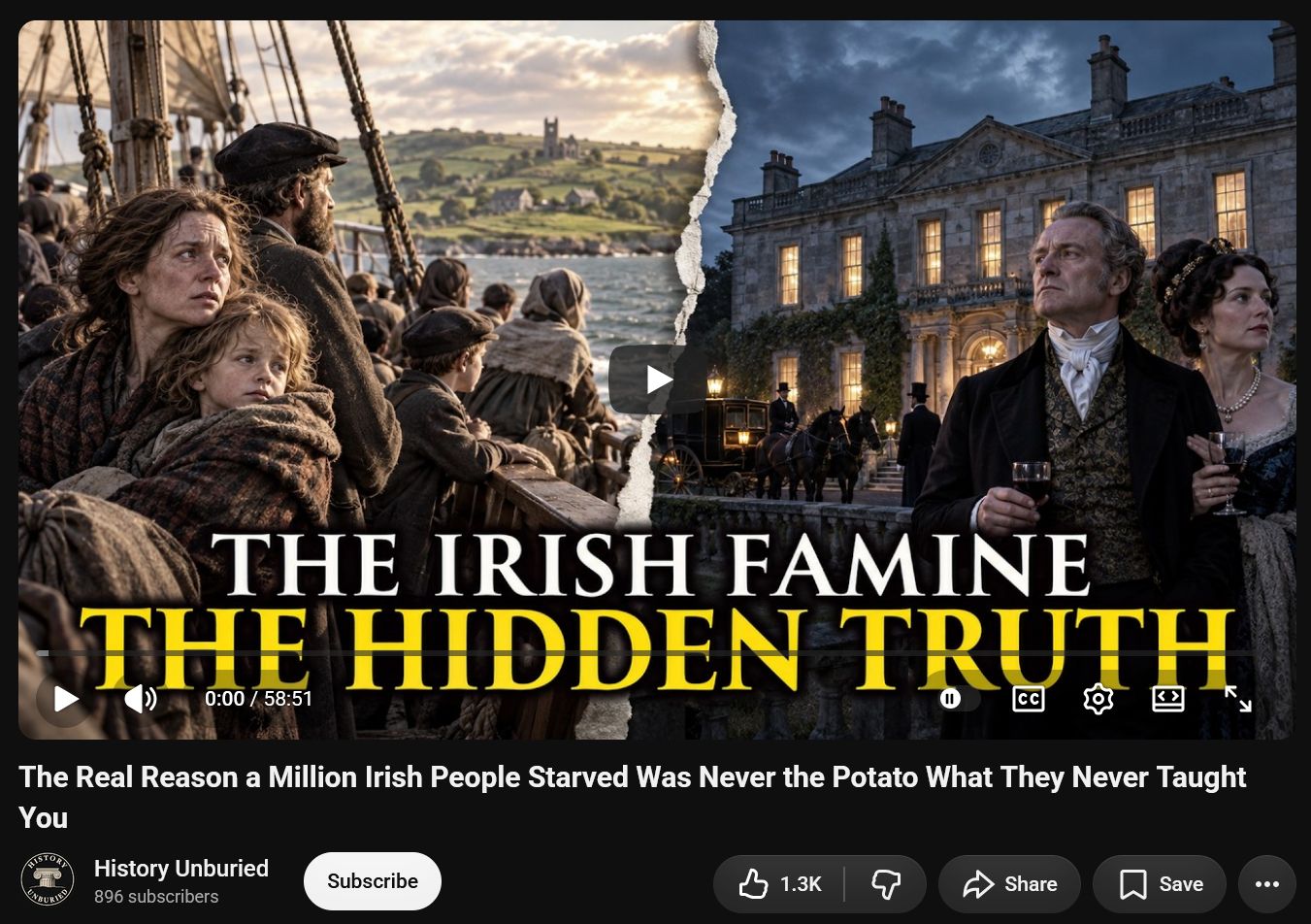
In December 1846, a Cork magistrate pushed open a cabin door in Skibbereen and found six people so starved he took them for corpses. That same winter, ships were leaving Irish harbours loaded with oats, calves, pork and butter. The same potato blight hit Belgium, the Netherlands and the Scottish Highlands, but only Ireland lost about a million people. So why did a million Irish people really die in the Great Famine?
This documentary follows the real reasons behind Ireland's Great Famine of 1845 to 1852, An Gorta Mór, the Great Hunger. The land and tenancy system and the absentee landlords. The Lumper potato that more than three million people lived on. Peel's Indian corn and the repeal of the Corn Laws. Lord John Russell's laissez-faire government and Charles Trevelyan's own words. The public works, the soup kitchens that fed three million people a day and were shut down anyway, and the Gregory clause, the quarter-acre clause that passed by 117 votes to 7. The workhouses, the evictions and clearances, the coffin ships to Grosse Île, the honest numbers on Irish food exports and grain imports, and the question people still argue about. Was the Irish Famine genocide, or a catastrophe made by policy?
If your school taught you the potato and nothing else, type quarter acre in the comments, and tell us where you're watching from. Did your family leave Ireland in the famine years? Share their story below, and subscribe to History Unburied for the documents, the names and the numbers behind history's most famous events.
Phytophthora started it, and a chain of decisions, every one of them on paper with names and dates beside it, turned it into a catastrophe. A quarter of an acre was the line Parliament drew in 1847 between a starving family and its next meal.

|
Click here: to donate by Credit Card Or here: to donate by PayPal Or by mail to: Free Republic, LLC - PO Box 9771 - Fresno, CA 93794 Thank you very much and God bless you. |
Detailed summary of the video (History Unburied on the Irish Great Hunger / Potato Famine)
The video argues that the catastrophe of 1845–1852 was not simply a “potato famine.” A water mold (Phytophthora infestans) destroyed the potato crop across parts of Europe, yet Ireland alone suffered roughly one million deaths (plus more than a million emigrants). The same blight killed tens of thousands in Belgium and the Netherlands. The decisive factors were Ireland’s extreme dependence on a single poor potato variety (the lumper), a deeply unequal land system, and deliberate British government policy choices driven by free-trade ideology, moral judgments about Irish character, and a preference for long-term “reform” over immediate survival.
Ireland’s population had roughly doubled to over 8.1 million by the 1841 census. Almost no ordinary cultivators owned land. After the Penal Laws, ownership remained concentrated among a largely Protestant landlord class, many of them absentees extracting large rents. Land was sublet through layers of middlemen down to small tenants and landless cottiers/labourers who paid rent in labor for tiny potato patches. By 1845 nearly a quarter of farms were 1–5 acres and another 40% were 5–15 acres; most holdings were at-will tenancies. Improvements by tenants raised rents, so there was no incentive to invest. More than three million people lived almost entirely on potatoes—often 12 lb per adult per day—largely the watery, genetically uniform lumper. Even in good years the “hungry months” between crops brought scarcity. Grain grown on better land was frequently sold to pay rent. A 1845 royal commission had already warned Parliament of extreme habitual privation.
Blight appeared in autumn 1845, destroying one-third to one-half of the crop. Few starved that winter because Prime Minister Sir Robert Peel (who knew Ireland from earlier service) secretly bought ~£100,000 of American maize (“Peel’s brimstone”), opened depots to moderate prices, funded public works, and used the crisis to repeal the Corn Laws. His government fell shortly afterward.
Lord John Russell’s Whig government took office with Chancellor Sir Charles Wood and especially Assistant Secretary to the Treasury Charles Edward Trevelyan in practical control of relief. Trevelyan (never elected, India veteran, brother-in-law of Macaulay) was a hard-working ideologue who believed markets should not be interfered with, government handouts created dependence, and Irish poverty stemmed partly from character defects that hardship might correct. He wound down Peel’s depots so people would not become “habitually dependent.” When officials urged restricting grain exports, Trevelyan insisted on free trade. Wood wrote that food shortage was a providential calamity and that Ireland would emerge only “through a purgatory of misery and starvation.”
In 1846 the blight was near-total. Under the Labour Rate Act, public works were charged to local Irish ratepayers. Relief came via wages for stone-breaking on often useless roads, not free food. Wages were late, insufficient, and paid on piece rates that penalized the weakest. That severe winter saw hundreds of thousands on the works; an inquest recorded a man dying of starvation while owed two weeks’ pay. Local officials who distributed free meal were rebuked. Nicholas Cummins’s letter describing skeletons in a Skibbereen cabin (printed Christmas Eve 1846) sparked international donations (British Relief Association, American, Indian, Choctaw, etc.), Quaker soup kitchens, and Illustrated London News sketches. The U.S. even lent a navy ship for relief cargo. Yet official policy did not change.
Food continued to leave Irish ports—oats, calves, butter, pork, etc.—while people starved; crowds rioted on quays. Lord Clarendon (later Lord Lieutenant) complained that Ireland had been sacrificed to London corn dealers. However, detailed trade figures show that in 1847 Ireland became a heavy net importer (exports fell, imports of American maize surged to ~4.5 million quarters). The critical “starvation gap” was the winter of 1846–47, when exports still exceeded arrivals and the government refused to ban or restrict outward shipments (unlike some continental responses). Amartya Sen’s insight applies: people starved because they lacked purchasing power, not solely because food vanished. John Mitchel’s later slogan—“the Almighty sent the potato blight, but the English created the famine”—is oversimplified yet points to this gap.
By early 1847 public works were failing. The Temporary Relief Act created state soup kitchens (modeled on Quaker efforts). By July they were issuing ~3 million rations a day—more than a third of the population—and saved many lives. Clergy, doctors, and volunteers (e.g., Robert Traill of Schull) died of fever while working. The kitchens were deliberately temporary. In autumn 1847 they closed; thereafter “Irish property must support Irish poverty” via the Poor Law. Seed potatoes had been eaten, so the 1847 harvest (though largely blight-free) was small. A financial panic in Britain reinforced the spending cut.
The Poor Law Extension Act of June 1847 allowed outdoor relief but included William Gregory’s clause: anyone holding more than a quarter-acre could not be deemed destitute and thus received no relief unless they surrendered the excess land. Gregory (an Irish landowner) argued people should not combine the “double vocation of pauper and farmer”; opponents warned it would clear small farmers. It passed 117–7. The result forced hundreds of thousands off their holdings. Landlords, already liable for rates on tiny holdings and receiving no rent, had a strong incentive to evict. Workhouses (designed for ~100,000 and deliberately harsh) became overcrowded death traps; fever (typhus, relapsing/“yellow” fever, dysentery) killed far more than pure starvation. “Crowbar brigades” leveled cabins. Formal eviction records begin only in 1849 (~250,000 by 1854); total pressure-driven clearances likely exceeded half a million. Evictors included aristocrats, merchants, clergy of both denominations, and even a chief secretary. Some landlords (e.g., Marquess of Sligo) spent heavily on relief before also clearing tenants. The Encumbered Estates Act accelerated sales and further clearances. At Strokestown, Major Denis Mahon shipped ~1,490 tenants to Canada; roughly a quarter died en route or in quarantine (over half on one ship); he was later assassinated. Cabinet minister Lord Lansdowne’s agent cleared thousands more from Kerry on pure cost arithmetic.
In January 1848 Trevelyan published (anonymously, with prior knowledge of Russell and Wood) “The Irish Crisis” in the Edinburgh Review. He treated the famine as essentially over, praised government policy, and called it “a direct stroke of an all-wise and all-merciful Providence” that would produce lasting moral improvement—while mass graves were still open. In April 1848 he was knighted (KCB) for his relief work. Blight returned in 1848; a tiny Young Ireland rising was crushed and used to portray the Irish as ungrateful. Cholera struck in 1849. Poor Law Commissioner Edward Twisleton resigned, saying no man of honour could continue and that modest British funds could have prevented the disgrace of subjects starving. Quakers refused a token Treasury offer, stating only government resources could meet the scale. Lord Clarendon privately wrote to Russell that no other European legislature would disregard such suffering or “coldly persist in a policy of extermination.” A later recollection attributes to economist Nassau Senior the remark that a million deaths “would scarcely be enough to do much good.” In Scotland (same blight, same Trevelyan) the rule was that people “cannot under any circumstances be allowed to starve”; death tolls remained far lower.
Roughly 2.1 million left Ireland between 1845 and 1855. 1847 alone saw ~300,000 land in Liverpool and ~100,000 sail to Canada on often overcrowded “coffin ships.” Quarantine stations (Grosse Île, Partridge Island, Montreal fever sheds) recorded thousands of deaths; monuments still mark mass graves. Some ships were relatively safe; overall mortality was high when fever boarded. Orphan girls were sent to Australia; arrivals in New York faced exploitation and later nativist hostility (Know-Nothings). Population fell from >8 million to 6.5 million by 1851 and continued declining; Irish-speaking western districts were hit hardest. Memory fueled the Land League, Fenianism, and diaspora nationalism. Russell later acknowledged the “old fires of disaffection” burning on the Hudson and Potomac.
The video presents the case for and against genocide under the 1948 UN definition (intent to destroy a group in whole or in part). Academic consensus generally rejects the label, citing the 1847 soup-kitchen effort and spending of £7–10 million (much as loans), while acknowledging severe moral culpability driven by free-trade dogma, fear of “moral hazard,” and ideological desire to reform Ireland. Extreme quotes often attributed to Trevelyan are poorly sourced or misread; his actual writings remain damning. Tony Blair’s 1997 message (issued by an aide) came closest to an official acknowledgment of failure. Survivors and descendants carried the anger; Strokestown House is now the National Famine Museum.
Core conclusion: Phytophthora started the crisis. A land system that left millions dependent on one crop, free-trade dogma that kept ports open during the worst winter, the deliberate shutdown of effective soup kitchens, the Gregory clause that forced land surrender for relief, and systematic clearances turned a crop failure into mass death. Named officials (Trevelyan, Wood, Russell, Gregory, etc.) advanced careers and collected titles; the dead largely remain anonymous in mass graves. The island’s population still has not recovered to 1841 levels.
Sounds like the Potato Famine was a Great Reset for the Irish landowners.
Capitalism kills!
Need more socialism!
My Irish great-great-grandparents left County Donegal and landed in Philadelphia in 1860, where there was already an Irish neighborhood, which would later cross the Delaware into Gloucester NJ. That is too late to be directly caused by the Potato Famine, but there must have been some lingering connection.
(P.S. He joined the Union Army upon arrival, something lots of Irish did in 1860/1 because it was a decent job, if you didn’t mind dying in battle or ending up in Andersonville, neither of which happened to my ancestor.)
Any other questions?
https://en.wikipedia.org/wiki/Great_Famine_(Ireland)#Causes_and_contributing_factors
https://www.history.com/articles/irish-potato-famine
[snip] Complicating matters further, historians have since concluded that Ireland continued to export large quantities of food, primarily to Great Britain, during the blight. In cases such as livestock and butter, research suggests that exports from Ireland may have actually increased during the Potato Famine.
In 1847 alone, records indicate that commodities such as peas, beans, rabbits, fish and honey continued to be exported from Ireland, even as the Great Hunger ravaged the countryside. [/snip]
I have Irish and Scottish ancestors as well. The Irish were in New Jersey. I'm just getting details now in my genealogy records.
In 1600, the native Irish owned over 90% of the land in Ireland. By the end of that century following events including the Confederate Wars, the Irish (aka the Catholics) owned 20% or less of the land. They were turned into tenant farmers, upsetting centuries of ownership and all of the culture that went with it. The social dislocation etc laid the seeds for the Potato Famine in the mid-1800s. So yeah, it was ultimately the usual combination of the English & Irish traitors.
Bkmk
Let’s not forget that the British had a policy of selling the Irish as slaves, ended when it turned out that black slaves although higher priced could work in the heat that killed the Irish. Oh yes this allowed the British to steal their lands.
When the Irish recruits arrived in Virginia my great-grandfather was there in company I, 10th Virginia infantry, Army of Northern Virginia, where he was killing them as fast as he could. But the story does not end on such a bitter note; his grandson married my Irish mother, and, somehow, sectionalism and real religious differences were smoothed over.

The English wanted the land for themselves.
The English aristocracy and business people were amongst the most inhumane people in the history of people.
So Kirk Douglas and Elizabeth Taylor were drinking wine while all this was happening?
That doesn’t seem right.
Spartacus and Cleopatra knocking back some Merlot by the castle?
So much for the Irish RM I guess.
A good series with Peter Bowles.
From the article I gathered the Irish farmers were Catholics and the remote landlords were Protestants.
Helps me understand “the troubles” a little.
Basically genocide by the British crown.
A history teacher friend of mine once remarked that the English aristocracy were the worst bunch of people, ever. The way they treated the Irish was just one example of that.
I was going to say something about the Nazi Germans. But my teacher friend was of German descent, so I let it pass.
There were quite a few Irish, especially from New Orleans, who were fighting for the South.
I don’t think the author understands what free trade is. It’s not free trade if buyers and sellers aren’t free, but are ruled. If producers don’t have real property rights, and have no representation, and the market is thrown off by taxes, systemic discrimination, and overregulation , such as price controls and land use restrictions like the mentioned quarter acre, then the resulting trade isn’t free at all- it is at minimum indirectly regulated by authoritarians.
Particularly General Patrick Cleburne, who was, in my mind, one of the most (if not THE most) tactically brilliant generals in the Confederate Army. Known as the "Stonewall Jackson of the West", he was killed in action at Nashville by the tactical incompetence of one of the worst generals (above brigade-level) in the Confederacy, John Bell Hood.
Disclaimer: Opinions posted on Free Republic are those of the individual posters and do not necessarily represent the opinion of Free Republic or its management. All materials posted herein are protected by copyright law and the exemption for fair use of copyrighted works.