 (Credit: Dr Ning Xu)
Posted on 10/12/2026 10:39:29 AM PDT by Red Badger
Acouple of weeks ago, the winning entry of the annual Nikon Small World in Motion contest was embroiled in a controversy, with experts alleging the undisclosed use of AI in creating some parts of the video.
At the time, the winner, Ning Xu, an optical engineer at Tsinghua University, and Nikon Instruments Inc. maintained that he only used AI for image enhancing, which fell within the competition policy. Nikon had also noted that “this particular use of AI—as a tool for enhancement of microscopy-generated source data, not for image generation from scratch—to be in compliance with the rules set forth by the competition”
However, today, the company has issued an update.
“After thoroughly re-evaluating the video and supporting materials and consulting with members of our judging panel, Nikon has determined that the winning video did not comply with the competition rules regarding generative AI,” Nikon Instruments Inc. posted in a statement.
“I'm not surprised,” said Robert Hirst, a lead scientist at Leicester University, in an email to The Scientist. When he first saw the winning video that supposedly showed abnormal beating of cilia in the airway of a child with primary ciliary dyskinesia (PCD), he right away realized that they “look nothing like those from PCD patients.”
Hirst noted, “I have been diagnosing PCD patients for 20 years by examining their cilia speed, structure, waveform, length, cell size and shape. I knew immediately that the video was AI generated and put my reputation on the line by being the first to publicly say so on LinkedIn. It is said to be from a child with PCD which is both emotive and needs to be factually correct. I was convinced it was not.”
As of the time of publication, Xu had not responded to requests for comment.
A Social Media Storm Forces Organizers to Review the Winning Film Following Hirst, a number of researchers took to social media to point out discrepancies in the scale and biology of the video. They expressed their frustration with undisclosed use of AI and appealed to Nikon to look into the matter.
After pushback on social media, Nikon Instruments Inc. updated the updated the video caption, calling it a rendition and noted that they would review the movie and their AI policy, before coming to a decision.
“Based on the winning entry and related materials provided by the winner, Nikon conducted a thorough, additional review involving the entrant and the judges,” a Nikon Instruments Inc. spokesperson said in an email to The Scientist. “We are unable to comment further on the details of those checks or discussions.”
The organizers released updated rankings to reflect this decision, with Nguyen Nam Nhat winning first place for a video showing a roundworm and a single-celled organism exploring their surroundings.
“This decision is based solely on the submitted video's eligibility under the rules outlined for this competition. It should not be interpreted as a judgment of the entrant's professional reputation, scientific contributions, or intent,” said Nikon Instruments Inc. in the statement.
Navigating AI and Ethics in Scientific Imaging “I’m glad Nikon took the questions from the scientific community seriously and investigated,” said Melanie White, a cell biologist who uses quantitative imaging at the University of Queensland, in an email. White was one of the researchers who shared her concerns with the undisclosed AI use in generating the video on social media. “Nikon did the right thing,” said Christophe Leterrier, a neuroscientist at the French National Centre for Scientific Research-Aix Marseille University, in an email. Leterrier, former Nikon Small World jury member and multiple-year awardee, was one of the scientists voicing his opinion on social media.
While this verdict resolved the status of the winning entry, both White and Leterrier noted that this incident highlighted the need for broader conversation about the use of AI in imaging.
“This should not be seen as the end of a controversy but the start of discussion on how AI is transforming microscopy,” said Leterrier. “What happened has shown that we have a whole community that cares deeply about the ethics and authenticity of microscopy, and we have some work ahead to communicate and educate on this issue.”
White agreed, “This episode has prompted a broader discussion about standards for AI in scientific imaging and research and I hope this continues.” With the immense potential of AI in advancing the field of microscopy, White called for transparency in the extent to which such tools are used. “The aim is not to restrict innovation, but to harness AI while protecting data integrity, scientific reproducibility and public trust,” she said.
Dear FRiends,
We need your continuing support to keep FR funded. Your donations are our sole source of funding. No sugar daddies, no advertisers, no paid memberships, no commercial sales, no gimmicks, no tax subsidies. No spam, no pop-ups, no ad trackers.
If you enjoy using FR and agree it's a worthwhile endeavor, please consider making a contribution today:
Click here: to donate by Credit Card
Or here: to donate by PayPal
Or by mail to: Free Republic, LLC - PO Box 9771 - Fresno, CA 93794
Thank you very much and God bless you,
Jim
(Credit: Dr Ning Xu)
I was disqualified for using AI. But it was a 100% genuine picture, I tell ya!
| Give credit to Nikon for due diligence and standing up on principle. The robots and AI systems can have their own competition. I'm a big fan of Super Intelligence (SI), but I can see why photographers seek to maintain the integrity of their competitive awards. |
As an amateur photographer specializing in nature photography and periodically submitting photos for contests, I endorse this post. I hate AI nature "photography".
I hate AI nature “photography”.
It does not take AI. There are tremendous things which are commonly done with image processing programs.
Ansel Adams captured Moon and Half Dome as a real, unmanipulated photograph on December 28, 1960, at 4:14 PM in Yosemite National Park.
The Reality of the Shot: Adams was driving toward the Ahwahnee Hotel (now the Majestic Yosemite Hotel) when he spotted the gibbous moon rising while the afternoon sun still lit the face of Half Dome.
How He Did It: He stopped his car, set up his Hasselblad 500C camera with a 250mm lens and an orange filter (to darken the blue sky and make the moon stand out), and took the picture.
The Zone System: Using his mastery of the Zone System, Adams calculated the exposure so the moon fell into Zone VII, balancing the bright winter highlights with the dark shadows on the granite cliff.
Related Links:

“The robots and AI systems can have their own competition.”
Can’t blame them. That’s already down stream without the paddle.
Kids in our schools are using AI to accomplish homework instead of learning it competing with other students and in time employment possibilities. We are gaining on the Japanese with this but losing ground in our eduation system.
wy69
Correct Source Link: https://www.google.com/search?client=firefox-b-1-d&q=ansel+adams+moon+and+half+dome+moon+never+would+have+been+in+that+spot
Is Xu on first?
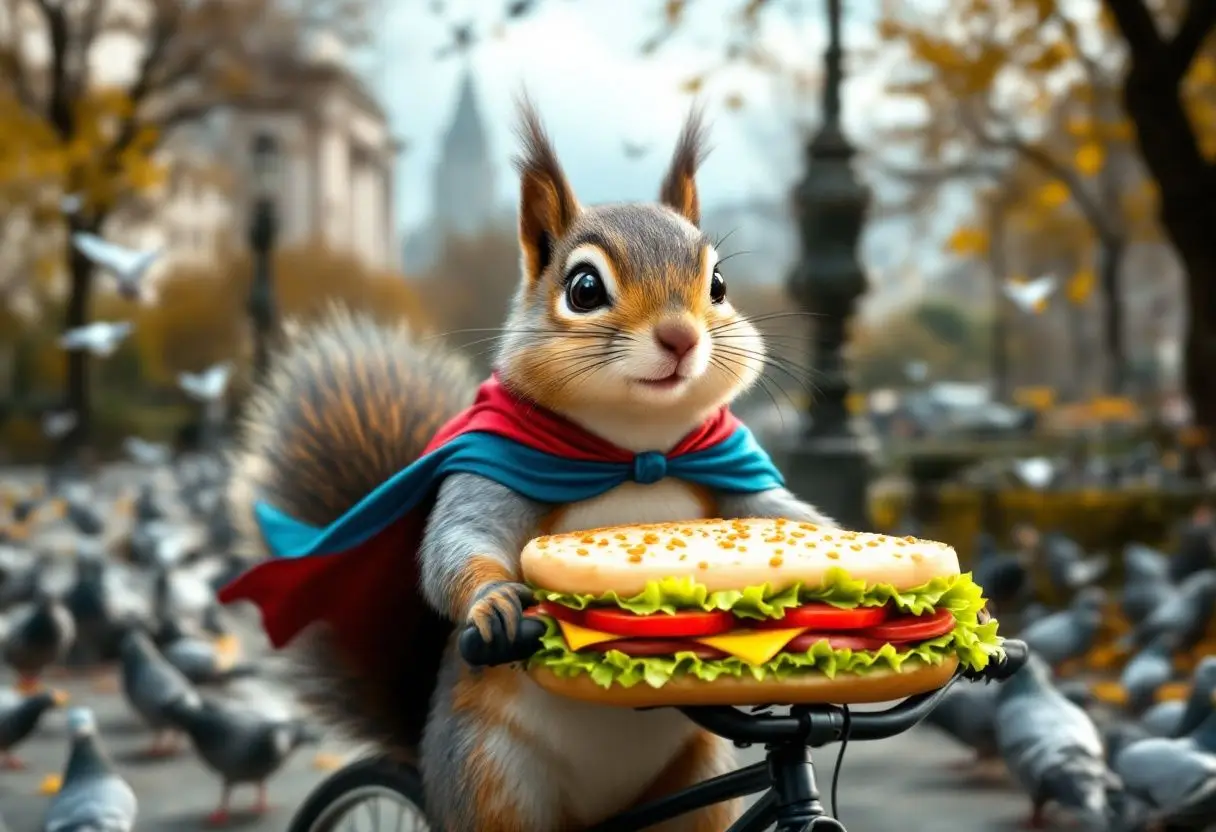
The squirrel, bicycle and lunch are clearly authentic. But a red and blue cape? No way. Squirrels only go for a natural color palette. That’s the big tip-off.
Is anyone NOT using AI for nature photography? All the major “editing” suites have significant AI capability. I think AI noise reduction is almost universally applied, and it makes a huge difference in the edited image.
My images are never going to be in any contest, so I use it freely. I also have no problem having AI remove distracting/unwanted features like people, power lines, fences, etc.
For sure, using filters, artificial lighting, and other techniques including light post-editing, etc. have always been accepted practices in photography, including in some prestigious contests. Even photography legends like Ansel Adams did so. But creating "nature" images out of whole cloth or substantially altering original shots through AI is a different thing. It's fake, misleading, and often dishonest.
| Kids in our schools are using AI to accomplish homework instead of learning it to compete with other students — and in time for jobs. * * * Yes! From my own experience, suffering losses and pain is one of the biggest contributors to learning. Dashing on the rocks one time makes for a wiser and more careful captain. |
Disclaimer: Opinions posted on Free Republic are those of the individual posters and do not necessarily represent the opinion of Free Republic or its management. All materials posted herein are protected by copyright law and the exemption for fair use of copyrighted works.