Posted on 10/09/2026 11:33:37 AM PDT by MtnClimber
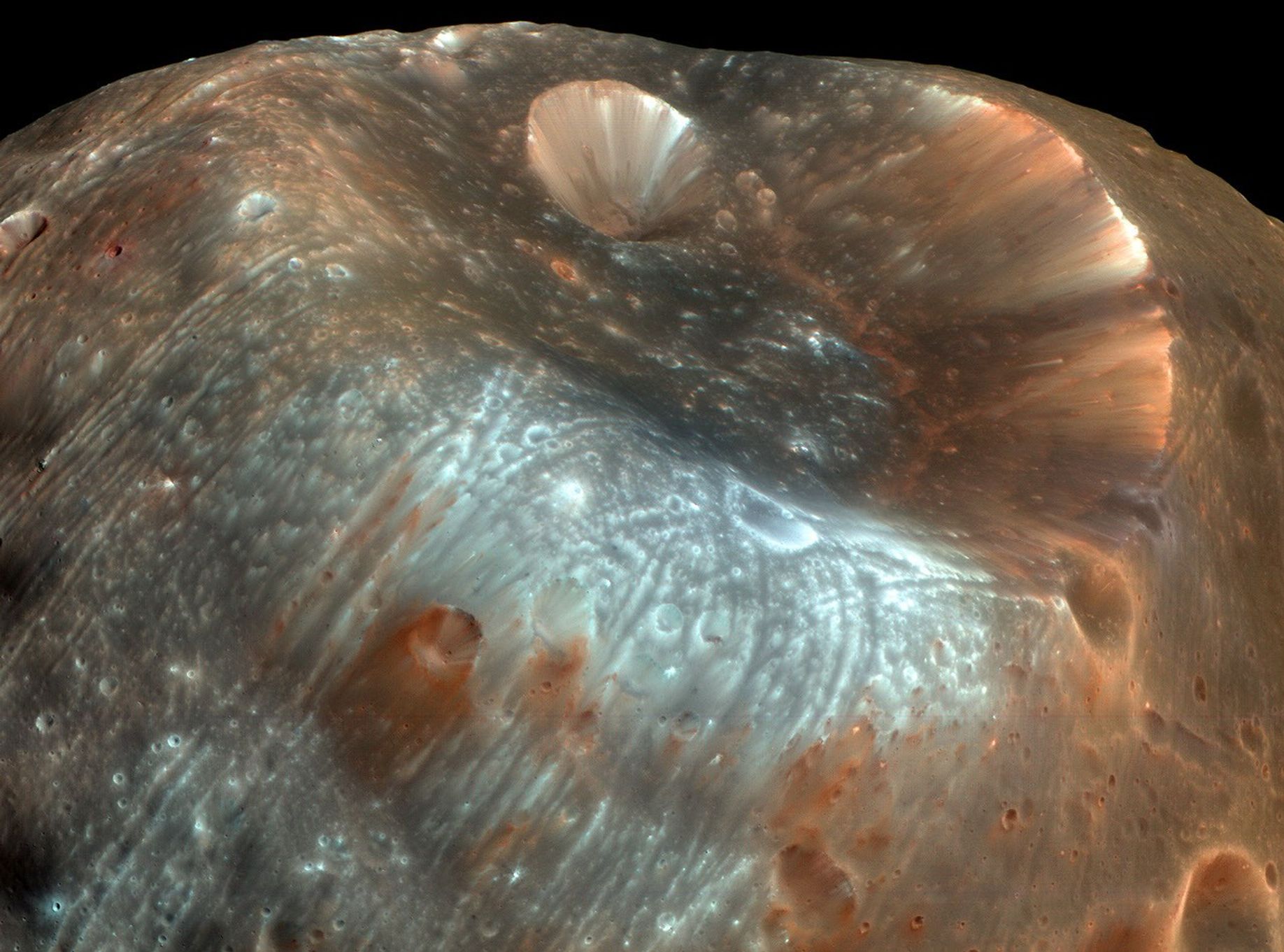
Explanation: Stickney Crater, the largest crater on the martian moon Phobos, is named for Chloe Angeline Stickney Hall, mathematician and wife of astronomer Asaph Hall. Asaph Hall discovered both the Red Planet's moons in 1877. Over 9 kilometers across, Stickney is nearly half the diameter of Phobos itself, so large that the impact that blasted out the crater likely came close to shattering the tiny moon. This enhanced-color image of Stickney and surroundings was recorded by the HiRISE camera onboard the Mars Reconnaissance Orbiter as it passed within some six thousand kilometers of Phobos in March of 2008. Even though the surface gravity of asteroid-like Phobos is less than 1/1000th Earth's gravity, streaks suggest loose material slid down inside the crater walls over time. Light bluish regions near the crater's rim could indicate a relatively freshly exposed surface. The origin of the curious grooves along the surface is mysterious but may be related to tidal stresses experienced by close-orbiting Phobos or the crater-forming impact itself.
Dear FRiends,
We need your continuing support to keep FR funded. Your donations are our sole source of funding. No sugar daddies, no advertisers, no paid memberships, no commercial sales, no gimmicks, no tax subsidies. No spam, no pop-ups, no ad trackers.
If you enjoy using FR and agree it's a worthwhile endeavor, please consider making a contribution today:
Click here: to donate by Credit Card
Or here: to donate by PayPal
Or by mail to: Free Republic, LLC - PO Box 9771 - Fresno, CA 93794
Thank you very much and God bless you,
Jim
For more detail go to the link and click on the image for a high definition image. You can then move the magnifying glass cursor then click to zoom in and click again to zoom out. When zoomed in you can scan by moving the side bars on the bottom and right side of the image.
🪐 🌟 🌌 🍔
Attempt no landing on Phobos.
Looks kinda like a volleyball after our Akita gets through with it.
Looks like a jellyfish.
Exactly, are we sure Phobos isn't a galactic Jellyfish.
Those tracks might have something to do with that white stuff, whatever it is.
That looks alive.
That’s one messed-up moon.
Fobos-Grunt
Just the name makes this worth reading.
“ Fobos-Grunt or Phobos-Grunt (Russian: Фобос-Грунт, lit. ‘Phobos-soil’) was an attempted Russian sample return mission to Phobos, one of the moons of Mars. Fobos-Grunt also carried the Chinese Mars orbiter Yinghuo-1 and the tiny Living Interplanetary Flight Experiment funded by the Planetary Society.[4][5]
It was launched on 8 November 2011, at 20:16 UTC, from the Baikonur Cosmodrome, but subsequent rocket burns intended to set the craft on a course for Mars failed, leaving it stranded in low Earth orbit.[6][7] Efforts to reactivate the craft were unsuccessful, and it fell back to Earth in an uncontrolled re-entry on 15 January 2012, over the Pacific Ocean, west of Chile.[8][9][10] The return vehicle was to have returned to Earth in August 2014, carrying up to 200 g (7.1 oz) of soil from Phobos.”
https://en.wikipedia.org/wiki/Fobos-Grunt#Mass_summary
The rest of the article is interesting, and parts are fun, but it only supports your statement.
Disclaimer: Opinions posted on Free Republic are those of the individual posters and do not necessarily represent the opinion of Free Republic or its management. All materials posted herein are protected by copyright law and the exemption for fair use of copyrighted works.