Posted on 10/07/2026 11:09:57 AM PDT by MtnClimber
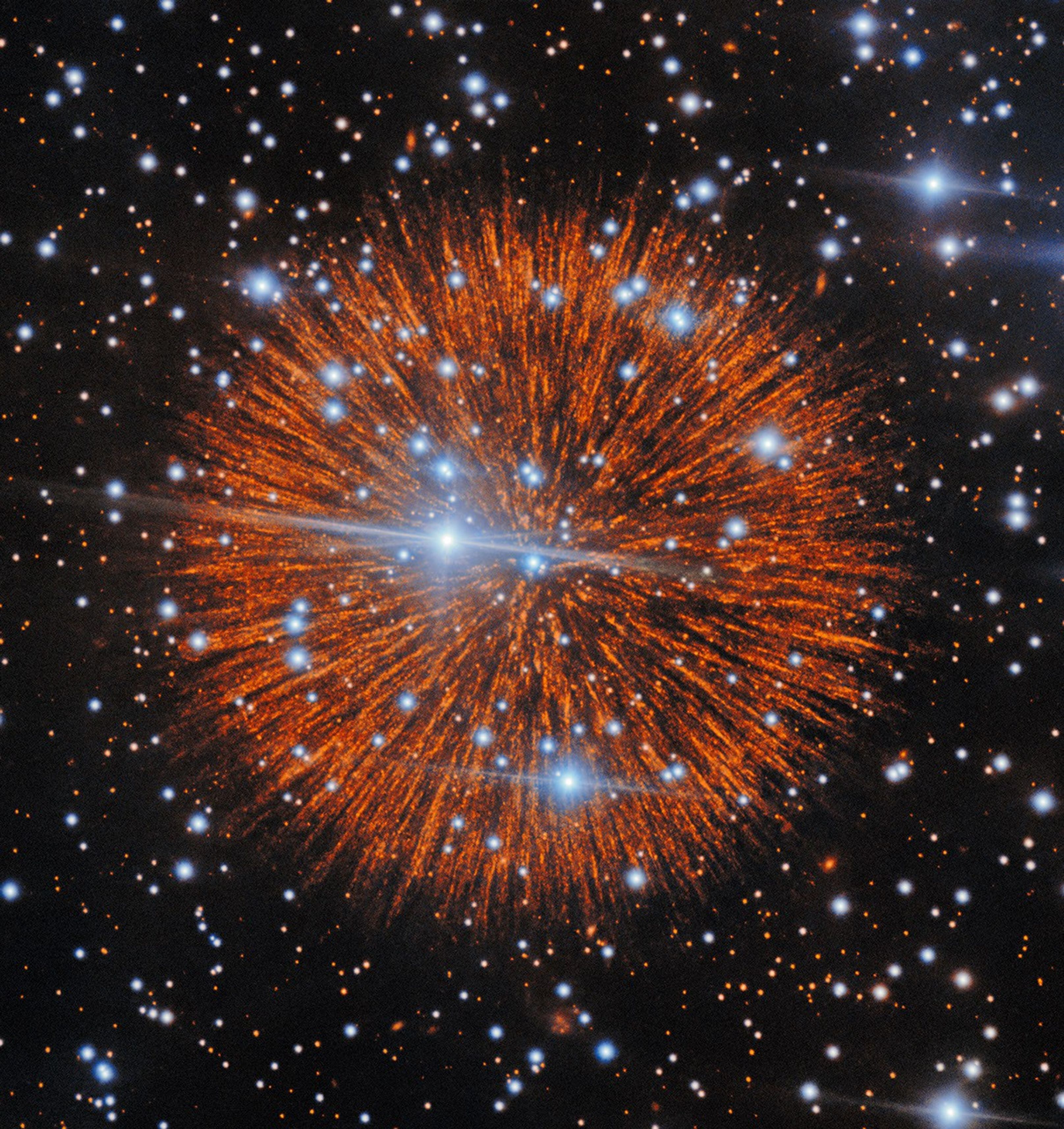
xplanation: "Happy New Year!" No, wait, this is not a fireworks display. This image shows Nebula Pa 30, observed with the Gemini North Telescope in Hawai'i. It is likely the remnant of an old supernova explosion: separate historical records by Chinese, Japanese and Arabic astronomers tell of a "guest star" that appeared in the sky for 185 days in the year 1181. It is believed that this bright new point of light came from the supernova that caused the fireworks in Pa 30. Astronomers don't know exactly what happened in this unusual explosion, classified as a Type Iax supernova, but it is thought to be caused by the merger of two white dwarfs. The mysterious central star in the image is extremely hot and produces a strong wind, possibly forming the radial filaments. Look closely at them: those pearl-like knots stringing the filaments are 4 light-days in diameter. Understanding how a supernova created this amazing nebula continues an 845-year old mystery (and counting).
Dear FRiends,
We need your continuing support to keep FR funded. Your donations are our sole source of funding. No sugar daddies, no advertisers, no paid memberships, no commercial sales, no gimmicks, no tax subsidies. No spam, no pop-ups, no ad trackers.
If you enjoy using FR and agree it's a worthwhile endeavor, please consider making a contribution today:
Click here: to donate by Credit Card
Or here: to donate by PayPal
Or by mail to: Free Republic, LLC - PO Box 9771 - Fresno, CA 93794
Thank you very much and God bless you,
Jim
For more detail go to the link and click on the image for a high definition image. You can then move the magnifying glass cursor then click to zoom in and click again to zoom out. When zoomed in you can scan by moving the side bars on the bottom and right side of the image.
🪐 🌟 🌌 🍔
One helluva fireworks display!............
PA-30...........
That was a real crowd-pleaser
No way
Wow.
The individual filaments are 4 light days across?
The starburst of filaments is 4 light days across?
The pearl like knots at the center are 4 light days across?
The stars "in" the filaments are really attached to the filaments and not in the distant foreground/background and are 4 light days across?
Cheese no whey
I think they are talking about the really small white dots in each of the red filaments. That is just my take. Not the foreground stars or the background stars. That would mean each of the little white specs are larger than our solar system by a factor of four.
The Allium nebula...
That is so cool. Very pretty!
In first?
That certainly looks like something exploded.
I think it was this telescope:
The International Gemini Observatory consists of twin 8.1-meter diameter optical/infrared telescopes located on two of the best observing sites on the planet. From their locations on Maunakea in Hawai‘i and Cerro Pachón in Chile, Gemini Observatory’s telescopes can collectively access the entire sky.

Amazing! makes me think of snow falling on a spider mum or some such flower.
It’s all for God’s glory, whether a person ever sees a thing or not. like all the animals that live in the wild and maybe live there whole life without encountering a human. or all the beautiful things in nature, in middle of forest or desert or jungle that maybe no person has ever seen. They are there a certain amount of time, all just because God wants them to be. He sees them :)
Looks like a corona-nova. grin. That is a beautiful picture - wow!
Disclaimer: Opinions posted on Free Republic are those of the individual posters and do not necessarily represent the opinion of Free Republic or its management. All materials posted herein are protected by copyright law and the exemption for fair use of copyrighted works.