Posted on 09/16/2026 5:23:10 PM PDT by MtnClimber
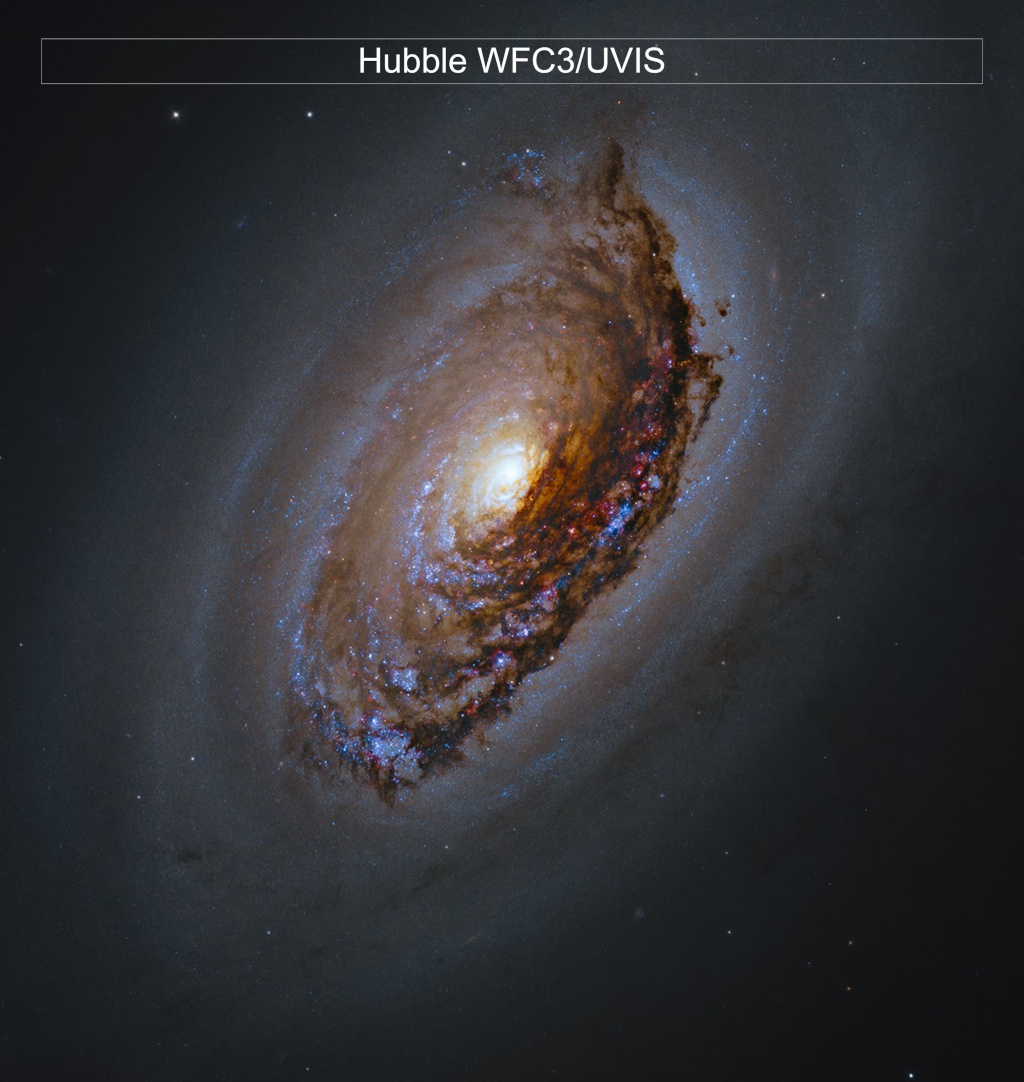
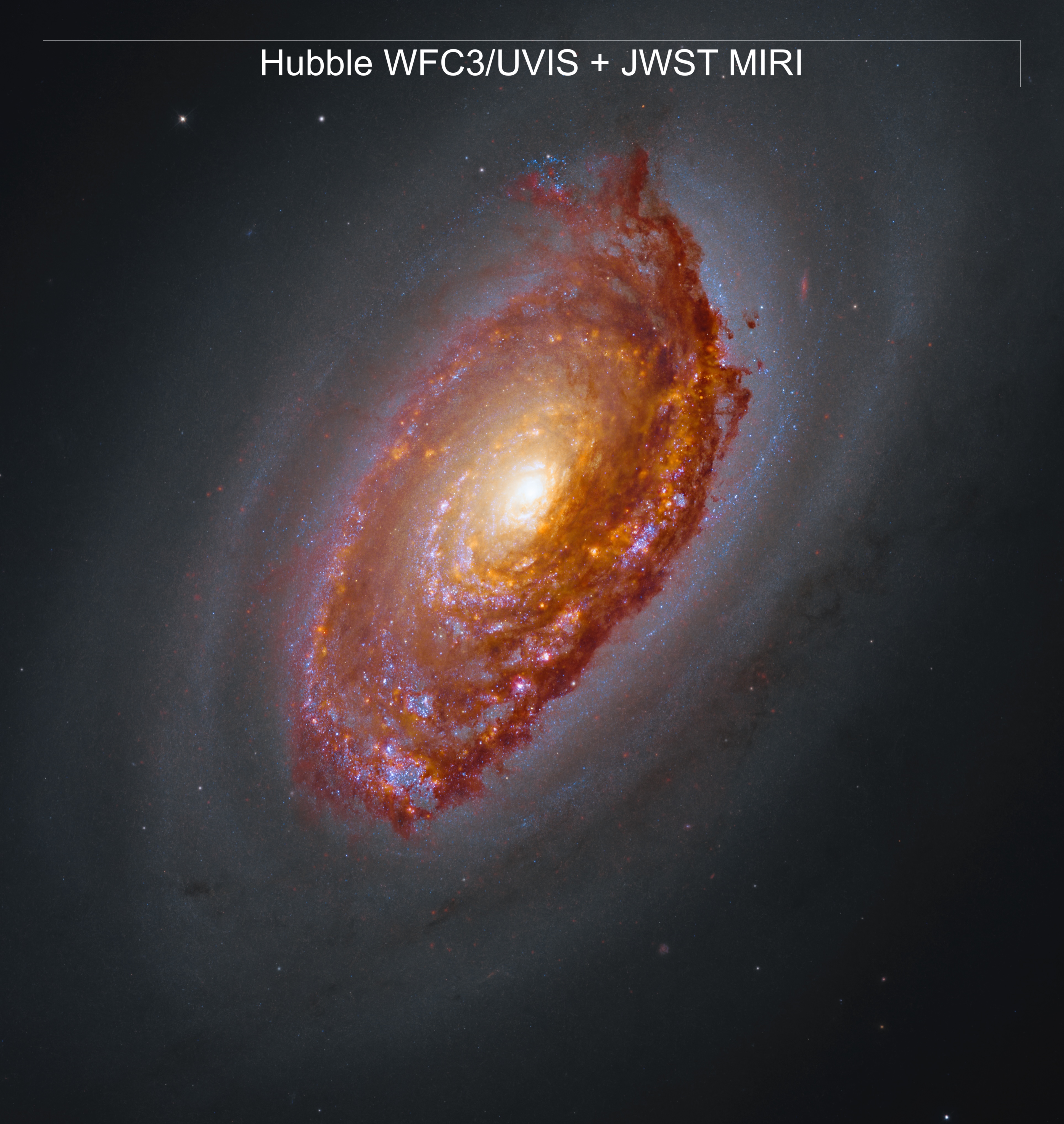
Explanation: Sometimes where Hubble finds darkness, Webb sees light. An example is today’s composite images of Messier 64 (M64), a nearby spiral galaxy of many names. The dark band of dust partially blocking its bright core earned it the moniker “the Black Eye Galaxy.” Webb’s Mid-InfraRed Instrument (MIRI) sees that dust, shown in red, as it absorbs and re-emits light from surrounding newborn stars. These young stars are embedded in pink star-forming regions in the secondary Hubble-only image. M64’s inner and outer gas regions counter-rotate, creating regions of increased star formation where the two gas “currents” meet and compress. A merger between M64 and a smaller galaxy was likely the cause of the opposing motion of the outer gas. Spiral galaxies were once thought to have peaceful histories. M64 was key evidence that spiral galaxies, including the Milky Way, can and do experience mergers. Webb’s view of M64 will tell astronomers about the structure, motion, and composition of the galaxy’s dust and add context to the galaxy’s merger history and evolution.
Dear FRiends,
We need your continuing support to keep FR funded. Your donations are our sole source of funding. No sugar daddies, no advertisers, no paid memberships, no commercial sales, no gimmicks, no tax subsidies. No spam, no pop-ups, no ad trackers.
If you enjoy using FR and agree it's a worthwhile endeavor, please consider making a contribution today:
Click here: to donate by Credit Card
Or here: to donate by PayPal
Or by mail to: Free Republic, LLC - PO Box 9771 - Fresno, CA 93794
Thank you very much and God bless you,
Jim
For more detail go to the link and click on the image for a high definition image. You can then move the magnifying glass cursor then click to zoom in and click again to zoom out. When zoomed in you can scan by moving the side bars on the bottom and right side of the image.
🪐 🌟 🌌 🍔
Wow.
Whoa.
A stellar vortex…
“creating regions of increased star formation “
Question:
Has any astronomer ever claimed to have witnessed a star being born in open space, OUTSIDE a nebula? I just wondered if it was possible.
Answer:
To my knowledge, no. Stars need gas and dust (and probably a few other things, like magnetic fields) to form, which one finds in dense nebulae. I am not aware of an alternate explanation that does not involve these ingredients to the star formation process.
https://public.nrao.edu/ask/has-a-star-ever-been-observed-to-form-outside-of-a-nebula/
That’s no galaxy. That’s a space station!
First of all, the second photo is MUCH more flattering. ;)
I hope I’m still around to see our Milky Way galaxy merge with Andromeda!
“But the galaxy’s merger-mania continues. Astronomers see evidence that the Milky Way has gobbled up as few as five and perhaps as many as 11 small galaxies in the past few hundred million years.”
I’m pretty sure I’ve got a few million years left in me to witness this. ;)
The white center looks like the face of Spanky McFarland of the Little Rascals.
Disclaimer: Opinions posted on Free Republic are those of the individual posters and do not necessarily represent the opinion of Free Republic or its management. All materials posted herein are protected by copyright law and the exemption for fair use of copyrighted works.