Skip to comments.
Replacing gas stoves with electric greatly reduces asthma symptoms
UPI ^
| July 23, 2026
| By Ashwini Sehgal, Case Western Reserve University
Posted on 09/04/2026 10:54:09 AM PDT by DoodleBob
More than one-third of American households rely on natural gas stoves to prepare their meals.
Burning natural gas generates carbon dioxide, which is the main driver of climate change. But cooking on gas stoves is also an under-recognized and important source of indoor air pollution. Combustion of natural gas creates nitrogen dioxide and other compounds that can irritate the lungs.
People with preexisting respiratory conditions, such as the 28 million Americans with asthma, may be especially susceptible. An analysis of more than 40 studies found a correlation between nitrogen dioxide levels and asthma symptoms.
I am a physician and medical researcher, and my colleagues and I recently completed the first study to examine whether replacing gas stoves with electric stoves can improve asthma symptoms.
How we conducted the study
Our study included 85 adults and children with poorly controlled asthma who lived in homes or apartments with gas stoves. Asthma control was determined from responses to a standard questionnaire that asked about specific asthma symptoms, activity limitations and use of rescue medication such as fast-acting inhalers.
Contractors removed the gas stoves, safely capped the gas lines, installed the necessary electrical outlets and replaced the stoves with electric induction models at no cost to participants. We chose electric induction stoves because they heat up and cool down rapidly, and they are safer and easier to clean than electric coil stoves.
Our research team assessed asthma control based on a questionnaire participants filled out before the stove replacement and again two to three months afterward. We used air quality monitors to measure indoor nitrogen dioxide levels for seven-day periods before and after stove replacement.
From moderate to mild symptoms
The results were striking: Improvements in asthma symptoms following stove change were similar to -- or even greater than -- those reported in clinical trials of commonly used asthma medications.
On average, participants went from having moderate asthma symptoms to having mild symptoms. Emergency room visits and hospitalizations for asthma fell by 70%. Missed days of work or school because of asthma dropped by about 80%. At the same time, indoor levels of nitrogen dioxide decreased by 70%.
These findings suggest that a relatively simple change in the home -- switching from a gas stove to an electric stove -- may lead to meaningful improvements in asthma control for people who are struggling with their symptoms.
And though the natural gas industry advertises gas stoves as being better for cooking, participants in our study preferred their electric stoves. Nearly all -- 98% -- said they were satisfied or very satisfied with their electric induction stove, compared with only 41% who felt that way about their gas stove.
That said, it is worth noting that our study included a relatively small number of participants and followed them for only a few months. The findings may not apply to people with milder asthma symptoms. We also did not include a comparison group that kept their gas stoves.
Potential obstacles
The cost of replacing gas stoves with electric stoves is likely to be a barrier for low-income communities, both in the U.S. and abroad.
In newer American homes, an electric stove and its installation typically costs about $1,500. Most of our study participants lived in homes that were built before 1960, and we spent an average of $7,000 per household to upgrade their electrical systems as part of the study.
But given the potential cost savings from reduced emergency room visits and hospitalizations, it might make sense for governments or health insurers to subsidize the costs of replacing gas stoves with electric ones for patients with poorly controlled asthma.
In developing countries, the high initial cost of new stoves can be a real impediment to switching. Inadequate home wiring and unreliable electrical grids present additional challenges in many places.
But countries with severe air pollution and a high prevalence of lung conditions may find it's worth the cost.
In Ecuador, one program demonstrated that providing subsidies could help the population transition from gas to electric stoves. From 2015 to 2021, the Ecuadorian government subsidized 750,000 households -- one-tenth of all households in the country -- to replace their gas stoves with electric induction stoves. Program uptake correlated with declines in hospitalizations for respiratory illnesses.
What patients and physicians can do
Switching stoves is not a cure for asthma and may not help everyone. People with asthma should continue working with their physicians, taking prescribed medications and reducing exposure to other asthma triggers, such as cigarette smoke, dust mites, pollen and viral respiratory infections.
But about 80% of our study participants experienced meaningful improvements. So people with poorly controlled asthma may consider transitioning away from gas stoves, depending on their resources and circumstances, to ease their symptoms.
Physicians may also want to ask asthma patients about the use of gas stoves and educate them about potential harms. And builders, landlords and restaurant owners may want to think about the types of stoves they install, as that may be a consideration for the future buyers, renters and employees who will cook in their kitchens.
TOPICS: Food; Science; Society
KEYWORDS: asthma; doodlebobmoron; electric; electricstoves; gas; gasstoves; ovens
Message from Jim Robinson:
Dear FRiends,
We need your continuing support to keep FR funded. Your donations are our sole source of funding. No sugar daddies, no advertisers, no paid memberships, no commercial sales, no gimmicks, no tax subsidies. No spam, no pop-ups, no ad trackers.
If you enjoy using FR and agree it's a worthwhile endeavor, please consider making a contribution today:
Click here: to donate by Credit Card
Or here: to donate by PayPal
Or by mail to: Free Republic, LLC - PO Box 9771 - Fresno, CA 93794
Thank you very much and God bless you,
Jim
Navigation: use the links below to view more comments.
first previous 1-20, 21-40, 41-60, 61-80, 81-98 last
To: struggle
“Yeah, “gas is bad”... yeah well I don’t have to wait 10 minutes for water to boil with gas.”
Electric “induction” stoves can boil water faster than gas. In all other respects, induction stovetops pretty much suck.
To: ByteMercenary
Pan upgrade. Sounds good.
82
posted on
09/04/2026 3:47:34 PM PDT
by
aspasia
(kyrie eleison)
To: struggle
*** Yeah, “gas is bad”... yeah well I don’t have to wait 10 minutes for water to boil with gas. ***
I can light a cigarette, roast tomatoes for easy peeling, ditto poblano peppers- when burner is off, there’s no cool down like with electric burners oh, and stir frying in a wok is best on gas because you can get flames in your wok for a quick char.
83
posted on
09/04/2026 4:13:44 PM PDT
by
sockmonkey
(Conservative. Not a Neocon. )
To: Dartoid
Me.
Empirical evidence and experience.
84
posted on
09/04/2026 5:07:09 PM PDT
by
DoodleBob
(Gravity's waiting period is about 9.8 m/s²)
To: DoodleBob
Except when the power goes down…the gas stays on.
To: DoodleBob
Which chapter of Woke 1 is this bs AOC?
86
posted on
09/04/2026 5:53:02 PM PDT
by
TornadoAlley3
( I'm Proud To Be An Okie From Muskogee)
To: kaktuskid; fella; Amendment10; Ruy Dias de Bivar; Texas Fossil; Dr. Sivana; MeanWestTexan; ...
This has been a cool thread. Thank you.
I don’t want the govt telling me or anyone else what type of heat source they can use for cooking. That’s not an enumerated power in the Constitution.
In fact there is safety in a diversified portfolio of ways to cook. Even in your own home…most of us have an outdoor grill or a propane camping stove.
It’s also a very personal matter, like what kind of car you want to drive, which makes it MORE off-limits for the govt.
I do want to address the power outage issue. It turns out the annual average number of hours where your electricity is out is about 4.5.
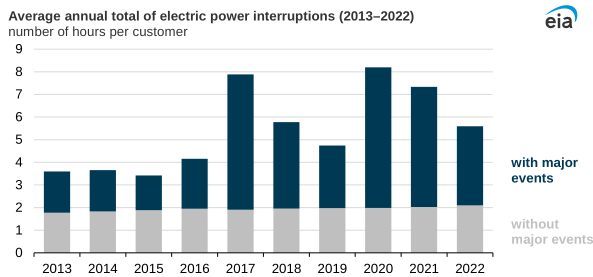
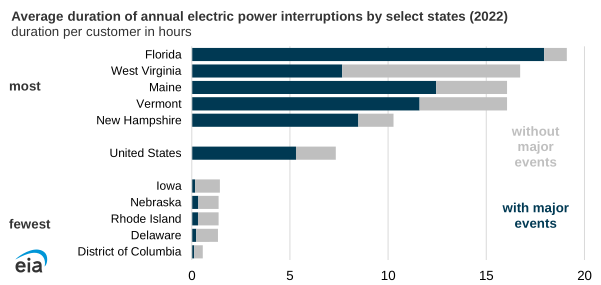
Even in Florida, West Virginia, Maine, Bermint, and New Hampshire, missing one or two mealtimes due to a power outage is a nothingburger. You can eat cereal or tuna or chips and salsa.
Especially when you consider that your gas grill is a large paperweight in a blackout. Opening a dead fridge and/or freezer to get out a steak is foolish during a blackout of unknown duration.
87
posted on
09/04/2026 6:15:31 PM PDT
by
DoodleBob
(Gravity's waiting period is about 9.8 m/s²)
To: DoodleBob
Propane is great stuff! Doesn’t spoil or go rancid.
The old school Coleman 2 burner suitcase stoves are practically free, can’t hardly give them away. They should be a part of any serious emergency kit. They run just fine on ordinary automotive gasoline. For standby or emergency use Coleman Fuel is best because it doesn’t sour sitting in the tank. I’ve found old stoves with Coleman fuel sitting in it for 20+ years and they fire up just fine. But for emergency use, ordinary gasoline is perfectly acceptable. Coleman fuel (Naptha) is getting hard to find, and damnably expensive too. The Lanterns are also an excellent addition to the emergency armamentarium. LEDs have their place, but they won’t keep plumbing pipes from freezing during a cold snap or warmth in a cabin or camper.
To: Zathras
Hmmm…let’s do some actual research.
https://chrp.org/pdf/SehgalCV04_06_07.pdf
Dr. Sehgal graduated in 1978 from Dunkirk Senior High School, Dunkirk, NY (valedictorian)
1982 B.A. University of Rochester, Rochester, NY (summa cum laude, mathematics)
1986 M.D. Harvard Medical School, Boston, MA
1986-1989 Internal medicine internship and residency, Massachusetts General
Hospital, Boston, MA
This guy’s been in America for quite some time.
Now, maybe you get emotional when you see foreign-sounding names. That’s a possibility: your views on blacks are emotional (https://freerepublic.com/focus/chat/4393949/posts?page=34#34), and your understanding of Bethlehem’s historic demographic make up and reason for the shift is also clouded by emotion (https://www.ncronline.org/bethlehems-declining-christian-population-casts-shadow-over-christmas).
That said, nobody is beyond redemption. It’s never too late to change.
89
posted on
09/04/2026 7:05:44 PM PDT
by
DoodleBob
(Gravity's waiting period is about 9.8 m/s²)
To: DoodleBob
Cute little chart.
Reality is much messier
Cause- Average Duration
Minor equipment failure - Less than 1 hour
Tree branches on power lines- 1-4 hours
Severe weather (e.g., storms)- 4-24 hours
Major infrastructure damage- 1-7 days
Rolling blackouts- 1-2 hours per session
Not quite the rosy picture you paint of just having a bowl of cereal (where are you getting the milk?) while waiting a few hours.
Minor blackouts are minor.
In my area we lose power a couple times a year and it is off for a day or two on average.
But you stick with your microwave.
Fire scary!
90
posted on
09/04/2026 7:09:44 PM PDT
by
Harmless Teddy Bear
(I just want FReepers to READ THE ARTICLE. And then think 30 secs before pounding keyboard.)
To: Harmless Teddy Bear
Thanks for your thoughts.
91
posted on
09/04/2026 7:23:19 PM PDT
by
DoodleBob
(Gravity's waiting period is about 9.8 m/s²)
To: DoodleBob
Is the number of power outage hours going up or down in the chart? Which way do you think this will go in the future?
Can the power going out kill people from cold?
92
posted on
09/04/2026 8:35:47 PM PDT
by
Tymesup
To: Mariner
What air monitor do you have?
To: DoodleBob
So, if you have *severe* respiratory issues, plan accordingly. Otherwise, leave *me* alone.
94
posted on
09/05/2026 1:27:37 AM PDT
by
Merrick
(It's a car - that runs on water, man!)
To: Merrick
Peanuts, peanut butter allergies used to be handled the same way. Every School Lunch program was thankful for a plentiful, inexpensive and well-loved source of protein.
To: JustRetired
I use IQ Air.
Premium product.
96
posted on
09/05/2026 9:06:15 AM PDT
by
Mariner
(War Criminal #18)
To: Mariner
Thank you. I looked and that one does not list nitrogen dioxide. I didn’t see any that did multiple contaminants that also did nitrogen dioxide.
To: JustRetired
Other contaminates from natural gas combustion will send it soaring...small particles and co2.
Warning by proxy.
98
posted on
09/05/2026 10:03:22 AM PDT
by
Mariner
(War Criminal #18)
Navigation: use the links below to view more comments.
first previous 1-20, 21-40, 41-60, 61-80, 81-98 last
Disclaimer:
Opinions posted on Free Republic are those of the individual
posters and do not necessarily represent the opinion of Free Republic or its
management. All materials posted herein are protected by copyright law and the
exemption for fair use of copyrighted works.
FreeRepublic.com is powered by software copyright 2000-2008 John Robinson