Posted on 09/03/2026 5:37:21 PM PDT by nickcarraway
The New Species of Demon-Named Flower Feeds on Fungi Instead of Sunlight
In A Nutshell
Researchers in Thailand discovered a new flower species, Thismia daemona, named for its dark, horn-like, demon-inspired appearance.
The plant has no chlorophyll and never needs sunlight, instead pulling nutrients from underground fungi.
Fewer than 50 known individuals exist, all in a single patch of forest inside a national park popular with tourists.
Scientists have preliminarily assessed the species as Critically Endangered under IUCN criteria.
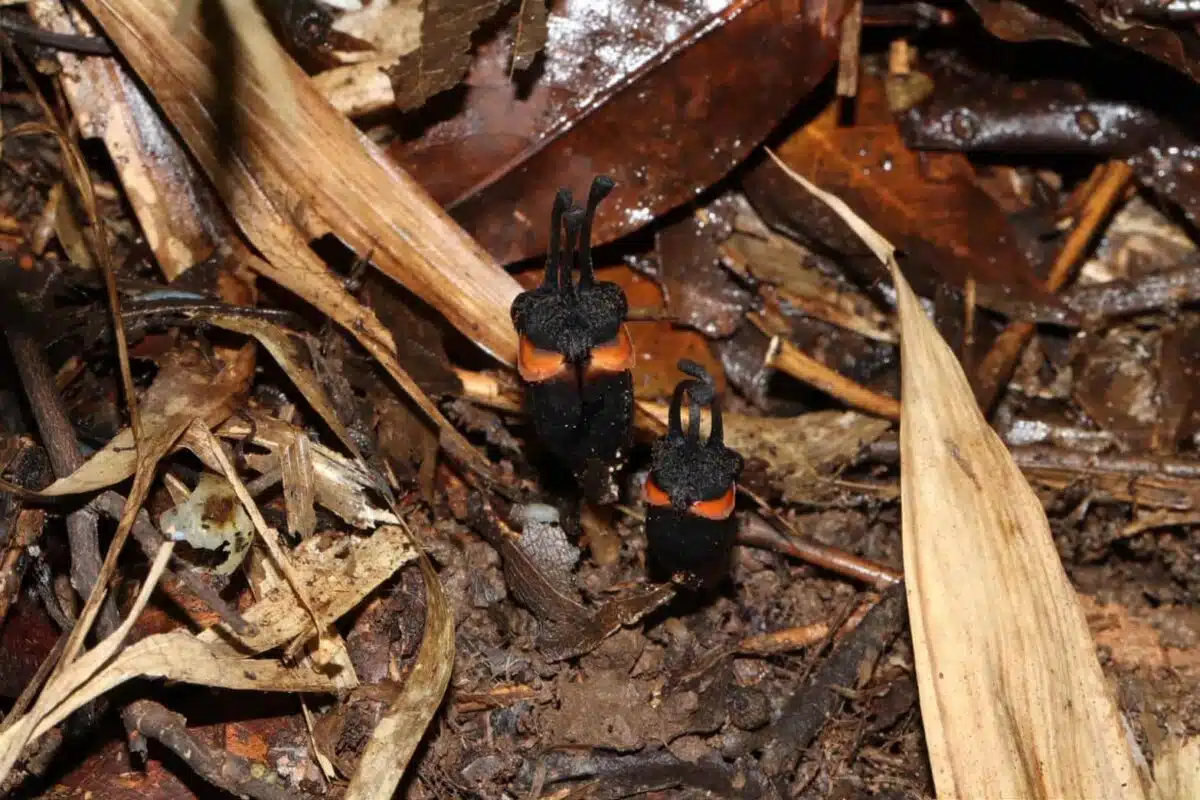
High in the mountain forests of western Thailand, researchers stumbled on a flower that looks like it belongs in a horror movie. Its petals are blackish red and curl into horn-like spikes. It grows low to the ground, tucked under fallen leaves, and it doesn’t bother with sunlight at all. It survives by feeding off underground fungi instead. The scientists who found it were so struck by its sinister look that they named it Thismia daemona, a nod to the word ‘demon.’
This isn’t just a spooky curiosity for a nature documentary. The plant was so rare when botanists found it that they preliminarily assessed it as Critically Endangered under IUCN criteria, one step from extinction in the wild. Fewer than 50 individual plants are known to exist, confined to a patch of forest smaller than a tenth of a square mile, inside a national park that also happens to be a popular tourist destination.
Published in the journal PhytoKeys, the discovery adds a sixteenth relative to Thailand’s odd lineup of Thismia plants. What makes this find worth paying attention to isn’t just its ghoulish appearance; it’s a reminder that new species are still turning up in the world’s forests, and some may vanish before most people ever learn they existed.
Meet Thismia Daemona, the Flower That Never Needs Sunlight
Thismia daemona belongs to a strange group of plants that have given up on making their own food from light. Instead, they tap into fungal networks living in the soil and essentially live as permanent freeloaders, pulling nutrients from fungi rather than the sun.
Because they don’t need light, these plants spend nearly their entire lives underground, surfacing only for a short window when they flower and fruit. That’s exactly why Thismia species are so hard to find; researchers have to catch them at the right moment in the right patch of forest, or miss them completely.
Thismia daemona was spotted in Thong Pha Phum National Park in Kanchanaburi Province, at an elevation of roughly 3,100 feet, growing in leaf litter under a shaded forest mixed with small bamboo. Two specimens were collected in May 2025, and one became the official reference sample used to formally describe the species.
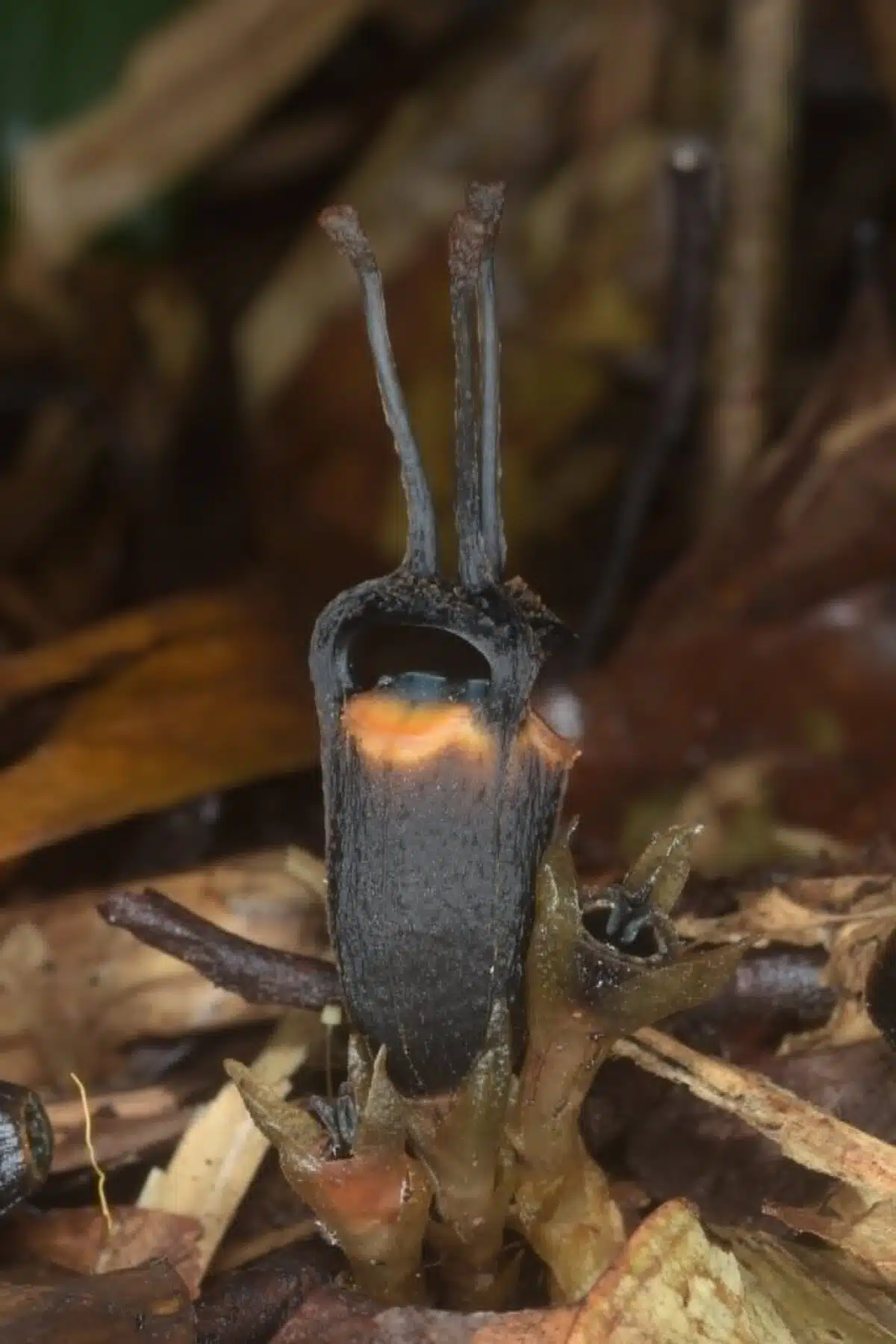
Its outer petals are thick, fleshy, and reddish orange, while its inner petals fuse into a crown-shaped dome topped with three slender, club-shaped horns. Inside the flower’s tube, the surface is covered in irregular ridges and a fine net-like pattern coated in tiny white, see-through hairs, and the pollen-producing parts are a translucent blue with curved tips. According to the study’s authors, the name ‘daemona’ refers to the flower’s devil-like appearance, with its dark orange outer lobes and horn-like appendages.
How Scientists Confirmed Thismia Daemona Was a New Species
Finding an odd-looking flower in the forest is one thing; proving it’s genuinely a new species takes more work. Researchers from Chulalongkorn University and Prince of Songkla University combined careful, old-fashioned botany with modern genetic testing to make their case.
On the traditional side, researchers examined fresh and preserved specimens under a microscope, measuring every part of the flower and comparing it against the original scientific descriptions of similar species, a standard practice for identifying new plants.
For the genetic half of the investigation, the team extracted DNA from the plant and compared it against dozens of other Thismia samples gathered from previous studies around the world. Two separate genetic analyses agreed, though the authors caution the finding rests on a limited sample of DNA: the closest known relative is Thismia betung-kerihunensis, a species from the island of Borneo, hundreds of miles away.
That relationship is interesting on its own, because despite being each other’s closest known relatives, the two plants differ strikingly in appearance: Thismia betung-kerihunensis has a blue-green flower with thin outer petals, while the new Thai species has a blackish flower with thick, reddish orange petals. Researchers also compared it closely to a similar-looking Malaysian species, Thismia limkokthayi, finding consistent differences in petal color and thickness, the texture of the flower’s crown-like structure, and the coloring of its pollen-producing parts.
Why This Newly Found Devil Flower Is Already Endangered
Discovering a new species and immediately worrying about its survival might sound backward, but for Thismia daemona, the math is grim from the start. Using the standard method for estimating occupied habitat, researchers calculated an area of roughly 4 square kilometers, though the plants themselves grow in a patch no larger than 0.05 square kilometers, smaller than a tenth of a square mile. With fewer than 50 known plants and one known population, the species meets the preliminary criteria for a Critically Endangered assessment under guidelines from the International Union for Conservation of Nature.
Making matters worse, that lone population sits inside a national park that draws regular visitors, and regular tourist traffic through the plant’s tiny habitat poses a threat to a species that exists nowhere else on record. The authors note that related populations could still turn up elsewhere in western Thailand or in neighboring Myanmar, where similar forest habitat exists.
This flower’s survival now comes down to a single patch of forest most visitors will walk right past without knowing it’s there. A species this rare, discovered this recently, has almost no margin for error; one bad season, one careless footpath, and Thismia daemona could vanish before science gets a second look at it.
Paper Notes
Limitations
The species description and conservation assessment rest on a small number of specimens: only two plants collected from a single site in Thong Pha Phum National Park, with just one specimen used for the genetic sequencing work. The evolutionary tree placing the species relative to its closest relative was built from a limited sample of DNA, as the authors themselves note when describing the sister relationship with Thismia betung-kerihunensis. Because the plant’s full range hasn’t been confirmed beyond its one known location, the conservation status is described as preliminary, and the authors suggest the species may exist in other areas of western Thailand or Myanmar that have not yet been surveyed.
Funding and Disclosures
The research was supported by Thailand’s National Science, Research and Innovation Fund together with Prince of Songkla University, as well as by the Graduate School of Chulalongkorn University through a scholarship commemorating the 72nd anniversary of King Bhumibol Aduladej and the 90th anniversary of Chulalongkorn University. The authors reported no competing interests and stated that no artificial intelligence tools were used in preparing the manuscript.
Publication Details
The study, titled “Thismia daemona (Thismiaceae), a new species from Thailand supported by morphological and molecular evidence,” was authored by Tosak Seelanan, Isareyakorn Chantapram, Neeranuch Taosiri, Chanachon Chuchuea, and Sahut Chantanaorrapint, representing Chulalongkorn University and Prince of Songkla University in Thailand. It was published in the journal PhytoKeys, volume 278, pages 177 to 189 (2026). DOI: 10.3897/phytokeys.278.202868.
Thailand?
Damn that’s ugly, probably best for that one to go extinct.
Everything has its own beauty and I find it uniquely beautiful. God’s creations are truly wondrous.
I am not certain that this organism should be classified as a plant. Parasitic plants make up only 1% of all plants. Most parasitic plants make Chlorophyll and provide some of their own sustenance. The rest they get from other plants.
Only a very few take take their food from fungi. Thismia daemona belongs to a strange group of plants that have given up on making their own food from light. Instead, they tap into fungal networks living in the soil and essentially live as permanent freeloaders, pulling nutrients from fungi rather than the sun.
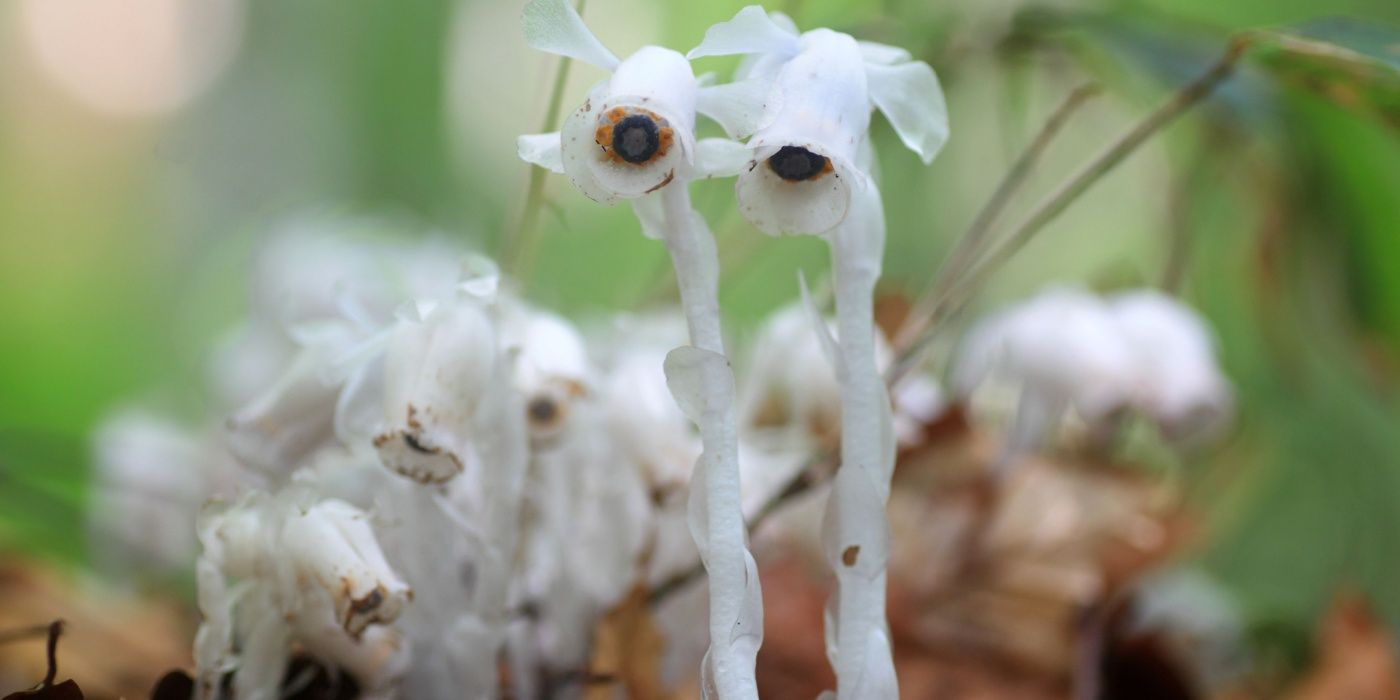
The only other parasitic plant I can find that feeds on fungus is that Ghost Plant (or Indian Pipe). What classifies these plants as plants other than their reproductive strategy
I’ll go for “plant” but not “flower”.
“Everything has its own beauty and I find it uniquely beautiful. God’s creations are truly wondrous.”
I agree, just having some fun. It’s species like this one that can lead to miracle drugs, like happened with Ivermectin (incredible story on that).
Wouldn’t that be a mushroom? Who cares? Fence it in with 12 foot chain link and barbed wire.
Kinda looks like a giant bee or hornet!
This should be a warning to all fungi’s.

Ditto.
Looks like a baby Triffid.
Ping

Regards,
“a strange group of plants that have given up on making their own food from light.”
Or ... that’s how God created them.
When I first moved to Maui, I thought the protea flowers were just awful. Then they grew (no pun) on me so that I loved them.
Disclaimer: Opinions posted on Free Republic are those of the individual posters and do not necessarily represent the opinion of Free Republic or its management. All materials posted herein are protected by copyright law and the exemption for fair use of copyrighted works.