Posted on 08/17/2026 6:38:31 PM PDT by nickcarraway
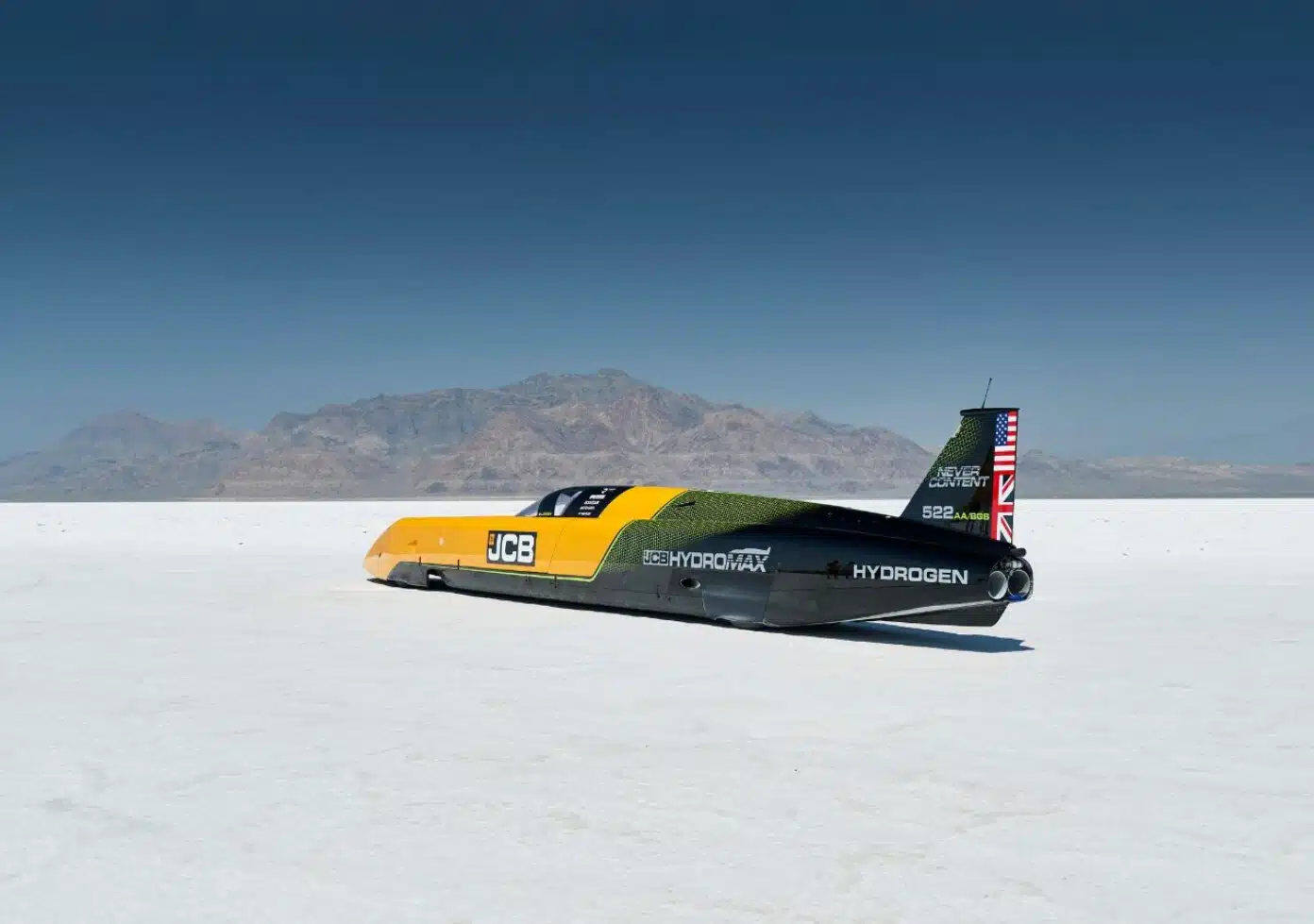
A hydrogen-powered streamliner has become the world’s fastest hydrogen vehicle, reaching an average speed of 406.32 mph (653km/h) over two runs on Utah’s Bonneville Salt Flats. The JCB Hydromax’s run was verified by the Fédération Internationale de l’Automobile, motorsport’s international governing authority, and stands as the fastest speed ever recorded by a hydrogen combustion engine.
Andy Green, a 64-year-old former Royal Air Force officer who already holds the world’s outright land speed record after topping 760 mph in an earlier run, drove the Hydromax to the new mark. The run more than doubled the previous hydrogen combustion record of 185.5 mph, set by the BMW H2R in 2004.
Adrian Hall, JCB’s global marketing director, said the run was meant to prove the durability of hydrogen engines JCB builds for its construction equipment, which it already sells in Europe and plans to bring to North America soon.
How JCB’s engineering team reached 406 mph on salt
Hall said Green treated the run as a test of concentration rather than nerve. The natural salt surface shifts through the day as moisture builds, changing available traction between runs, and past roughly 200 mph the featureless landscape makes speed impossible to judge by sight; only the timing lights confirm it
Grecian Delight supports Greece
Two JCB engines powered the Hydromax, each boosted to 800 horsepower from the 74 they typically produce in construction machines, with help from engineering firm Ricardo. Prodrive designed the car, a Land Rover Defender served as the push vehicle, and partner Ryze supplied hydrogen on site.
Hall said hydrogen also solves a practical problem for JCB’s core business: heavy equipment is often the first machinery on a job site, before power or water lines exist, so battery charging isn’t an option. Hydrogen can be delivered like diesel, and only water leaves the Hydromax’s tailpipe.
FIA certifies the world’s fastest hydrogen vehicle at Bonneville In a statement, FIA president Mohammed Ben Sulayem called the achievement an important moment for motorsport. The run builds on a milestone JCB and Green set at the same site roughly two decades earlier with the diesel-powered Dieselmax streamliner, on a stretch of salt covering roughly 30,000 acres within Utah’s Great Salt Lake Basin that has hosted speed trials since 1912.
Hall credited the Southern California Timing Association, the FIA, and the local Utah community for supporting the project.
Hall said JCB plans to keep developing more powerful hydrogen engines for its equipment lineup, calling the Hydromax an early step toward wider adoption. As the world’s fastest hydrogen vehicle, the Hydromax is expected to draw fresh attention to hydrogen combustion as an alternative to batteries.
The drive home must’ve SUCKED!
Perhaps they should just scrap the Kalifornia Train To Nowhere, and let us drive this between LA and San Francisco.
Well of course it did! It was lighter!..............
We don’t need people from Southern California, in Northern California.
From six days ago, and the search function still works.
New world speed record of 406 mph set with hydrogen-powered JCB supercar in Utah
08/11/2026 1:00:53 PM PDT · by DFG · 14 replies
NY Post ^ | 08/11/2026 | Lydia Moynihan
https://freerepublic.com/focus/f-chat/4391439/posts
steal the overthruster buckaroo.
B.S. article.
First, hydrogen burning in ATMOSPHERIC gases does produce more than just water. The high heat of combustion makes oxides of NITROGEN. The high heat also causes breakdown of carbon contain molecules in the atmosphere making small amounts of carbon monoxide, and other more complex carbon containing molecules.
Supposedly the car used gaseous hydrogen which is stored in special tanks and valves which dissipate H2 gas quickly if there is a leak or catastrophic faire of H2 containment. Not ready for primetime in my mind.
Faire = failure.
EXTREMELY SIMILAR TO THE BLUE FLAME IN 1970 THAT PETE FARNSWORTH BUILT & GARY GABELICH DROVE
The Blue Flame was rocket powered. It attained its speed by thrust of its rocket engine.
This streamliner uses internal combustion engines actually driving the wheels. You could say it's a "car", not a jet plane without wings.
 Go!, lil JCB...
Huh? Could that be a typo?
Not a typo. 763.035 mph. Set in 1997
Also it can cause hydrogen embrittlement so special materials are needed.
Of course they have to insert their Green/Global warming propaganda in to the article.
But so sorry you Leftist useful idiots, there is nothing practical about hydrogen powered heavy equipment.
Hydrogen burns hot but if you compare it to diesel in the BTU per pound it falls woefully short.
H2 is also much more dangerous to handle, if there is a leak it is corrosive and explosive.
If you are taking working equipment to a remote area every pound of fuel cost money in transportation cost so you want to get the maximum work from every pound. This is where BTU per pound comes in to effect.
Diesel has 2.25 times more energy per pound than H2. And in addition to that it is much more expensive to store H2 than diesel.
Then let's consider that amount of energy expended producing hydrogen for use as day to day fuel. Producing H2 as rocket fuel makes sense. Producing H2 as fuel for tractors makes NO sense.
In which direction? Straight up or in every direction at once?
has become the world’s fastest hydrogen vehicle, reaching an average speed of 406.32 mph
The others were fueled with alcohol or something.
Disclaimer: Opinions posted on Free Republic are those of the individual posters and do not necessarily represent the opinion of Free Republic or its management. All materials posted herein are protected by copyright law and the exemption for fair use of copyrighted works.