Skip to comments.
Astronomy Picture of the Day - Three Galaxy Pairs
NASA ^
| 10 Aug, 2026
| Image Credit & Copyright: Rafael Sampaio
Posted on 08/10/2026 12:22:26 PM PDT by MtnClimber
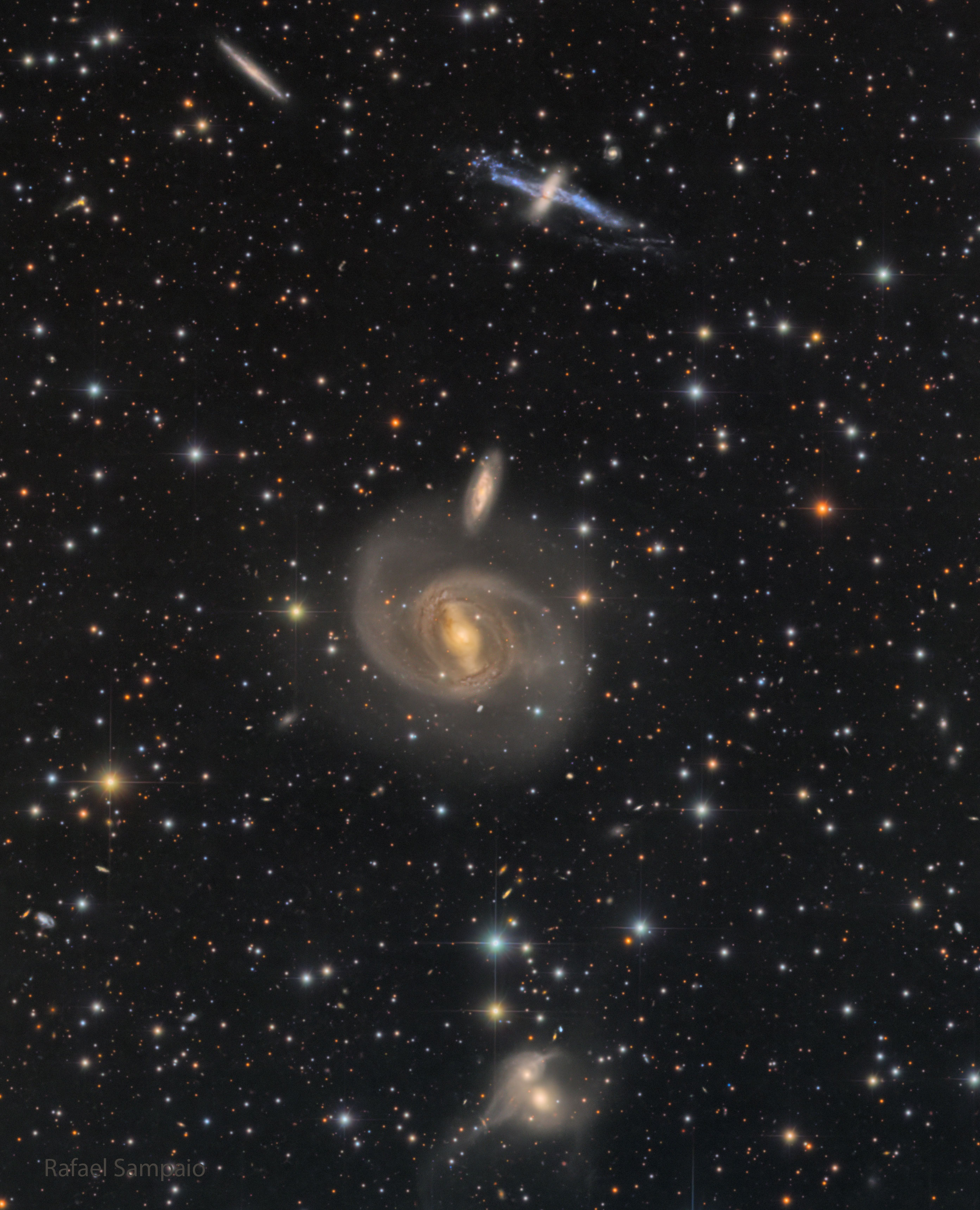
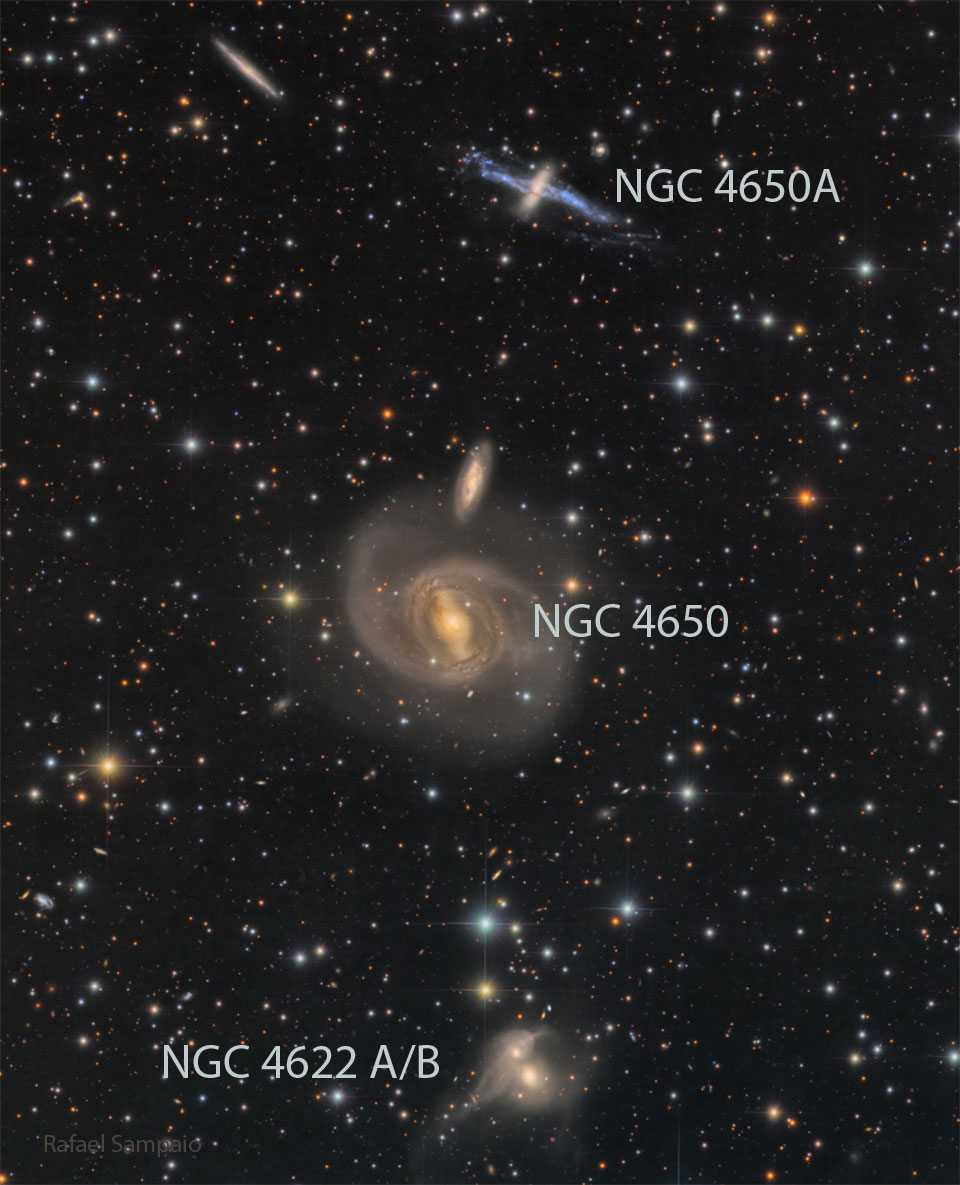
Explanation: Each of these pairs of galaxies is different. The two galaxies at the top are likely not interacting, at least presently. However, the top galaxy with the blue stripe, NGC 4650A, is a polar ring galaxy and may be the result of a past galaxy collision. The two galaxies in the middle of the featured image appear like they could be interacting gravitationally -- but their relative speeds make this unlikely. Of these two, the larger galaxy, NGC 4650, is a spiral galaxy with a bright bar of stars across its center. The two galaxies at the bottom are actively interacting. Possibly in a billion years or so, NGC 4622A and NGC 4622B will merge and become one single galaxy. All of these galaxies are likely members of the larger Centaurus Galaxy Cluster.
TOPICS: Astronomy; Astronomy Picture of the Day; Science
KEYWORDS: apod; nasa
To be added or removed from the Astronomy Picture of the Day ping list please send me a request via "Private Reply" (Mail). For more detail go to the link and click on the image for a high definition image. You can then move the magnifying glass cursor then click to zoom in and click again to zoom out. When zoomed in you can scan by moving the side bars on the bottom and right side of the image.
To: MtnClimber
2
posted on
08/10/2026 12:22:53 PM PDT
by
MtnClimber
(For photos of scenery, wildlife and climbing, click on my screen name for my FR home page.)
To: MtnClimber
3
posted on
08/10/2026 12:23:15 PM PDT
by
MtnClimber
(For photos of scenery, wildlife and climbing, click on my screen name for my FR home page.)
To: 21stCenturion; 21twelve; 4everontheRight; A Navy Vet; A_perfect_lady; abb; AFB-XYZ; AFPhys; ...
Pinging the APOD list
🪐 🌟 🌌 🍔
4
posted on
08/10/2026 12:24:21 PM PDT
by
MtnClimber
(For photos of scenery, wildlife and climbing, click on my screen name for my FR home page.)
To: MtnClimber
In some parts of the universe the night sky isn’t dark at all, I’ll bet.
To: MtnClimber
Out of the trillions of galaxies that are out there shows how insignificant we really are.
6
posted on
08/10/2026 1:05:07 PM PDT
by
SkyDancer
( ~ Am Yisrael Chai ~)
To: MtnClimber
7
posted on
08/10/2026 1:27:10 PM PDT
by
No name given
( Anonymous is who you’ll know me as )
To: MtnClimber
8
posted on
08/10/2026 1:27:15 PM PDT
by
No name given
( Anonymous is who you’ll know me as )
To: MtnClimber
9
posted on
08/10/2026 1:54:28 PM PDT
by
telescope115
(Ad Astra, Ad Deum…)
To: ComputerGuy
In some parts of the universe the night sky isn’t dark at all, I’ll bet.
I've read that the sheer density of stars in the bulging part of a galactic core is often estimated to be something like 2,000 to 2,000,000x our part of the galaxy by volume. At typical brightnesses that seriously adds up- most of the estimates I've seen say that the night sky on a planet in one of those systems would be on the order of the luminous intensity of a full moon, everywhere. It wouldn't be like full a sunny day here on Earth, but still darned impressive!
(I've also read that being close enough to an actively-accreting black hole or quasar in one of those galactic centers could exceed that brightness, but at that range there's so much stuff flying around and orbits are so unstable from all the shifting mass that it would be difficult to survive long enough to enjoy it)
10
posted on
08/10/2026 7:02:24 PM PDT
by
verum ago
(I figure some people must truly be in love, for only love can be so blind.)
To: verum ago
Disclaimer:
Opinions posted on Free Republic are those of the individual
posters and do not necessarily represent the opinion of Free Republic or its
management. All materials posted herein are protected by copyright law and the
exemption for fair use of copyrighted works.
FreeRepublic.com is powered by software copyright 2000-2008 John Robinson