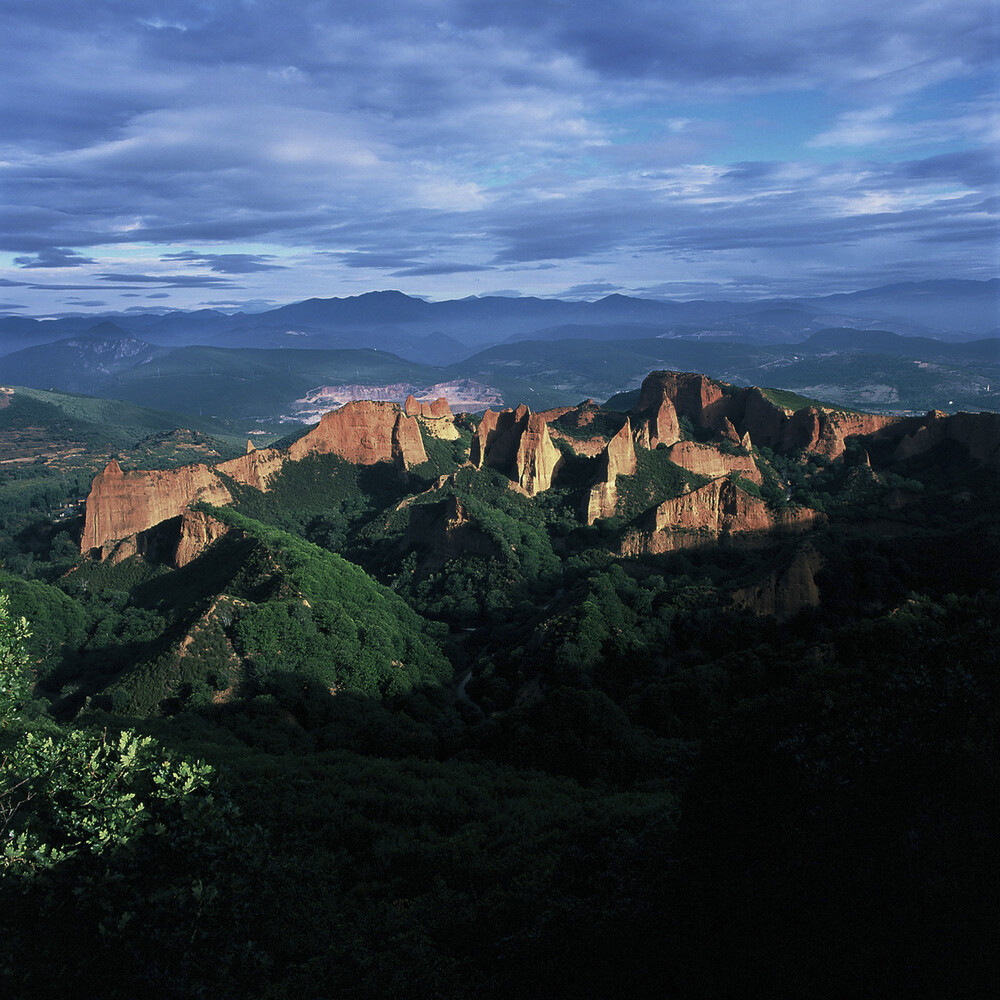
This video explores the spectacular remains of the Roman mines at Las Médulas, Spain.The Roman Gold Mine that Ate Mountains | 9:09
toldinstone | 21,693 views | July 10, 2026
Posted on 07/11/2026 4:12:30 AM PDT by SunkenCiv
This video explores the spectacular remains of the Roman mines at Las Médulas, Spain.
The Roman Gold Mine that Ate Mountains | 9:09
toldinstone | 21,693 views | July 10, 2026
(Excerpt) Read more at youtube.com ...
YouTube transcript reformatted at textformatter.ai *may* follow.
Transcript
Chapter 1: Introduction
Here at Las Médulas, in the rugged northwest of Spain, a mountain is missing. It vanished two thousand years ago, when miners channeling the water of six aqueducts washed it away to expose the gold that financed the power of Rome. Today’s video will survey how this incredible operation worked, and explore the strange landscape left behind by the ancient miners. From the reign of Augustus to the final days of Byzantium, the Roman Empire ran on gold.
Chapter 2: Gold and Gold Mines
Soldiers and officials were paid in gold coins. So was the tribute demanded by Attila the Hun. Gilded busts of the emperors were carried in processions, and empresses appeared before the people in gowns of gilded cloth.
This gold came from many sources. Caesar seized so much from the sanctuaries of Gaul that the value of precious metal dropped throughout Italy. Hundreds of tons, hidden on the orders of the Dacian king Decebalus, were reportedly recovered from a river in Transylvania. Mines were scattered throughout the provinces; those of Mount Pangaion, which had once underwritten the rise of Alexander the Great, were especially famous.
Transcript
Chapter 3: Mines of Spain
The most productive mines, however, were in Spain. Pliny the Elder describes a mine that cut a mile and a half into the mountains, and was so deep that it had to be continuously pumped by slaves working waterwheels. The opencast mines of northwestern Spain were on an even grander scale.
Here, as throughout the empire, gold mines were owned by the state and overseen by an imperial procurator. Individual mines were managed by imperial freedmen, who leased concessions to private contractors. Although these contractors employed both slave and free workers, the most dangerous work was always done by condemned prisoners.
There was plenty of dangerous work at Las Médulas, the most spectacular of Roman Spain’s gold mines. The site began to be exploited early in the first century AD, not long after Augustus added the surrounding region to the empire. Over the next hundred and fifty years, a workforce that may have sometimes swelled to twenty thousand men transformed what had been a nondescript valley into a moonscape.
The gold of Las Médulas was embedded in layers of sand and clay that had eroded from the Somideo Mountains. Only some strata contained gold — and these were buried beneath up to a hundred meters of sterile sediment.
Where the gold-bearing strata were close to the surface, water was funneled through networks of converging trenches and into a central channel, where miners strained suspended gold flakes from the stream — a process analogous to the hydraulic mining used to such devastating effect in the later stages of the California Gold Rush. Where the gold was deeper, the Romans resorted to the method that Pliny described as ruina montium — “the ruin of mountains.” More on that after the break.
Chapter 4: Echos of Antiquity
[ad text redacted]
Transcript
Chapter 5: Ruina Montium
What Pliny called ruina montium is now known as hushing. A network of galleries was cut into the sediment covering the gold-bearing strata. The work, Pliny tells us, could take months. When the miners encountered masses of rock too hard for their picks, they cracked the stones with fires or 150-pound weights.
Once the tunnels were finished, they were flooded. To obtain the vast amount of water required, the miners built aqueducts through the mountains. Pliny describes the immense labor of driving conduits through ridges and over valleys. In some places, the channels were supported on precarious wooden trestles. In others, they had to be carved from sheer cliff faces by men suspended from ropes.
The aqueducts that served Las Médulas eventually included about 600 kilometers of water channels, which supplied between 50 and 90 million cubic meters of water annually. Much of this was held in reservoirs above the mines. When the hushing galleries were ready, the reservoirs’ stone sluicegates were opened. The force of the water thundering through the tunnels and saturation of the surrounding sediment created landslides that stripped away millions of tons of overburden.
Transcript
Chapter 6: Recovering the Gold
The miners at Las Médulas used the ruina montium technique again and again, creating a caldera that covered more than ten square kilometers — by far the largest opencast mine in the Roman Empire. Once the gold-bearing strata had been exposed, the miners piled the larger stones into heaps and dug channels along the surface. They lined the bottoms of the channels with gorse branches, then played streams of aqueduct water over the slopes. Gold flakes were washed downhill and caught in the gorse; they were retrieved after the branches were dried and burned.
More than a hundred million cubic meters of sediment were washed down from the mines at Las Médulas. The debris transformed the topography of the plain below, leaving a series of ridges and channels. In channels blocked by later floods, lakes formed. Some, like Lake Somido, are still extant today.
The gold-bearing strata at Las Médulas were not especially rich; by one estimate, they contained only about three grams of gold for every ton of sediment. Around the beginning of the third century, the sheer difficulty of recovering gold from the site seems to have brought mining to an end. Since the mines were never reopened, Las Médulas remains largely as the Romans left it — a monument to both the scale and the limitations of ancient ingenuity.
Las Médulas, UNESCO World HeritageCredit: Yvon Fruneau
Spot gold this a.m. is $132.46/gram, so that's $397.38 per ton excavated.
Assuming he means imperial/short tons, that comes to 0.106 ounces avdp or 0.096 Troy ounces per ton of sediment. That's about 302,000 parts soil to one part gold (by weight). Not much ROI.
Stories like this remind me how invested the Romans were in monetizing human suffering. I suppose it wasn't that unusual for the era, but in the end, the Romans just had so much more to show for it.
There was an old phosphate hydraulic mine near where I grew up. Between the water cannon blasting and the Ph of the tailings piles, it was craggy and barren, like moonscape. And it attracted kids on dirt bikes from all over the region, ... until they were forced to close the place over litigation concerns.
Actually it shows that the Romans used water to do a lot of the work to extract a lot of gold over a few centuries, pretty smart.
Courtesy Katrin Westner
Spain's Silver Boom
Jason Urbanus
Archaeology Magazine
Digs & Discoveries
November/December 2017
so what happened to all that roman gold. they also got a lot of gold from thrace.
So the Romans were a resource empire like the Spanish. The coolest book I’ve ever read was 1493 by Charles Mann. He described Potosi, a mountain in Bolivia whose gold financed the spanish empire for 200 years from roughly 1550-1750 at times the silver that flooded into Europe was so vast it helped cause the famous dutch tulip craze. But when the gold ran out, the power of the Spanish vanished.
That has been the great cautionary tale that people have heard since.
What I find interesting is that the tip of the spear and the current economic endpoint of the american space program today is psyche. The amount of precious metals on that asteroid makes the current complete wealth of earth look approximately like a grain of sand.
The technical/engineering difficulty today of getting the precious metals of psyche is about on a level as that of spain getting the silver of petosi in say 1540. ( a bavarian mining engineer figured out how to extract the silver of potosi about roughly 1540.)
For context on this historical story is this story about a revaluation of gold coming later this year. I totally think this is in the offing.
https://freerepublic.com/focus/f-chat/4387563/posts
The trump administration will be known as providing the financial bridge between the post war world and the dawning space age. ... no it won’t ... but in monetary terms ...that will be the case.
the trump people have both understood the past very well and understood the future very well.
For context on this historical story is this story about a revaluation of gold coming later this year. I totally think this is in the offing.
https://freerepublic.com/focus/f-chat/4387563/posts
The trump administration will be known as providing the financial bridge between the post war world and the dawning space age. ... no it won’t ... but in monetary terms ...that will be the case.
the trump people have both understood the past very well and understood the future very well.
The Potosi mines have produced circa 4-5 percent of all the silver ever mined, but in that time period, in peak years it was producing as much as 35-40 percent. It's what kept the lights on, even though the Spanish also hauled out gold and emeralds.
Regardless of source, the vast fortune apparently went into adornment including loads of palaces.
The list of wars lost by the Spanish Empire (as well as pyrrhic victories) is pretty impressive in its own way. They managed to defeat lesser opponents, and tottered on with occasional victories until loss of most of their American colonies.
It got recycled, just as most of the gold of Lydia has.
https://freerepublic.com/focus/chat/4019442/posts
Endpoints of the US space program is the Moon, Mars. Everything after that is up for grabs, with mining the asteroid belt way down on the list, including Psyche.
Endpoints of the US space program is the Moon, Mars. Everything after that is up for grabs, with mining the asteroid belt way down on the list, including Psyche.
//////
agree. but its worth noting that a couple months back the first the successful launch of the new heavy lift musk rocket coincided with a NASA sattelite that slingshotted around mars on its way to psyche.
Disclaimer: Opinions posted on Free Republic are those of the individual posters and do not necessarily represent the opinion of Free Republic or its management. All materials posted herein are protected by copyright law and the exemption for fair use of copyrighted works.