Posted on 07/09/2026 5:43:29 PM PDT by delta7
KEY TAKEAWAYS
Silver Enables the Design: A 5-micrometer silver-carbon layer suppresses dendrites and allows Samsung's compact "anode-less" architecture. Performance Leap: The technology targets 900 Wh/L, 600-mile range, and 9-minute fast charging, roughly double current lithium-ion density. 2027 Timeline: Mass production is targeted for 2027, signaling a potential new role for silver in the EV supply chain.
The electric vehicle (EV) industry is approaching a generational transition. While current lithium-ion technology has enabled the first wave of mass adoption, manufacturers are actively seeking solutions to persistent challenges regarding energy density, charging speed, and safety. Among the leading candidates for the next generation of energy storage is the solid-state battery (SSB), with major developers like Samsung SDI targeting mass production by 2027.
Recent technical specifications point to potential improvements in performance, including ranges approaching 600 miles and rapid charging times of nine minutes. Beyond the headline performance figures, the material science enabling them, specifically the integration of a silver-carbon layer, represents a notable shift in battery chemistry.
Addressing the Dendrite Challenge
A primary hurdle in developing high-density batteries is the formation of "dendrites." These are needle-like lithium structures that can grow during charging, potentially piercing the separator and causing short circuits.
To address this, Samsung's research team, as detailed in Nature Energy, introduced a silver-carbon (Ag-C) nanocomposite layer. In this application, silver functions as a stabilizing agent. It forms a reversible alloy with lithium during charging, promoting uniform deposition and suppressing dendrite growth. This stability is a key factor in longevity, and Samsung SDI publicly targets a service life of over 20 years for its commercial all-solid-state product.
The "Anode-Less" Design Concept
The stability provided by the Ag-C layer allows for an "anode-less" architecture. Unlike traditional batteries that use a graphite anode, this design begins with a thin 5-micrometer Ag-C layer. The active lithium metal anode forms in situ (during the charging process) between the solid electrolyte and the current collector.
By removing the bulk of the pre-existing anode material, the cell becomes more compact. This efficiency is central to achieving volumetric energy densities of 900 Wh/L, significantly higher than conventional cells.
While other developers, including Toyota, QuantumScape, and ProLogium, are pursuing alternative solid-state chemistries, Samsung SDI's silver-carbon approach is among the most advanced toward commercial production.
The table below outlines how this silver-enabled architecture compares to current production technology:
Implications for Silver Demand
For the resource sector, this development signals a potential expansion of silver's role in the automotive supply chain. Silver is currently used in EVs primarily for its conductivity in contacts, switches, and electronic components. Samsung SDI's architecture introduces silver as a functional component within the battery cell itself, a structural rather than peripheral application.
As Samsung SDI progresses toward its 2027 production target, with evaluation partnerships including BMW underway, the metal's position in next-generation energy storage warrants closer attention from market participants. Should silver-carbon architectures move from pilot lines to mass production on the timeline Samsung has committed to, and should other developers pursue similar chemistries, the implications for high-purity silver demand in the automotive sector could be material.
Silver has nowhere to go but up.
It’s a much better investment than gold at this point in time.
“600 mile range” probably translates to optimum conditions like local driving speed. Probably closer to 400 mile range while driving at 75 - 80 mph. Still impressive IMHO.
I wonder what the range is at -20°F?
“Silver has nowhere to go but up.”
I saw that posted Jan. 29, 2026 just before it crashed!
To: TexasGator
Best you do what the smart money is doing, sell and buy PM’s….its all about economic cycles. Be sure to get back with us.
87 posted on 1/29/2026, 5:31:36 PM by delta7
Blah...blah...blah... been hearing about these silver based batteries for a year. If they are the real deal the increase in silver prices will make them less affordable than lithium batteries.
I just researched with several different search engines. They all provided the same basic response:
“”Yes, fast charging can cause unique stress on Solid-State Batteries (SSBs). While they are known for higher safety and energy density than standard lithium-ion, extreme fast charging (XFC) risks causing irreversible structural wear, microscopic cracks in the solid electrolyte, and increased internal resistance.””
“I wonder what the range is at -20°F?”
Your ignorance is revealing. The battery doesn’t run that cold.
so invest in silver!
Short answer: there's plenty of silver in the Earth's crust in raw terms, but nowhere near enough running through actual mines and reserves to cover the silver-carbon EV battery, AI chip and Solar industries at any real scale.
Silver makes up roughly 0.05–0.075 ppm of the Earth's crust by mass. With a crust mass around 2.5×10²² kg, that works out to something like 1.5–2 trillion tonnes of silver total — an astronomically large number compared to any conceivable industrial demand. There's no fundamental scarcity of silver atoms in the planet.
The catch is that almost all of that silver is spread so thinly through ordinary rock that it's not economically recoverable. What actually matters is proven reserves and mining capacity: global reserves are estimated around 530,000–640,000 tonnes, and annual mine production is only about 25,000–26,000 tonnes a year — mostly as a byproduct of copper, lead, and zinc mining, not primary silver mining.
Reports on the silver-carbon anode layer suggest roughly 1 kg of silver per 100 kWh EV pack. Retrofitting the ~1.5 billion vehicles on the road today would take about 1.5 million tonnes of silver, more than double current global reserves. Even limiting it to new production going forward — around 80–90 million vehicles a year — would require 80,000–90,000 tonnes of silver annually, roughly 3x current global mine output, which already has to cover electronics, solar panels, jewelry, and investment demand.
Silver is also used in chip packaging and bond wires for conductivity. The global semiconductor packaging industry, covering roughly 1.15 trillion chips a year — nearly all cheap and simple — consumes about 1,200–1,500 tonnes of silver annually, an average of around 1 mg per chip. That average is dragged down by trillions of small commodity chips; denser packages use far more, from 200–300 mg in a smartphone up to 1–3 g in a laptop, TV, or game console.
Large AI accelerator chips are dense, high-pin-count packages closer to that laptop-or-console end of the range. Applied to a stated production target of 100–200 billion AI chips a year, that puts silver demand at roughly 100,000–400,000 tonnes annually — several times more than the entire world currently mines in a year.
Add the two together and a single year of combined demand — 80,000–90,000 tonnes for EV batteries plus 100,000–400,000 tonnes for AI chips — could run from roughly 180,000 to nearly 500,000 tonnes, against a current annual mine supply of just 25,000–26,000 tonnes and total proven reserves of only 530,000–640,000 tonnes. Layer on solar power's own fast-growing silver appetite, and three major industries end up competing for a supply that can't expand quickly, since most of it comes as a byproduct of copper, lead, and zinc mining rather than from dedicated silver mines. Closing that gap would take a major, sustained expansion of silver mining and sharply higher prices, not just faster demand growth.
IATG
IACF
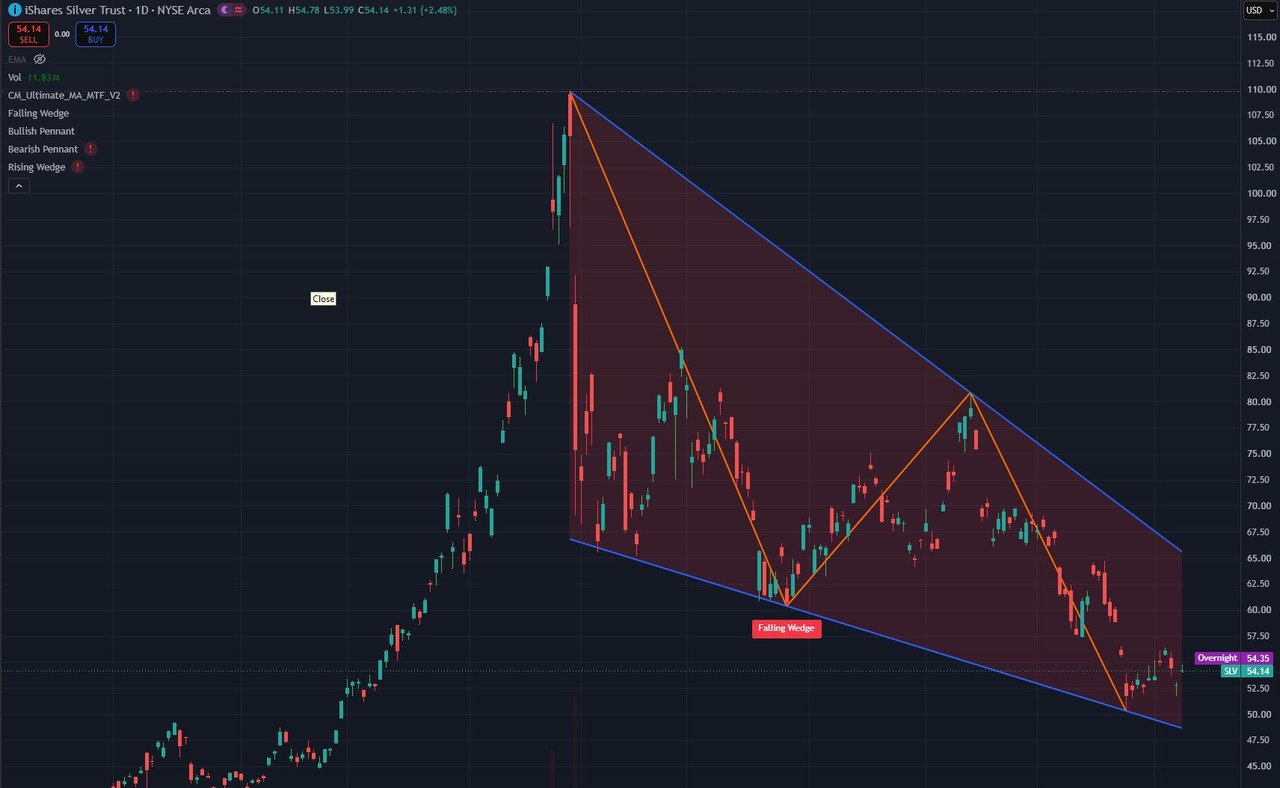
well Silver is in a downward wedgeAll this "Technical Analysis (TA)" is complete bullocks as has been proven time and time again.
Maybe those will drive the price of Reyna bucks up above $130 a pop.
Then all the chumps that invested in those grifts can finally sell their massive holdings.

ReynaBucks - if you were feeling REALLY stupid that morning.
The GaytorFloss is NOT a professional investment advisor, and shouldn’t be giving financial advice on the Interwebs.
He should stick to futures in Reyna cryptocurrency - stuff he’s Abel to talk about.
“and that’s why the silver pumpers are out in force, crying.”
I am sure you heard about Rosland Capital.
Another side to that is that Armstrong was one of their financial advisors. The same Armstrong that has a court order banning him providing financial advice.
This guy says some may go to jail.
https://youtu.be/2vk1J2dm2-w?is=qipNy1vD9TT8SDMA
You forgot to ping Bikkuri.
The 900Wh/L is the only thing this battery has over existing fast charge LFP cells.
CATL has demonstrated in a production car not just a beta 3 min and 40 seconds charging 10-80% and 6 min to 100%. With 9 min from 10% to 100% at minus 30C. They have this pack in a 1000km range EV.
Game set match there is no other tech needed.
Even smaller cheaper 500km packs with 3 min charging eliminates the case entirely for larger packs.
I personally didn’t own a car or SUV before 2005 that has a longer than 300 mile range every single one had 250 ish miles before the fuel light turned on. With 5 min fuel stops it is irrelevant that you need to stop once every 3-4 hours in the seat. Only my modern era hybrid and turbo cars crossed the 400 mile range mark and it still didn’t matter with 5 min refuel.
CATL 3 min packs could be 200 mile packs and that would be 3 hours in the seat before a 3 min top up. This is as irrelevant as the 5 min refuel in past suvs. The fact that it’s in a 1000km EV is vast overkill a 300km pack 1/3 the size would with 3 min charging reach any seat busting.distance per day. Fast DC chargers are every 50 miles down major highways in the USA and in China they are closer than that. The tech is 3-4 min chargers using their GB/T plug that can do 1200V at 1000amps today right now at the retail level that’s actually faster than a 3 min top up in a car sized pack that’s semi truck level charging in the mandatory break times in an 8 hour on duty period level fill ups. You legally cannot drive diesel or not without a mandatory break outside the cab in a solid 8 hour window and after 10 you must stop and rest for ten hours as well.
Disclaimer: Opinions posted on Free Republic are those of the individual posters and do not necessarily represent the opinion of Free Republic or its management. All materials posted herein are protected by copyright law and the exemption for fair use of copyrighted works.