Posted on 06/02/2026 8:04:42 AM PDT by ShadowAce
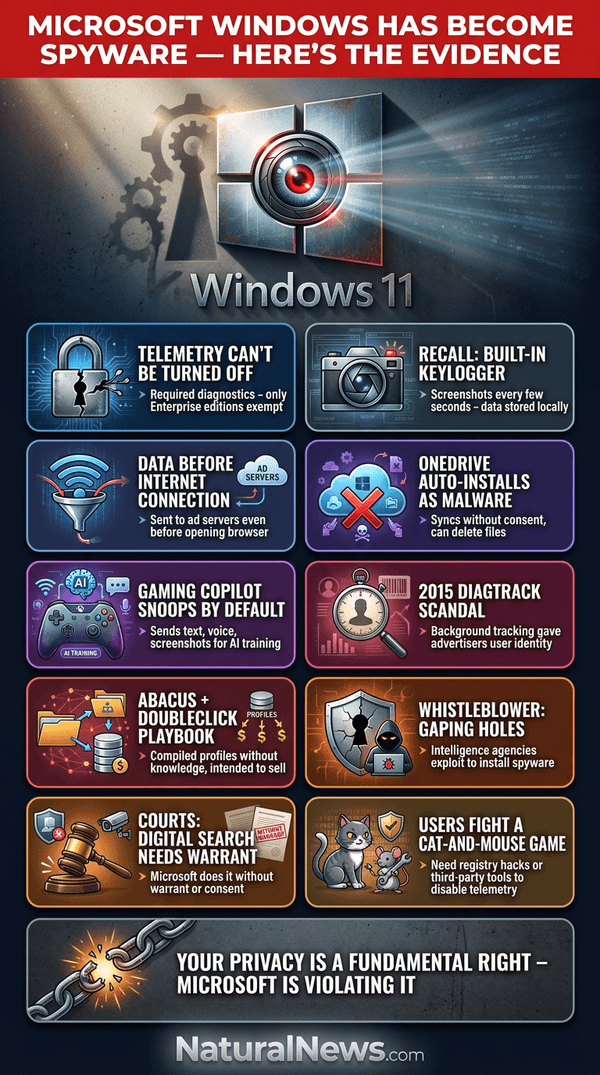
I have spent over two decades investigating corporate surveillance and the erosion of digital privacy. After years of watching Microsoft’s behavior, I believe Windows is no longer simply an operating system but a surveillance platform designed to extract data from every user. From telemetry that can’t be turned off to a built-in screenshot keylogger called Recall, Microsoft has made spying a core feature. Here’s why this matters: your privacy is not an inconvenience to be traded for convenience — it’s a fundamental right that Microsoft is systematically violating.
Back in 2015, I warned that Windows 10 was “the world’s first spyware OS” because it tracked and logged everything you do on your own computer [1]. Yet Microsoft has doubled down. They now gather diagnostics, browsing habits, location data, and even voice recordings in some cases — all under the guise of improving your experience. Courts have recognized that using sense-enhancing technology to peer into what we do is a search [2], yet Microsoft does it without a warrant, without your meaningful consent, and with opt-out options that are deliberately confusing.
The most egregious example is Windows Recall, a feature that takes screenshots every few seconds of everything you do — passwords, bank details, private conversations — and stores them locally by default. Even after Microsoft encrypted the data, the feature remains a massive security risk: any attacker who gets your unlocked PC can search your entire digital history. Critics rightly call it spyware — and I agree. A feature that records your every move without your knowledge is the definition of surveillance.
This is not just a privacy nuisance; it’s a gift to hackers. As a whistleblower once explained to me, major tech platforms have “gaping holes” that intelligence agencies exploit to install spyware on any computer [3]. By building a continuous screenshot recorder into Windows, Microsoft has handed a master key to every cybercriminal and three-letter agency. In my view, this is a frightening weakening of security in exchange for data collection, and it makes a mockery of Microsoft’s claims to care about user safety.
Experiments show Windows 11 sends data to Microsoft and third-party ad servers before you even open a browser or connect to the internet. You can disable optional diagnostics, but required telemetry remains, and only expensive Enterprise editions let you truly turn it off. In my view, this is not diagnostic data — it’s a blatant data grab. Microsoft uses its monopoly to force users into a surveillance system that generates revenue from advertising and AI training.
The data collection is reminiscent of the DiagTrack controversy from 2015, when Microsoft’s background tracking device raised concerns about privacy and allowed advertisers to obtain user identity information [4]. Little has changed since then. In fact, the model has grown more aggressive. As I’ve seen in my own research, the telemetry is designed to be impossible to fully disable without resorting to third-party tools or registry hacks — exactly the sort of cat-and-mouse game that spyware authors play.
OneDrive installs automatically, syncs files without explicit consent, and can delete or move your data — behavior that looks a lot like malware, not a helpful tool. Gaming Copilot sends your text, voice, and gameplay screenshots to Microsoft’s servers for AI training, enabled by default without asking. On the few Windows systems I run, I’ve removed OneDrive completely and disabled every AI training toggle. No user should have to fight their own OS to keep their data private.
This aggressive bundling mirrors the tactics used by adware companies. The merger of database marketer Abacus Direct with online ad company DoubleClick sparked a federal investigation when it was revealed that the company had compiled profiles of users without their knowledge and intended to sell them [5]. Microsoft is following the same playbook — collect everything, ask forgiveness later. And because Windows runs on billions of devices, they have an unparalleled pipeline into our personal lives.
Forced Microsoft accounts, advertising IDs, in-OS ads, and browsing history scraped for Start menu recommendations — it all points to one conclusion. Microsoft treats users as products, not customers. Privacy controls are opt-out, incomplete, and reserved for premium editions. We must demand better. Until then, I recommend using third-party debloat tools or switching to a privacy-respecting operating system like Linux.
As I’ve discussed with tech innovators like Zach Vorhies, the shift toward open-source solutions enhances security and transparency and provides users with greater sovereignty over their technology use [6]. The CrowdStrike incident that bricked millions of Windows servers showed how fragile and opaque the entire Windows ecosystem is [6]. I am now using Linux-based systems for my daily work, and I encourage others to explore alternatives like Above Phone’s de-Googled notebooks [7]. The most effective way to stop the spying is to simply stop using the spyware.
The screenshot capturing is to circumvent VPNs. If you see it on your screen - Microsoft and the Deep State sees it.
It’s not a bug! It’s a FEATURE!....................
This is news?
Why I migrated to Linux Mint and only use Win 10 offline for games and the now-rare stuff Linux can’t handle.
Life’s so much better now.
I had to go to Windows 10 from Windows 8. I liked 8 better. From what I hear, I would probably like Windows 11 even less. I was told that Linux...I would probably not care for, but what are the choices???
I highly recommend the site of “www.majorgeeks.com” for access to anything you might not realize you need on your computers/ could be anything from a RAM optimizer to Registry tools that can make your machine just how you want it. Fortunately for me I have been a steadfast ANTI-islam/ANTI-faggotry/dykes/crossdressers/Grateful to God above for being born in such a great Nation back in 61’.....I detest the thieves within any government position and call them out on it when I have the facts. I do not fear our government as our Republic is still the absolute best humans have done in forming a Nation to reside in.
My favorite Windows command is this:
The command rm -rf /* is an extremely destructive command in Unix/Linux operating systems. It forcefully and permanently deletes every file and directory on your system—including the operating system files themselves. Bill doesn’t get in the way.
Anyone who thinks Linux saves them from being surveilled 7x24x365 is deluded.
My windows has none of that stuff, and Natural News is not my go to source for computer security information.
oh well hopefully my new linux kernel 7.1.0-rc6 upgrade will finish compiling in a few more minutes.
This has become a major concern of mine. Will send. FReepmail.
Ummm, I think that ship sailed decades ago...
The needle in the haystack. Anonymity standing in plain sight among tens of millions...
“The most egregious example is Windows Recall”
It is opt-in.
“Microsoft Windows Has Become Spyware”
“HAS BECOME”? LOL!
Where ARE you ... Y2K?
Windows has been spyware for a long time.
What happens when you enter:
sudo rm -rf —no-preserve-root /
https://www.youtube.com/watch?v=nkPpwH2HTOU
That image is very appropriate for this discussion. Thanks for including it here.
Disclaimer: Opinions posted on Free Republic are those of the individual posters and do not necessarily represent the opinion of Free Republic or its management. All materials posted herein are protected by copyright law and the exemption for fair use of copyrighted works.