Posted on 05/09/2026 6:52:14 PM PDT by Red Badger
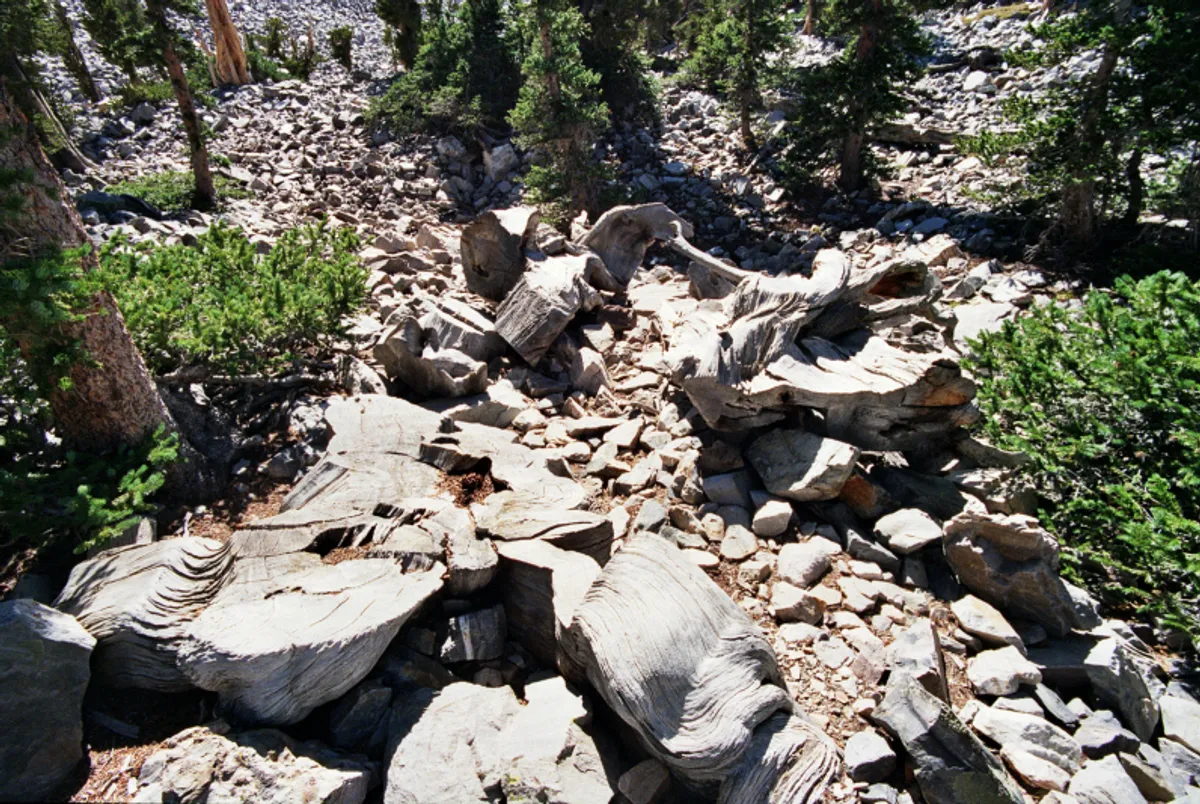
The tree, known as Prometheus, was cut down to study, with permission from the US Forest Service.
The stump of Prometheus in the Wheeler Bristlecone Pine Grove at Great Basin National Park, Nevada.
Image credit: James R Bouldin via Wikimedia Commons (public domain)
Science isn't always perfect; mistakes are made, occasionally to the detriment of one's subject. But what about inadvertently chopping down what would later turn out to be the world's oldest non-clonal tree?
That’s exactly what happened to an unfortunate graduate student named Donald R. Currey back in the summer of 1964, who ended up responsible for the demise of Prometheus, a bristlecone pine that stood in what is now Great Basin National Park, Nevada.
Bristlecone pines are some of the hardiest trees out there; they’re slow growing, with dense wood keeping them resistant to the effects of weather, insects, and fungi, and have a characteristically twisted appearance. One species in particular, the Great Basin bristlecone pine (Pinus longaeva) is capable of living for thousands of years.
After never having heard of bristlecone pines before graduate school, Currey took an interest in them after his mother sent him a National Geographic article written by Edmund Schulman, the researcher who famously sampled bristlecone pine Methuselah – which may now be the oldest known non-clonal tree in the world.
A geographer, Currey theorized that these trees could possibly be of use to his research in dating glacial features found below Great Basin’s Wheeler Peak, where he was carrying out fieldwork. The growth rings of trees can act as a record of the climate at the time they formed, which in turn can provide information about what glaciers were up to at the time, too. And when it comes to ancient trees like bristlecone pines, the information they contain can span a seriously long period of time.
To get this growth ring data requires using a borer to extract a roughly pencil-sized cylinder of wood from a tree, known as a core sample. Currey got permission from the US Forest Service to do exactly that on a group of bristlecone pines growing beneath Wheeler Peak, including one known to local mountaineers as Prometheus.
But when it came to this particular tree, Currey ran into a problem. In a 2001 NOVA documentary, the researcher said that it was particularly tricky to sample with the usual method. “The normal approach to coring the tree wasn't working because the largest available increment bores were too small to core even from several angles,” Currey explained.
And so, with further permission from the Forest Service, Prometheus was cut down, with a 30-centimeter (1-foot) thick cross-section taken from the felled tree.
Currey had already suspected that Prometheus was over 4,000 years old, but it was only when he sat down to count the rings later on that he realized what exactly he’d just chopped down.
“We could begin to see that we were getting over 4,000 years, over 4,500, over 4,600, which was the oldest record that had been reported in the literature up until that time,” said Currey. “And we ended around 4,900 years. And you've got to think, "I've got to have done something wrong. I better recount. I better recount again. I better look really carefully with higher magnification.”
But there was no mistake. Prometheus was an estimated 4,900 years old, and at that point, the oldest tree ever dated – and it was now dead. No one knew exactly how significant it was before it was cut down, of course, but we can imagine the slow realization of what happened was probably downright gut-wrenching regardless.
Now, all that remains of Prometheus in its original location is its stump, which looks rather inconspicuous amongst the surrounding, similarly colored rocks. Pop to the Great Basin Visitor Center, however, and you’ll be able to see a slab of the tree – and you can count the rings yourself.
Since then, we have new contenders for the world's oldest tree. As mentioned, Methuselah, another bristlecone pine, is thought to be around 4,789 years old. Great Grandfather, a giant cypress tree in Chile, is thought to be around 5,400 years old. However, Utah holds the record for one of the oldest living organisms in the world, with the sprawling lump of quaking aspen (Populus tremuloides) known as Pando – made up of a tangle of clones – that dates up to 80,000 years old.
An earlier version of this article was published in 2025.
That number would not surprise me. There’s hardly any protein in beef fat, though. It would take a lot of beef protein to keep muscles going.
Did you see the lumbering movie in the Pacific Northwest called “Train Dreams”? Interesting look at the life of timber crews back in that era. It’s about an “everyman” eking out a living, falling love, and tragedy.
Funny you mention that. The US Army has done a lot of physiological work and modeling to determine how much weight a soldier can carry, how far, food needs, etc. For example, see "Modeling the Metabolic Costs of Heavy Military Backpacking.
I'm working on preserving muscle mass in my 70s and shedding weight. So, when I hike with a pack in the mountains and hills, I'm interested in my calorie burn. I found the app I use ("MapMyRun") is wildly optimistic, so I started researching calorie burn models and found three: METs, American College of Sports Medicine (ACSM), and the Army's "Load Carriage Decision Aid (LCDA)." I started plugging my hike data into the models and getting much better numbers with pretty close agreement. Eventually, I used Grok, ChatGPT and Claude to write a program that does all the work for me.
Well stated!
I have visited the Methuselah tree in the Bristlecone Pine Forest that sits at 11,000 feet in elevation in the White Mountains above Bishop, California. Years ago, they removed its location from maps so it is no longer easy to find out of fear of people cutting souvenirs from the tree and killing it.
The Forest Service is a bunch of idiots who have managed to burn down a half a million acres of New Mexico in the last decade.
There are Alligator Junipers on the south slopes of the Sandia Mountains that have to be over 1000 years old.
Then there’s the Medallion Trees
https://www.newmexicomagazine.org/blog/post/sandia-mountains-medallion-trees-mystery/
I have dropped my intake to 2K calories and am at 182 lbs @ 5’ 11 1/2”.
I grew up in the sierra Nevadas (Tahoe) I loved visiting those trees when we would drive down to visit the family in SoCal. The drive is not for the feint of heart. I loved visiting those the high desert trees. If I am not mistaken they are the oldest living things on earth.
So, when God created the first Bristlecone Pine, how many rings did it have?
Same mind set. Perhaps a specially manufactured MRI could have solved the coreing problem and saved the tree.
Some people believe that every living thing has the life-spirit not found anywhere else in the known universe.
Believe those are redwoods. Sequoia had little commercial value except for matchsticks.
Not 10k The US Army determined “heavy exertion” needs 4,500 calories. Something like that. And when they classify “heavy” exertion, they know what they are talking about. The USDA 2000 calorie RDA is intended for moderately active individuals, most people can easily gain weight with those numbers, especially elderly or sedentary.
—
Except the military diet is no where near the activity level of the old time [ late 19th and early 20th century ] loggers, nor is the food they consumed anything like a modern diet the military estimate is based on.
If you had ever worked in the woods or been a commercial fisherman, you would know the truth of the 10k calories needed. Its not just the falling of the trees, its walking through heavy brush uphill carrying the saw, your food and water, for 10-12 hours a day, 6 days a week.
Go watch an episode of Timber Titans or The Last Woodman and spot the fat faller or Deadliest Catch and spot the fat deckhand.
Indeed money isn’t always perfect; mistakes are made.
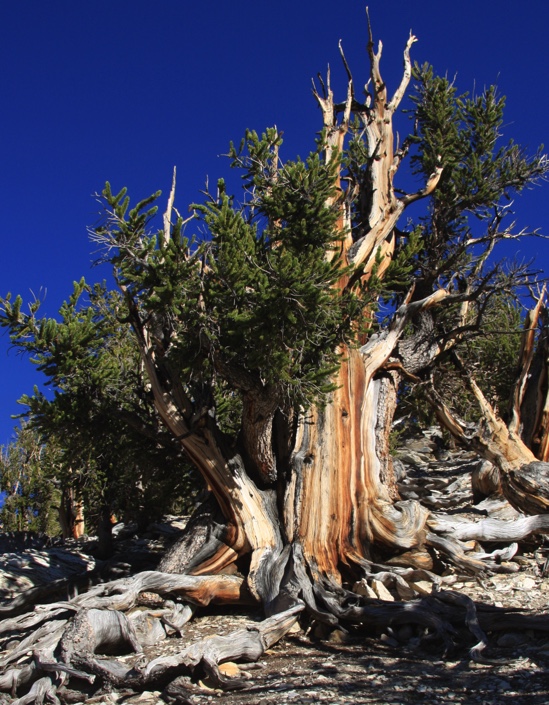
Prometheus before it was cut down.
Nope, those are definitely giant sequoia trees (Sequoiadendron giganteum). They were extensively harvested (logged) in the Sierra Nevada mountains of California.
Roughly one-third (about 34%) of the original giant sequoia acreage was logged. Some entire groves were nearly wiped out (e.g., Converse Basin became a “Big Stump” area with massive remnants). Logging was driven by demand for lumber.
But, as you wrote, the wood’s brittleness caused high waste—trees often shattered on impact, yielding as little as 50% usable timber for shingles, fence posts, grape stakes, etc.
Interestingly, Eucalyptus trees had the same problem. There were Eucalyptus plantations planted all over northern CA (the tree is native to Australia and was imported). It was the AI Boom of the time. But the wood was brittle and had little commercial value. The trees grew like weeds and area still all over the place.
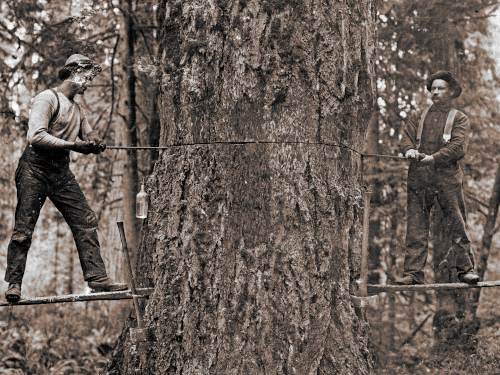
My Dad was sent from Alabama to Northern California to a CCC camp as a helper felling Sequoias. He and his buddies would make the springboards to allow the fellers to get high enough to cut through the trunk. They wore neckerchiefs like the Boy Scout uniforms.
That was a little less than 90 years ago.
A graduate student with federal government consent.
When an aspiring academic elite joins forces with fedgov, even the most entrenched, hardiest of organisms don't stand a chance.
For those who don't know what Higgmeister's dad did, here you go...


I worked in the Pacific Northwest a lot in the 70s and went to some Lumberjack Fairs. The first time I saw them scamper up a 90 ft pole, lop a couple inches off the top with a hand saw and get back on the ground -- in about 60 seconds! I was so blown away. Then watching the guys cut through a 12" diameter log with their axes in under 10 seconds! And the overhand axe throw to big bullseye targets. I'm still impressed over 50 years later!
My mom's family was in the lumber business in the 20s to 50s in Potlatch, Idaho and Fort Worth, Texas. My uncle in Fort Worth sold lumber for Weyerhaeuser. He really cleaned up in big tornado years!
Apparently so! Combining academic and government hubris leads to some strong stupidity.
Disclaimer: Opinions posted on Free Republic are those of the individual posters and do not necessarily represent the opinion of Free Republic or its management. All materials posted herein are protected by copyright law and the exemption for fair use of copyrighted works.