Skip to comments.
The Impact Crater Beneath Chicago; The Des Plaines Crater [4:32]
YouTube ^
| May 23, 2024
| GeologyHub
Posted on 05/08/2026 3:40:00 PM PDT by SunkenCiv
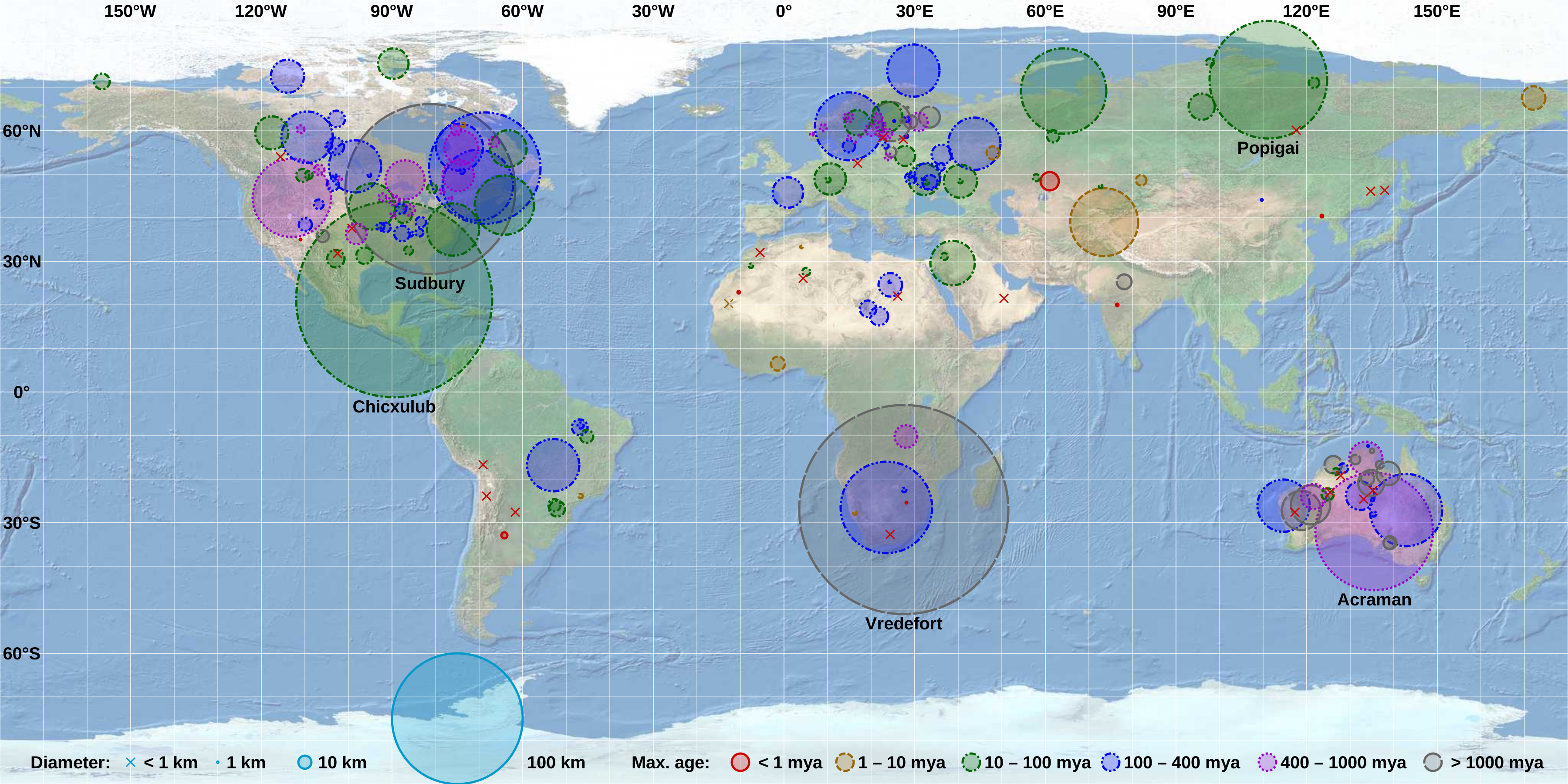
Beneath a section of Chicago, there is a hidden several mile wide impact crater. This might initially seem like a crazy claim but it is true, existing underneath the city of Des Plaines. The only reason it isn't highly visible today is due to sediments emplaced during extensive glaciers during the last 2 million years. It is for this reason that I will discuss when this crater formed, what evidence we have, and what immediate effects its formation had.
Thumbnail Photo Credit: Google Earth. This image was overlaid with text, and then overlaid with GeologyHub made graphics (the image border, the orange dotted buried impact crater outline, and the GeologyHub logo).
Estimates on asteroid diameter, velocity, tnt energy equivalent, frequency of a similar magnitude asteroid/comet impact event, and effects from the impact (including earthquake magnitude generated and wind speeds generated) in this video were sourced using the calculator at Earth Impact Effects Program, which was used with permission. The Impact Crater Beneath Chicago; The Des Plaines Crater | 4:32
GeologyHub | 392K subscribers | 44,468 views | May 23, 2024

(Excerpt) Read more at youtube.com ...
TOPICS: Astronomy; Science
KEYWORDS: catastrophism; chicago; desplaines; illinois; impact; permian; uranus
Navigation: use the links below to view more comments.
first 1-20, 21-22 next last
1
posted on
05/08/2026 3:40:00 PM PDT
by
SunkenCiv
To: 75thOVI; Abathar; agrace; aimhigh; Alice in Wonderland; AnalogReigns; AndrewC; aragorn; ...
2
posted on
05/08/2026 3:40:42 PM PDT
by
SunkenCiv
(TDS -- it's not just for DNC shills anymore -- oh, wait, yeah it is.)
Transcript
Chicago’s Impact Crater
Within Chicago, there exists a surprisingly large and mostly unknown geologic impact crater. I am not referring to downtown Chicago, but rather one of its suburbs towards the Northwest. There, just north of the O’Hare International Airport at the city of Deps, is the remnants of a 5-mile or 8 km wide impact crater. The only reason we cannot easily spot this feature today is that it was filled by glacial till during the recent ice siege when glaciers at the time stretched as far south as the city of Carbondale in far southern Illinois. As a result, over 2 million years, what may have been a fairly pristine crater was buried by between 50 and 250 ft thick of glacial till. While this complex impact crater likely originally had a circular shape, it is mapped as having an all blown and jagged profile due to this representing the location of noon fultz, the form of its greater rim edge in the impact-deformed bedrock below.
A Buried Crater
So, what evidence exists that proves this buried feature is an impact crater? For one, in its center, the bedrock is seemingly uplifted in a fairly circular shape, being about 800 ft higher than where it should be located. This marks a central peak, which is found in all Earth-based impact craters with a diameter of greater than 4 km or 2 1/2 miles. Also, in the largely soleran period bedrock, there are planer microact which have been found that indicate a high-pressure impact origin, which formed all the way back in what is today Chicago. It was the site of a lar sea. When you combine this with the shatter cones that have been found here in layers of limestone and Doone, it is clear-cut that the Do planes disturbance, as it was formerly called, is indeed an impact crater.
Crater Evidence
So, how old is this feature and how large was the asteroid which created it? For its age, we are currently unsure, although current evidence limits its age to being younger than the youngest bedrock, which is 280 million years old, and older than the glacial till that buries the crater, which is up to 2 million years old. Due to the level of erosion present, I would guess that this crater is on the older end of the spectrum, perhaps originating during the middle peran period around 265 million years ago.
Regardless of its exact timing, long ago there was an approximately 500 m or 1,640 ft asteroid on a collision course with Earth, likely knocked into a more variable orbit by an encounter with a larger asteroid. This asteroid had a low density and a composition similar to that of an El condrate. In other words, it was probably composed of grains of rock and dust that cemented together during the early solar system 4.5 billion years ago.
Impact Effects
As this 220 million metric ton asteroid began to approach Earth, it continued to accelerate, reaching a speed of 17 km/s or 38,000 mph. Entering our planet’s upper atmosphere, a bright strike of light would have become visible across the sky, causing many reptiles at the time to look up out of curiosity. Then, 10 seconds later, this asteroid impacted ancient Illinois, long before any Great Lakes existed, releasing a tremendous amount of energy equivalent to approximately double that of the world’s combined nuclear weapons detonating, AKA about 7,360 megatons of TNT.
As a bright fireball was created, any creature who witnessed it within a 50 m radius would have immediately suffered third-degree burns, while all trees ignited alone instantaneously, causing second-degree burns for any living thing within a radius of 62 miles. Simultaneously, the hard rock at the impact site was heated to such a degree that it temporarily acted like a liquid, quickly falling back into the crater to form a central pie.
As a several thousand mph shock wave raced outwards, it would flatten all trees and vegetation facing outwards from the blast in a radius of 75 miles. After the falling ejecta seized, what remained was a 5 m wide and 1,820 ft deep crater in the ground. While rare impacts of this size appear to occur on Earth about an average of once every 140,000 years.
3
posted on
05/08/2026 3:41:14 PM PDT
by
SunkenCiv
(TDS -- it's not just for DNC shills anymore -- oh, wait, yeah it is.)
To: SunkenCiv
4
posted on
05/08/2026 3:46:31 PM PDT
by
JZelle
To: SunkenCiv
5
posted on
05/08/2026 3:54:49 PM PDT
by
Paladin2
( YMMV)
To: SunkenCiv
265 million years ago? So they will have to do more research before they can blame it on the Republicans.
Only land animals at the time would have been reptiles and amphibians. But the female reptiles and amphibians would have suffered disparate impact.
To: SunkenCiv
“...a 5 m wide and 1,820 ft deep crater in the ground....”
Sounds small, but possibly large enough to hold The Mahdi....
7
posted on
05/08/2026 4:10:26 PM PDT
by
Paladin2
( YMMV)
To: SunkenCiv
8
posted on
05/08/2026 4:11:01 PM PDT
by
Paladin2
( YMMV)
To: Paladin2
9
posted on
05/08/2026 4:12:30 PM PDT
by
SunkenCiv
(TDS -- it's not just for DNC shills anymore -- oh, wait, yeah it is.)
To: SunkenCiv
10
posted on
05/08/2026 4:16:19 PM PDT
by
Paladin2
( YMMV)
To: SunkenCiv
... the city of Deps ... Is that anywhere near Homs or Kars?
The impact was so devastating that it darkened the skies for years and killed off the White Sox's hopes forever.
11
posted on
05/08/2026 4:26:19 PM PDT
by
x
To: SunkenCiv
There are many impact crater remnants on the Earth.
If not for atmosphere, erosion, ice ages, and plane tectonics, Earth would look like the Moon, or worse.
12
posted on
05/08/2026 4:38:10 PM PDT
by
AZJeep
(sane )
To: SunkenCiv
I lived in Des Plaines for about ten years. I had no idea, but this is the kind of stuff I like learning.
To: SunkenCiv
So that’s why Chicago is such a wasteland...an asteroid smashed a hole straight to hell and all the demons are leaking out.
14
posted on
05/08/2026 6:03:29 PM PDT
by
rottndog
(250 years...will we make it to 300?)
To: SunkenCiv
Rocks hitting the Earth hard enough to make a crater don’t happen very often. The earliest I can think of was 50,000 years ago in Arizona. On the Moon where only new craters erase old ones it is pretty obvious just how old Earth has to be.
15
posted on
05/08/2026 7:20:23 PM PDT
by
Nateman
(Democrats did not strive for fraud friendly voting merely to continue honest elections.)
To: x
Depp’s, right on 21 Jump St.
16
posted on
05/08/2026 8:07:34 PM PDT
by
SunkenCiv
(TDS -- it's not just for DNC shills anymore -- oh, wait, yeah it is.)
To: Southside_Chicago_Republican
It’s the first I’d heard of this one.
17
posted on
05/08/2026 8:08:16 PM PDT
by
SunkenCiv
(TDS -- it's not just for DNC shills anymore -- oh, wait, yeah it is.)
To: rottndog
It wasn’t just because of that. Most of the deterioration has happened since the gangster era.
18
posted on
05/08/2026 8:09:12 PM PDT
by
SunkenCiv
(TDS -- it's not just for DNC shills anymore -- oh, wait, yeah it is.)
To: Nateman
19
posted on
05/08/2026 8:11:13 PM PDT
by
SunkenCiv
(TDS -- it's not just for DNC shills anymore -- oh, wait, yeah it is.)
To: Nateman
20
posted on
05/08/2026 8:25:24 PM PDT
by
SunkenCiv
(TDS -- it's not just for DNC shills anymore -- oh, wait, yeah it is.)
Navigation: use the links below to view more comments.
first 1-20, 21-22 next last
Disclaimer:
Opinions posted on Free Republic are those of the individual
posters and do not necessarily represent the opinion of Free Republic or its
management. All materials posted herein are protected by copyright law and the
exemption for fair use of copyrighted works.
FreeRepublic.com is powered by software copyright 2000-2008 John Robinson