Skip to comments.
Considering the Louisiana Purchase, did the United States inherit slavery from France?
Grok ^
Posted on 05/07/2026 7:39:36 AM PDT by ProgressingAmerica
Yes, the United States effectively inherited the existing institution of slavery in the territory acquired through the Louisiana Purchase of 1803 from France (which had briefly reacquired it from Spain in 1800). The U.S. did not introduce slavery there as a new practice; it was already well-established under prior colonial rule, and the transfer preserved the property rights of slaveholders.
Historical Context of Slavery in the Louisiana Territory
* French origins: France introduced chattel slavery to the Louisiana colony starting in the early 1700s, importing enslaved Africans (beginning around 1710) to support plantation agriculture, alongside some raids on Native American groups for labor. The Code Noir (1685) regulated slavery in French colonies, outlining rules for treatment, manumission, and rights of free people of color.
* Spanish period (1762–1800): Spain continued and expanded the transatlantic slave trade in the territory. By the time of the Purchase, there was a significant population of enslaved Africans, especially in the lower Mississippi Valley (present-day Louisiana), along with free people of color. Spain had banned enslavement of Native Americans in 1769, but some mixed-descent individuals remained in bondage.
* Brief French return (1800–1803): Napoleon reacquired Louisiana from Spain via the secret Treaty of San Ildefonso but never fully reimposed control on a large scale. His broader plans for a New World empire (including using Louisiana to supply Saint-Domingue/Haiti) collapsed due to the successful Haitian Revolution (a massive slave rebellion that led to Haiti's independence in 1804) and disease among French troops. Napoleon restored slavery in other French colonies in 1802 but sold Louisiana before deeply reasserting it there.
At the time of the Purchase, slavery was a functioning economic and social institution in parts of the territory, particularly around New Orleans and agricultural areas. The Purchase doubled the size of the U.S. and brought in a diverse population that included thousands of enslaved people.
The Louisiana Purchase Treaty and Its Provisions
The 1803 treaty (signed April 30, 1803) made no direct mention of slavery or its abolition. Key relevant language came in Article III:
"The inhabitants of the ceded territory shall be incorporated in the Union of the United States and admitted as soon as possible according to the principles of the federal Constitution to the enjoyment of all these rights, advantages and immunities of citizens of the United States, and in the mean time they shall be maintained and protected in the free enjoyment of their liberty, property and the Religion which they profess."
In the legal and social context of the era, enslaved people were treated as property under colonial (and later U.S.) law. Protecting "property" rights thus meant the U.S. recognized and upheld existing claims to enslaved individuals. President Thomas Jefferson and Congress had no intention of ending slavery in the acquired lands; they focused on governance, citizenship for free inhabitants (including free people of color in some cases), and eventual statehood.
Early U.S. actions included:
* Temporary restrictions on importing new slaves into the Orleans Territory (except those brought by migrating owners), but these were quickly weakened or removed due to local opposition.
* The territory (later split into the Orleans and Louisiana Districts) adopted laws similar to those in southern U.S. states while incorporating some French/Spanish precedents. Slavery expanded significantly post-Purchase, fueled by the cotton gin, sugar plantations, and the domestic slave trade. New Orleans became a major slave-trading hub.
Broader Impacts
The Purchase did not "create" slavery in the region but integrated an existing slave society into the U.S., exacerbating sectional tensions over whether new states carved from the territory would allow slavery. This contributed to debates leading to the Missouri Compromise (1820), the expansion of the domestic slave trade, and ultimately tensions culminating in the American Civil War. Parts of the territory (e.g., future Missouri) already had some slaveholders; lower Louisiana had many more.
In short: The U.S. acquired a territory where slavery was a longstanding colonial practice under France (and Spain). By guaranteeing property rights and incorporating the inhabitants without disrupting the institution, the U.S. inherited and then expanded slavery there under American law and governance. The Haitian Revolution indirectly enabled the sale by derailing Napoleon's plans, creating an ironic link between the end of slavery in one former French colony and its reinforcement in another.
TOPICS: History
KEYWORDS: grok; jewhatingkeywrdtroll; jews; louisiana; no; nuts; slavery; sumerians
Navigation: use the links below to view more comments.
first 1-20, 21-40, 41-60, 61-80 ... 121-139 next last
We need to break the mindset we've been propagandized with that the U.S. originated this practice.
This was someone else's fault.
Slavery was France's Original Sin.
To: ProgressingAmerica
It was already well established in Virginia and Georgia. France had it, as well as Spain, though.
2
posted on
05/07/2026 7:44:26 AM PDT
by
Dr. Sivana
("Whatsoever he shall say to you, do ye." (John 2:5))
To: ProgressingAmerica
Google Admiral John Hawkins. He was important in the reign of Elizabeth the First and began the slave trade from Africa to the West Indies.
3
posted on
05/07/2026 7:44:36 AM PDT
by
Mercat
To: ProgressingAmerica
Slavery existed in the Thirteen Colonies.
4
posted on
05/07/2026 7:45:00 AM PDT
by
Kleon
To: Dr. Sivana
Virginia and Georgia were not acquisition points of the Louisiana Purchase.
5
posted on
05/07/2026 7:47:02 AM PDT
by
ProgressingAmerica
(The U.S. Constitution is not a suicide pact. Progressivism is a suicide pact.)
To: Mercat
where did he get the slaves from to trade?
To: ProgressingAmerica
--- "The U.S. did not introduce slavery there as a new practice."
Moreover, before the ACTUAL American revolution against Britain, the British loyalists were also among slave owners.
The attempt by the Left to make slavery into a Democrat talking point has been insidious and wholly unfounded. One finds easily:
"During the Civil War, the Republican Party was the anti-slavery party of the North, led by President Lincoln, while the Democratic Party was divided, with its Southern wing supporting secession and slavery, and its Northern wing opposing Republican war policies. Republicans championed a strong federal government, while Democrats largely favored states' rights."
For any and all who would find the following graphics somehow offensive, this graphic of a Democrat campaign ad in the Civil War era is found in the "America's Black Holocaust Museum" website.
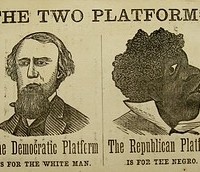
Source: The Republican Party Fought Slavery and Established Reconstruction
To: Jeff Vader
The Louisiana Purchase-I guess we’re in debt to Haiti. Napoleon needed the money to put down the Haitian rebellion so we got it cheap.
To: Kleon
Are you saying that slavery is The British Empire’s original sin?
It most certainly is NOT the United States’s - we can rule this one out completely.
9
posted on
05/07/2026 7:57:19 AM PDT
by
ProgressingAmerica
(The U.S. Constitution is not a suicide pact. Progressivism is a suicide pact.)
To: ProgressingAmerica
Virginia and Georgia were not acquisition points of the Louisiana Purchase.
I never said they were, only that slavery was well established in the original colonies and the fledgling states before the purchase. The fact that the Spanish, French, Dutch, and Portuguese colonies ALL made use of African slaves, with the eager cooperation of the African slave traders, shows that it was NOT a "peculiar" institution at the time. The Portuguese were the big dog in slave employment, making the U.S. look like a bunch of Quakers by comparison.
10
posted on
05/07/2026 7:58:48 AM PDT
by
Dr. Sivana
("Whatsoever he shall say to you, do ye." (John 2:5))
To: Worldtraveler once upon a time
“During the Civil War”
Oh.
My.
God.
Is everybody clueless as to the fact that there is a world that existed prior to the %#(%&^ Civil War????
Why is everybody so poisoned on this?
Is this CW poisoning the root cause as to why the left keeps winning this argument?
11
posted on
05/07/2026 7:59:06 AM PDT
by
ProgressingAmerica
(The U.S. Constitution is not a suicide pact. Progressivism is a suicide pact.)
To: ProgressingAmerica
It most certainly is NOT the United States’s - we can rule this one out completely. Well, it's not our original sin in the sense that we invented it, because we obviously didn't. On the other hand, it is a sin that was with us from the original moment of our founding.
To: ProgressingAmerica
Considering the Louisiana Purchase, did the United States inherit slavery from France? Your continuous efforts to absolve the United States from any complicity in slavery reminds me of the people who for decades maintained the Rosenbergs were innocent.
After the opening of the Soviet files in which it was revealed that "Yes, the Rosenbergs were spies", even the most hardcore advocates finally admitted the truth.
I don't think you are susceptible to any such solid proof regarding your desire to separate the US from slavery.
I can't speak for others, but to me it comes across as a little obsessive.
But good luck to you.
13
posted on
05/07/2026 8:04:07 AM PDT
by
DiogenesLamp
("of parents owing allegiance to no other sovereignty.")
To: Dr. Sivana
“I never said they were, only that slavery was well established in the original colonies and the fledgling states before the purchase.”
This is a classic non-sequitor.
I have news for you. The Louisiana Purchase was (shocker) new land. New land for the United States - which it did not previously hold.
So, since this was new land, we are presented with a few options.
One of those options is that immediately all of the American slavers were so eager to buy this land and bring their slaves to this clean pristine land because it never existed with the institution before and was never upheld by previous empires before.
Since that one cannot be true, it must be true that slavery was already there and it must be true that the U.S. inherited slavery on that land from the previous empire.
In this case. The French Empire.
All of the facts check out. The U.S. inherited slavery through the Louisiana Purchase on that particular set(s) of land which were purchased.
You do not have to complicate this.
“shows that it was NOT a “peculiar” institution at the time”
That is fair.
14
posted on
05/07/2026 8:05:27 AM PDT
by
ProgressingAmerica
(The U.S. Constitution is not a suicide pact. Progressivism is a suicide pact.)
To: Worldtraveler once upon a time
"During the Civil War, the Republican Party was the anti-slavery party of the North, led by President Lincoln, Would you say these Northern Republicans were conservative or liberal?
And what sort of people live in these Northern Republican strongholds now?
15
posted on
05/07/2026 8:06:26 AM PDT
by
DiogenesLamp
("of parents owing allegiance to no other sovereignty.")
To: ProgressingAmerica
OMG?
Slavery has existed across the great span of history. OMG. Moreover, the Israelite flight from Egyptian bondage was a seminal tale in the many historical tales of peoples take into captivity. OMG. Moreover, the entire swath of Islamic slave trading, long before the British, Dutch and Portuguese made it a business for this fledgling nation, is easily documented. Centuries of it, and grounded in the idiotic Koran itself. OMG. Why is "everybody clueless...?" OMG. Not everybody is.
--- "Is this CW poisoning the root cause as to why the left keeps winning this argument?"
No. It is because they lie. And then lie some more.
Besides, "free stuff" socialism is the lure of "liberals" worldwide, of which "reparations" are a subset.
---- "Why is everybody so poisoned on this?"
No idea why you addressed this question to me. Think me "poisoned?" See paragraph two above.
To: DiogenesLamp
If you can tell me how the United States is responsible for slavery in the year 1802 or any year prior in French controlled territory I need to hear it.
"Your continuous efforts to absolve the United States from any complicity in slavery"
Your continuous efforts to absolve the United States from any complicity in abolitionism reminds me of the people from The New York Times 1619 Project.
So we can be even on that.
You have facts you cannot account for just as all the same leftists cannot account for these facts.
I will continue to exploit those facts. It's not my fault you side with the left and either are unfairly caught in the middle or you are complicit. Either way I do not care. If you want to stop getting caught in the middle, stop siding with the left. Or even better, put an end to your complicity with the left.
America invented abolitionism, not slavery. It will always be there. It will never go away.
17
posted on
05/07/2026 8:12:00 AM PDT
by
ProgressingAmerica
(The U.S. Constitution is not a suicide pact. Progressivism is a suicide pact.)
To: ProgressingAmerica
We’d already decided to go back on our founding statement and keep slavery by the time the Louisiana Purchase happened. We didn’t create it, but the western world was already starting to consider it a problem. And we had the audacity to declare it was a self evident truth that all men are created equal. Except in some states. Whining about who started what when is just playing the distraction game. We knew it was wrong, but we did it anyway.
18
posted on
05/07/2026 8:12:56 AM PDT
by
discostu
(like a dog being shown a card trick)
To: DiogenesLamp
---- "Would you say these Northern Republicans were conservative or liberal?"
I wouldn't use today's bumbling and inexact terms for that time in our history.
--- "And what sort of people live in these Northern Republican strongholds now?"
What "Northern Republican strongholds?"
To: Dr. Sivana
More whites were slaves than blacks in the original colonies.
What is this? Someone trying to blame France for US slavery? Trying to disguise the fact that slavery was everywhere and had nothing to do with Africa?
Trying to tie property rights to slavery— gimme a F@#$in break! This is commie trash bait&switch — condeming property rights by tying it to owning people.
20
posted on
05/07/2026 8:16:05 AM PDT
by
bobbo666
Navigation: use the links below to view more comments.
first 1-20, 21-40, 41-60, 61-80 ... 121-139 next last
Disclaimer:
Opinions posted on Free Republic are those of the individual
posters and do not necessarily represent the opinion of Free Republic or its
management. All materials posted herein are protected by copyright law and the
exemption for fair use of copyrighted works.
FreeRepublic.com is powered by software copyright 2000-2008 John Robinson