Posted on 04/27/2026 12:04:14 PM PDT by MtnClimber
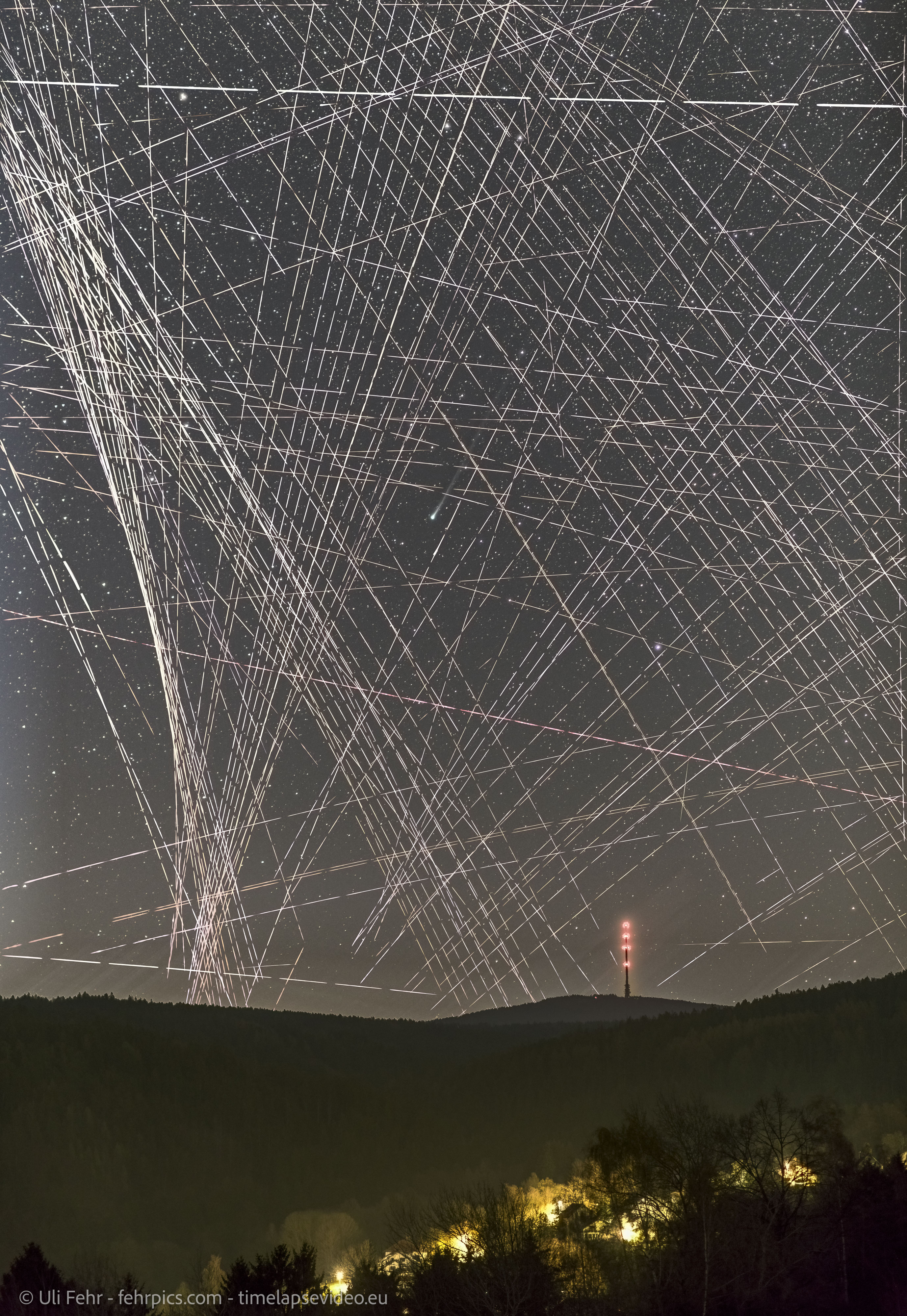
Explanation: Can you find the comet? Somewhere through this web of satellite trails is Comet C/2025 R3 (PanSTARRS), a bright visitor passing through the inner Solar System. Now, the orbiting satellites themselves only appear as streaks because of the long camera exposure, over 10 minutes in this case. On the contrary, to the eye, satellites appear as points that drift slowly across the night sky and shine by reflecting sunlight -- primarily just after sunset and before sunrise. The featured image was taken just before sunrise two weeks ago from Bavaria, Germany. Presently, Comet R3 PanSTARRS is hard to see for even another reason -- because it is so (angularly) close to the Sun. As the comet rounds the Sun, it will be best seen in coming weeks from southern hemispheree skies, although then it will be heading out to interstellar space and fading. If you haven't yet found the comet, don't despair; please take a closer look just above the image center.
For more detail go to the link and click on the image for a high definition image. You can then move the magnifying glass cursor then click to zoom in and click again to zoom out. When zoomed in you can scan by moving the side bars on the bottom and right side of the image.
🪐 🌟 🌌 🍔
Wow.
Interstellar space?
L
Everything that is not inside a star is inside interstellar space. It is a wacky statement, but technically true.
Let’s see the autopilot navigate through that!

The Vera Rubin telescope was finished recently . It collects massive amounts of detailed data from the sky. This is the kind of noise this amazing telescope has to deal with!
This is a cause for concern, not just for us ground based amateur astronomers, but radio astronomers as well. And what about launching spacecraft thru that mess?
STILL, it’s an incredible picture.
Disclaimer: Opinions posted on Free Republic are those of the individual posters and do not necessarily represent the opinion of Free Republic or its management. All materials posted herein are protected by copyright law and the exemption for fair use of copyrighted works.