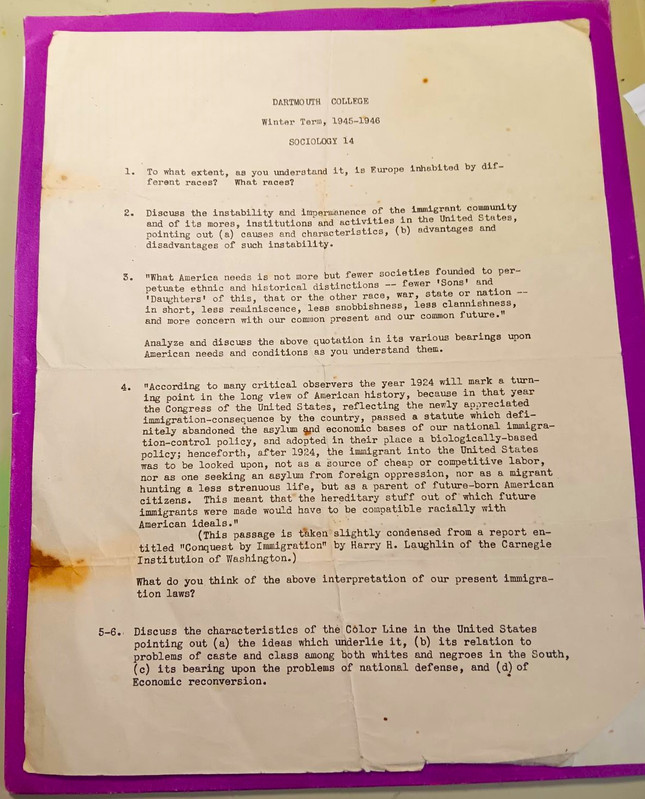
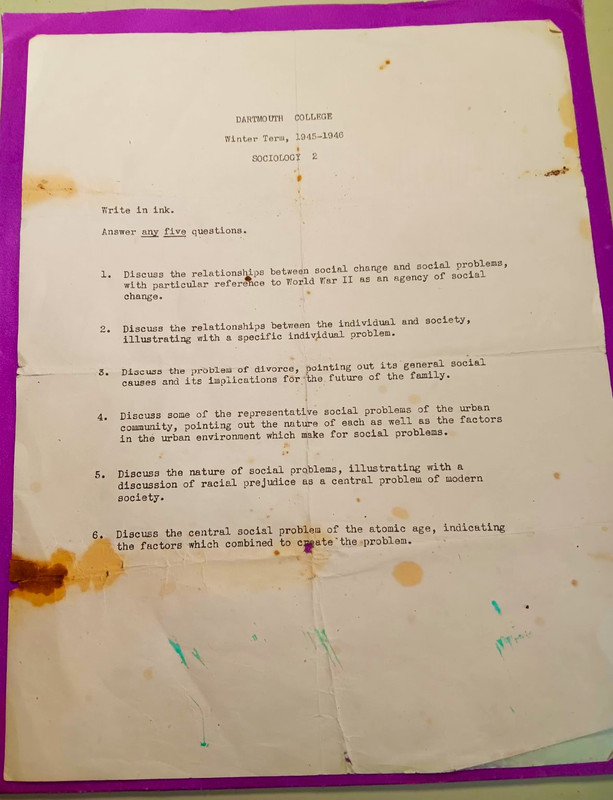
Posted on 04/17/2026 8:03:45 AM PDT by MomwithHope
It's been ages since I started a thread. These two pages seemed worthy of a read and discussion for those who might be interested. They are from family archives, an assignment in Sociology for the winter term 1944-1945 at Dartmouth College. Just discovered. They address many of the topics that are being discussed today.
Link?
https://soc.appstate.edu/students/student-writing-guide/common-paper-assignments
Good find and the education our parents got. My folks never got past 5th grade the the basics they had were amazing.
DARTMOUTH COLLEGE
Winter Term, 1945–1946
SOCIOLOGY 14
To what extent, as you understand it, is Europe inhabited by different races? What races?
Discuss the instability and impermanence of the immigrant community and of its mores, institutions and activities in the United States, pointing out (a) causes and characteristics, (b) advantages and disadvantages of such instability.
“What America needs is not more but fewer societies founded to perpetuate ethnic and historical distinctions — fewer ‘Sons’ and ‘Daughters’ of this, that or the other race, war, state or nation — in short, less remoteness, less snobbishness, less clannishness, and more concern with our common present and our common future.”
Analyze and discuss the above quotation in its various bearings upon American needs and conditions as you understand them.
“According to many critical observers, the year 1924 will mark a turning point in the long view of American history, because in that year the Congress of the United States, reflecting the newly appreciated immigrant-consequence of the country, passed a statute which definitely abandoned the asylum and economic bases of our national immigration-control policy, and adopted in their place a biological-based policy; henceforth, after 1924, the immigrant into the United States was to be looked upon, not as a source of cheap or competitive labor, nor as one seeking asylum from foreign oppression, nor as a migrant hunting a less strenuous life, but as a parent future-born American citizens. This meant that the hereditary stuff out of which immigrants are made would have to be compatible racially with American ideals.”
(This passage is taken slightly condensed from a report entitled “Conquest by Immigration” by Harry H. Laughlin of the Carnegie Institution of Washington.)
What do you think of the above interpretation of our present immigration laws?
5–6. Discuss the characteristics of the Color Line in the United States pointing out (a) the ideas which underlie it, (b) its relation to the problem of caste and class among both whites and negroes in the South, (c) its bearing upon the problems of national defense, and (d) of Economic reconversion.
DARTMOUTH COLLEGE
Winter Term, 1945–1946
SOCIOLOGY 2
Write in ink.
Answer any five questions.
Discuss the relationships between social change and social problems, with particular reference to World War II as an agency of social change.
Discuss the relationships between the individual and society, illustrating with a specific individual problem.
Discuss the problem of divorce, pointing out its general social causes and its implications for the future of the family.
Discuss some of the representative social problems of the urban community, pointing out the nature of each as well as the factors in the urban environment which make for social problems.
Discuss the nature of social problems, illustrating with a discussion of racial prejudice as a central problem of modern society.
Discuss the central social problem of the atomic age, indicating the factors which combined to create the problem.
I never asked my paternal grandma how far she went in school. She was a typical Russian born in the Ukraine. Left after the Communist “revolution” because the Commies were so uncivilized. Went to China. Met my Belgian grandfather there. There they lived like Europeans in the European community until the Japanese invaded in 1939 and sent them to a concentration camp because they came from countries on the wrong side. Their Czechoslovakian neighbors did not have to report.
If you like spy shows, this one is excellent.
“1924 turning point” refers to The Immigration Act of 1924 (The Johnson-Reed Act). It limited the number of immigrants allowed entry into the United States through a national origins quota. The quota provided immigration visas to two percent of the total number of people of each nationality in the United States as of the 1890 national census. It completely excluded immigrants from Asia.
An extremely sensible policy for national united and domestic peace
in 2026 - America’s woke elites want to allow absolutely no debate on this topic. They will simply tar it with the broad brush of “racist”
Interesting. No sociology professor would ask such questions today. The questions themselves would be considered “racist” and the students would not be allowed to give any analysis that contradicted the globalist narrative.
“1924 turning point” refers to The Immigration Act of 1924 (The Johnson-Reed Act). It limited the number of immigrants allowed entry into the United States through a national origins quota. The quota provided immigration visas to two percent of the total number of people of each nationality in the United States as of the 1890 national census. It completely excluded immigrants from Asia.
And it ultimately led to Pearl Harbor. The Japs took it as an insult, and it gave credence to those who always saw the US as Japan’s enemy.
Just remember, Grok will give you a 2026 answer, colored by its 2026 programmers and 2026 internet data upon which it "learned."
colored by its 2026 programmers
With compassion and vision!
That's a stretch. That's painting the Japanese of the 1920s and 1930s as globalist woke warriors, aggrieved by Western Racism. Not true.
In fact, Japan was very busy building its own empire, based very much on the notion of Japanese racial supremacy, particularly over Koreans and Chinese.
They were however Allies in WWI and were upset that they felt slighted in the their share of the spoils, not unlike Italy.
But all you have to do is read the Japanese newspapers of that era, to see how the mood changed overnight. Japan was technically still a democracy then, and the militarists were on the outside looking in. But this started a shift in their direction.
Today's leading essay topics in sociology departments:
1. Describe and discuss the ways in which white people oppress blacks and other non-white peoples.
2. Describe and discuss the way in which white heterosexual men oppress women and homosexuals.
Good find and the education our parents got. My folks never got past 5th grade the the basics they had were amazing.
Everybody talks about how great it is that ever increasing proportions of the US population attend and graduate from college. All that means is that curricula from elementary school through college have been dumbed down to the point of being meaningless, i.e. high schools are teaching basic elementary school reading skills, colleges are picking up the slack on what middle and high school should have taught. So today's college degree is often roughly equivalent to a high school degree from 40-50 years ago.
The American Home Front During World War II: The Economy
There was social pressure during the war for people to show their patriotism . Some displayed service flags and Victory Home decals and wore ...
nps.gov
Overview | The Post War United States, 1945 to 1968
Public policy, like the so-called GI Bill of Rights passed in 1944 , provided money for veterans to attend college, to purchase homes, and to buy farms. The ...
loc.gov
Postwar Politics and the Cold War
The late summer of 1945 marked the height of American power. The country that had suffered from dust bowls, economic depression, and a devastating attack on ...
gilderlehrman.org
The Post World War II Boom: How America Got Into Gear
By the summer of 1945, Americans had been living under war time rationing policies for more than three years, including limits on such common ...
history.com
United States home front during World War II
Peacetime conflicts concerning race and labor took on a special dimension because of the pressure for national unity. The Hollywood film industry was important ...
en.wikipedia.org
1945–1952: The Early Cold War The United States emerged from World War II as one of the foremost economic, political, and military powers in the world.
history.state.gov
The Cost of Victory
As the costs of victory came into devastating focus, the diplomatic responses, rising global tensions between the United States and the Soviet Union, and social ...
nationalww2museum.org
The Challenges of Peacetime | United States History II
In December 1944 , Franklin Roosevelt had declared an end to the forced relocation of Japanese Americans, and as of January 1945 , they were free to return to ...
courses.lumenlearning.com
Post-War Era
Nearly a third of Americans lived in poverty . A third of the country's homes had no running water, two-fifths lacked flushing toilets, and three-fifths lacked ...
digitalhistory.uh.edu
Disclaimer: Opinions posted on Free Republic are those of the individual posters and do not necessarily represent the opinion of Free Republic or its management. All materials posted herein are protected by copyright law and the exemption for fair use of copyrighted works.