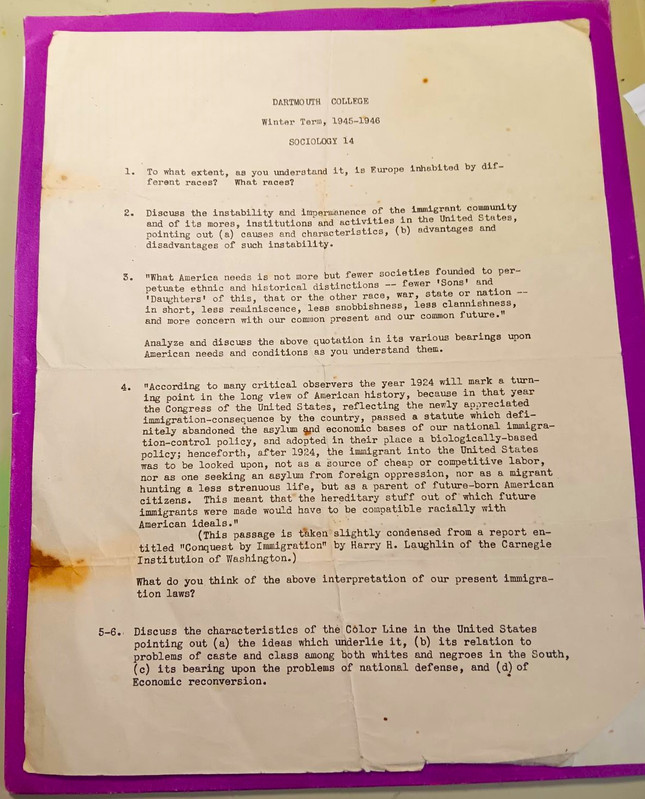
DARTMOUTH COLLEGE
Winter Term, 1945–1946
SOCIOLOGY 14
To what extent, as you understand it, is Europe inhabited by different races? What races?
Discuss the instability and impermanence of the immigrant community and of its mores, institutions and activities in the United States, pointing out (a) causes and characteristics, (b) advantages and disadvantages of such instability.
“What America needs is not more but fewer societies founded to perpetuate ethnic and historical distinctions — fewer ‘Sons’ and ‘Daughters’ of this, that or the other race, war, state or nation — in short, less remoteness, less snobbishness, less clannishness, and more concern with our common present and our common future.”
Analyze and discuss the above quotation in its various bearings upon American needs and conditions as you understand them.
“According to many critical observers, the year 1924 will mark a turning point in the long view of American history, because in that year the Congress of the United States, reflecting the newly appreciated immigrant-consequence of the country, passed a statute which definitely abandoned the asylum and economic bases of our national immigration-control policy, and adopted in their place a biological-based policy; henceforth, after 1924, the immigrant into the United States was to be looked upon, not as a source of cheap or competitive labor, nor as one seeking asylum from foreign oppression, nor as a migrant hunting a less strenuous life, but as a parent future-born American citizens. This meant that the hereditary stuff out of which immigrants are made would have to be compatible racially with American ideals.”
(This passage is taken slightly condensed from a report entitled “Conquest by Immigration” by Harry H. Laughlin of the Carnegie Institution of Washington.)
What do you think of the above interpretation of our present immigration laws?
5–6. Discuss the characteristics of the Color Line in the United States pointing out (a) the ideas which underlie it, (b) its relation to the problem of caste and class among both whites and negroes in the South, (c) its bearing upon the problems of national defense, and (d) of Economic reconversion.
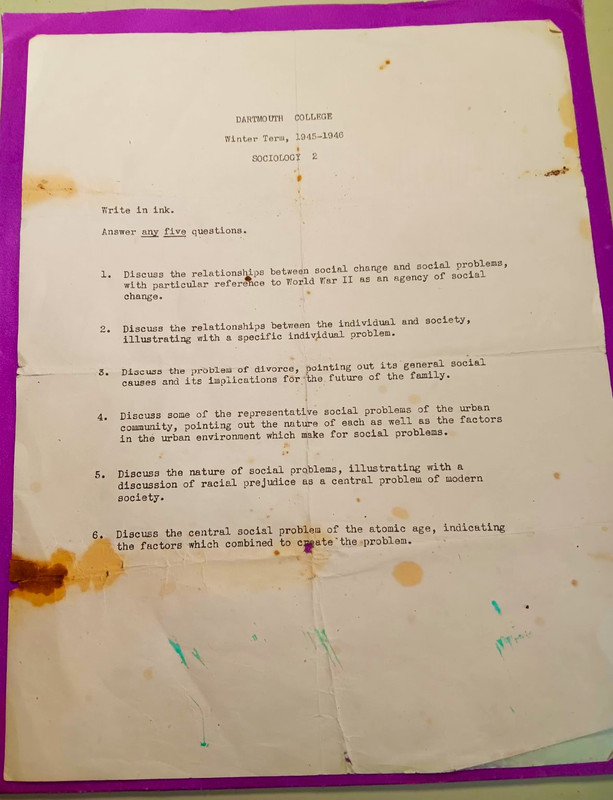
DARTMOUTH COLLEGE
Winter Term, 1945–1946
SOCIOLOGY 2
Write in ink.
Answer any five questions.
Discuss the relationships between social change and social problems, with particular reference to World War II as an agency of social change.
Discuss the relationships between the individual and society, illustrating with a specific individual problem.
Discuss the problem of divorce, pointing out its general social causes and its implications for the future of the family.
Discuss some of the representative social problems of the urban community, pointing out the nature of each as well as the factors in the urban environment which make for social problems.
Discuss the nature of social problems, illustrating with a discussion of racial prejudice as a central problem of modern society.
Discuss the central social problem of the atomic age, indicating the factors which combined to create the problem.
If you like spy shows, this one is excellent.
Interesting. No sociology professor would ask such questions today. The questions themselves would be considered “racist” and the students would not be allowed to give any analysis that contradicted the globalist narrative.