Posted on 04/15/2026 12:43:57 PM PDT by MtnClimber
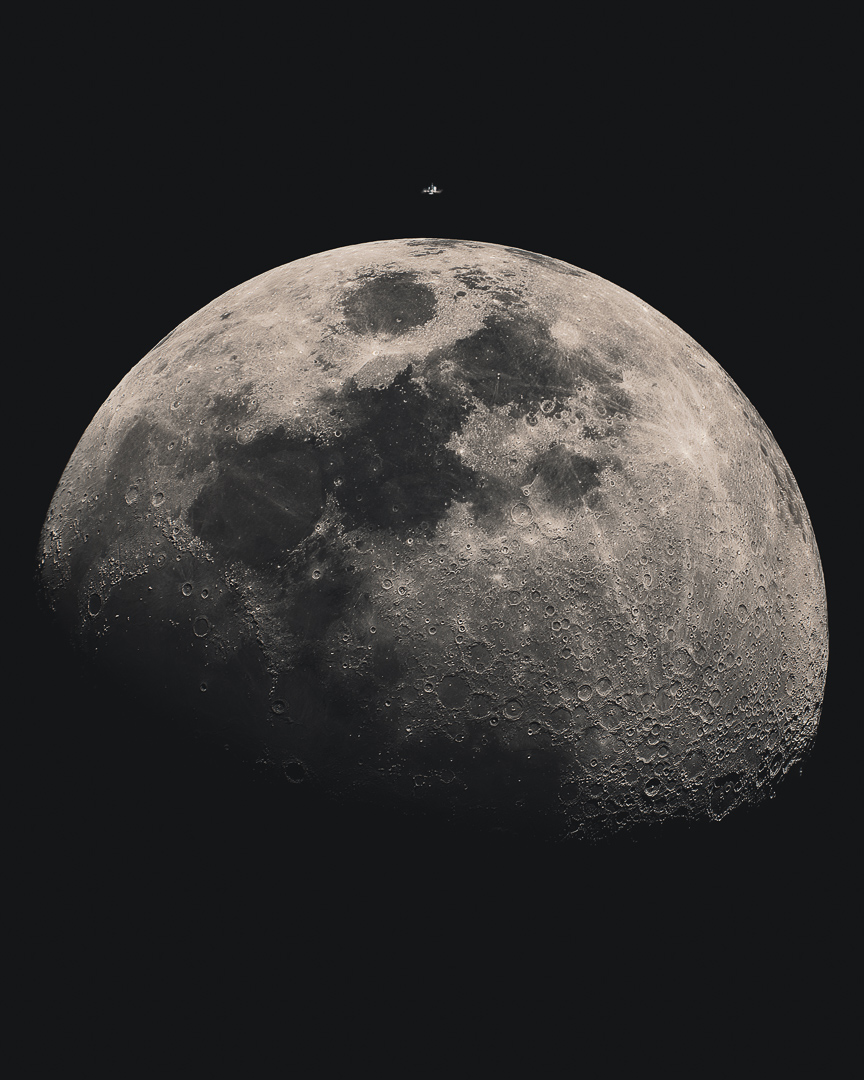
Explanation: Nope, that is not an alien spaceship landing on the Moon! This is an image of the International Space Station (ISS) as it begins to transit in front of the Moon. The ISS is in low-Earth orbit (LEO) where it wizzes around the Earth every 90 minutes. Orbiting the Earth 16 times per day for 25 years, the ISS has photobombed many familiar celestial objects including Venus, Mars, Saturn, and the Sun. Thousands of experiments led by researchers from over one hundred countries have been conducted on the ISS. Growing protein crystals in low gravity was one of the first experiments onboard the ISS and continues to contribute to new medical treatments. ISS astronauts study plant growth, water recycling, human health, and more to support the Artemis missions which will take humans farther than they’ve ever gone before. Next time you are out and about at night, try to spot the ISS zooming across the sky!
For more detail go to the link and click on the image for a high definition image. You can then move the magnifying glass cursor then click to zoom in and click again to zoom out. When zoomed in you can scan by moving the side bars on the bottom and right side of the image.
🪐 🌟 🌌 🍔
Wow.
man that moon has been pelted over the years aye!?? sure would like to have seen a few impacts at that resolution!!
The zone on the lower right. is someone savvy enough to know from the light direction if the side that is heavily cratered, is that what would be the leading side of the moon in its orbit around the earth. It would seem logical that it is, being most of the craters are on that side.
What say you??
SHADO will take care of this.
Looking at photos of phases of the moon it looks like the N/S axis goes from the top-left of the photo to the bottom right. The moon is tidal-locked to the earth so the same side always faces Earth. The greatest velocity is the Earth and Moon orbit around the Sun, so the direction that would tend to have more impacts due to velocity changes as the moon orbits earth. The same side is not always in the direction of motion around the sun. The heavily cratered area is in the southern hemisphere of the moon. It is possible that the gravitational forces cause more tectonic activity around the equator of the Moon which could cause craters to erode more quickly there than at the north or south polar regions.
Coolest show ever
Nice!
It looks like the ISS station beat the Artemis to the moon....
Disclaimer: Opinions posted on Free Republic are those of the individual posters and do not necessarily represent the opinion of Free Republic or its management. All materials posted herein are protected by copyright law and the exemption for fair use of copyrighted works.