Skip to comments.
Was the Battle of Mount Badon at Liddington Castle? [7:43]
YouTube ^
| April 7, 2026
| Caleb Howells
Posted on 04/08/2026 12:04:27 AM PDT by SunkenCiv
One popular theory about the location of the Battle of Badon is that it took place at Liddington Castle. Does the evidence really support this theory?
Caleb Howells examines the geographical and archaeological evidence surrounding Liddington Castle as a potential location for this historic clash. By analyzing place-name etymology and existing scholarly arguments, the investigation weighs the strategic suitability of the site against the lack of physical habitation remains from the period and conflicting traditional accounts. Was the Battle of Mount Badon at Liddington Castle? | 7:43
Caleb Howells | 12.8K subscribers | 1,382 views | April 7, 2026

(Excerpt) Read more at youtube.com ...
TOPICS: History; Science; Travel
KEYWORDS: godsgravesglyphs; kingarthur; liddingtoncastle; mountbadon
1
posted on
04/08/2026 12:04:27 AM PDT
by
SunkenCiv
In Welsh legend and texts, Ambrosius appears as Emrys Wledig (Emperor Ambrose). The term "Wledig" is a title used by notable royal and military commanders. It is mostly used for famous figures such as Cunedda, and the Roman emperor Magnus Maximus ("Macsen Wledig") when he appears in Welsh folklore... Bede follows Gildas's account of Ambrosius in his Ecclesiastical History of the English People, but in his Chronica Majora he dates Ambrosius's victory to the reign of the Emperor Zeno (474–491).Ambrosius Aurelianus | Wikipedia
2
posted on
04/08/2026 12:06:19 AM PDT
by
SunkenCiv
(TDS -- it's not just for DNC shills anymore -- oh, wait, yeah it is.)
Zeno (/ˈziːnoʊ/; Ancient Greek: Ζήνων, romanized: Zēnōn; c. 425 – 9 April 491) was Eastern Roman emperor from 474 to 475 and again from 476 to 491. His reign was plagued by domestic revolts and religious dissension, but was more successful on the foreign front. He is credited with further stabilizing the Eastern empire, while the Western Roman Empire fell following the deposition of Romulus Augustulus.Zeno | Wikipedia
3
posted on
04/08/2026 12:06:39 AM PDT
by
SunkenCiv
(TDS -- it's not just for DNC shills anymore -- oh, wait, yeah it is.)
Magnus Maximus (Classical Latin: [ˈmaːgnus ˈmaːksimus]; died 28 August 388 was Roman emperor in the West from 383 to 388. He usurped the throne from emperor Gratian.
Born in Gallaecia, he served as an officer in Britain under Theodosius the Elder during the Great Conspiracy. In 383, he was proclaimed emperor in Britannia, and in Gaul the next year, while Gratian's brother Valentinian II retained Italy, Pannonia, Hispania, and Africa. In 387, Maximus's ambitions led him to invade Italy, resulting in his defeat by Theodosius I at the Battle of Poetovio in 388. In the view of some historians, his death marked the end of direct imperial presence in Northern Gaul and Britannia. ...
The medieval English king Edward I was influenced by the legendary dream of Macsen Wledig/Magnus Maximus. In the dream Maximus had seen a fort, "the fairest that man ever saw", within a city at the mouth of a river in a mountainous country and opposite an island. Edward interpreted this to mean Segontium was the city of Maximus's dream and drew on the imperial link when building Caernarfon Castle in 1283.[46] It was apparently believed that Maximus died in Wales. According to the Flores Historiarum, during the construction of the Castle and the nearby planned town, the body believed to be of Magnus Maximus was discovered entombed; King Edward ordered its reburial in a local church.Magnus Maximus | Wikipedia
4
posted on
04/08/2026 12:07:19 AM PDT
by
SunkenCiv
(TDS -- it's not just for DNC shills anymore -- oh, wait, yeah it is.)
Excavations at Tinnis Fort, which overlooks Merlin's Grave, revealed that this prominent hillfort was occupied around the late sixth and early seventh centuries AD, precisely when the story is set. The fort bears the hallmarks of a lordly stronghold from that time.
Further excavations at the Thirlestane Barrows, across the Tweed, discovered that between the late third and late sixth centuries AD, a square barrow was constructed over the graves of two individuals of exceptional elite status.Uncovering Merlin's Scottish Legacy: New Archaeological Findings at Drumelzier | Medievalists
5
posted on
04/08/2026 12:08:10 AM PDT
by
SunkenCiv
(TDS -- it's not just for DNC shills anymore -- oh, wait, yeah it is.)
Buile Shuibhne (Irish pronunciation: [ˈbˠɪlʲə ˈhɪvʲnʲə], BWILL-uh HIV-n'yuh, The Madness of Suibhne, The Madness of Sweeney, Sweeney Astray or Suibhne's Frenzy) is a medieval Irish tale about Suibhne mac Colmáin ('Suibne son of Colmán,' Anglicised as Sweeney), king of the Dál nAraidi, who was driven insane by the curse of Saint Rónán Finn. The insanity makes Suibhne leave the Battle of Mag Rath and begin a life of wandering (which earns him the nickname Suibne Geilt, "Suibhne the Madman"). He dies under the refuge of St. Moling.Buile Shuibhne | Wikipedia
6
posted on
04/08/2026 12:08:39 AM PDT
by
SunkenCiv
(TDS -- it's not just for DNC shills anymore -- oh, wait, yeah it is.)
In 637, the settlement of Moira was substantially smaller than it is in present times. However, there was at the very least a motte (the mound of which can still be seen in the village). The area was also much more forested in the 1st millennium, with the existence of expansive woodland near the hamlet. The location may also have been outside Newry in an area that is today rich in historical monuments.
Little is known about the actual battle itself. Domnall I of Dál Riata brought a more varied force to the fight. His army included Scots, Picts, Anglo-Saxons and Britons (Welshmen). There were about 50,000 men on either side. At least one side had a substantial cavalry force.
Congal and his army probably landed near Dunseverick on their return from Scotland. He possibly planned on marching to Tara, as one of the five main roads running from Tara, the High King's Road, ran north and ended at Dunseverick, where there was a bridge that crossed the Lagan located near modern Moira. Domnall II had gathered his army at Tara and he marched north to meet the enemy forces. Congal marched south to meet him. The two armies comprising 100,000 men in total met at Moira.
According to Sir Samuel Ferguson "there appears reason to believe that the fight lasted a week", at the end of which the defeated force fled towards the woods of Killultagh. The forces of Ulaid and Dál Riata were defeated, with Domnall of Dál Riata forced to flee north to his kingdom's holdings. Congal was killed in the course of the battle.
The scale of the battle was, however, confirmed in the 19th century when the Ulster Railway which ran through Moira was being constructed. The remains of thousands of men and horses were discovered during the excavations. When one considers that the survivors probably numbered quite considerably more, then the reputation of the scale of the battle becomes obvious.Battle of Moira | Wikipedia
7
posted on
04/08/2026 12:09:09 AM PDT
by
SunkenCiv
(TDS -- it's not just for DNC shills anymore -- oh, wait, yeah it is.)
Transcript
Hi everyone. I am at Liddington Castle. I'm actually standing in the middle of two different ramp parts at the top because this is the least windy spot that I could find. So according to many modern scholars, Liddington Castle, Lington Hill Fort is the site at which King Arthur fought his final battle against the Saxons, the Battle of Badon, the last of the 12 famous battles mentioned in the historian.
Also, it's known independently of Arthur from Gildas. He wrote on the Roman conquest of Britain in the sixth century, and he mentions this battle, although he doesn't mention Arthur. But because he mentions this battle, it's widely agreed as being a historical event. And according to many scholars, independent of the question of King Arthur, they believe that this is the site of that battle. This is Mount Badon.
Now, why do they believe that? Well, the main reason is that this is a prominent hill fort. It's in a fairly strategic part of the country in the sixth century around about the year 500. It's in the southern part of the country around the area where there was lots of Anglo-Saxon activity. So it fits the criteria of being a site where there would have been a clash between the Britons and the Anglo-Saxons.
Also crucially, it is about half a mile away from a village or town called Badbury. Now, Badbury according to many scholars preserves in the first part of its name preserves Badon as in Mount Badon and the second part, the berry part, that is just an Anglo-Saxon term that refers to a settlement or enclosure, kind of like Chester but a little bit different.
But the idea is that it's just a collocation of Baden and a settlement or enclosure. So it preserves in that first part of Badbury the name of Baden or Badon where this battle was fought according to Gildas. So that is the argument that connects this location with that place name that Gildas mentions.
And there's actually a really interesting line of reasoning here which I've never seen anyone else mention, but it is a point in favor of this being the right place. So Gildas doesn't actually call the site Mount Badon. He actually calls it the Badonic Mount. Now we don't know exactly what he meant by that, but logically it means that the mountain was in some way associated with some other place or thing or feature called Badon. The mountain itself was not necessarily called Mount Badon, but it was associated with something else that was. Hence, it was the Badonic Mount.
And since this place is just half a mile away from a settlement which may preserve the name Badon, then you can see the logic about how this would be called the Badonic Mount; maybe it was known in association with the nearby settlement. So that's an argument which I've never seen anyone else mention, but it does seem to me like a good argument that this is the right place.
So those are the key points. It's maybe associated with the right name and it's in the right general part of the country for where we would expect a major battle between the Britons and the Anglo-Saxons, and it's a prominent hill fort. However, there are some serious problems with it. First of all, there's the issue of the fact that excavations have been performed here. They have been done.
So, we know the history of the settlement of the site. Now, here's the issue. We know that there is some evidence for limited occupation here in the Roman era. However, in the fifth century, it was abandoned. So, there's no evidence for any settlement here as late as 500 or even later. In my opinion, the Battle of Badon happened in the middle of the sixth century. But even if we go by an earlier estimate around about the year 500, this place was long uninhabited by then. It was long abandoned by that point.
And Gildas specifically says that the Battle of Badon was actually the siege. He calls it the siege of the Badonic Mount which indicates that there was a settlement here which was being besieged by -- well, he doesn't say whether it was by the Anglo-Saxons or by the Britons -- but in either case, there must have been a settlement here for it to be a siege. Now if this was abandoned before the sixth century, this was abandoned just after the Roman period, then that doesn't look like it could fit.
Another issue is the fact that this doesn't fit Welsh tradition. You see, according to Welsh tradition, which we see in among other places the Dream of Rhonabwy, the Battle of Badon took place in Wales, not in what's now England. So that doesn't fit Liddington Castle, which is thoroughly within England. So those two issues are the main objections to this site. There's no evidence of habitation in the era in which the siege is said to have taken place and it doesn't fit the Welsh tradition that places the Battle of Badon in the borders of modern Wales.
Now, of course, you could come up with some counterarguments to those objections. Like, for example, you could say that maybe this site was just temporarily reoccupied for the siege itself. Maybe, for example, the Britons upon seeing the Anglo-Saxons coming took a fortified position here at this -- it's a prominent hill fort; it's still well protected. Even though it had been abandoned by the time the battle took place, it would still have been a strategic location. So maybe it was just temporarily reoccupied and then this siege took place, leaving no archaeological trace of any extended period of occupation in that time period. That is possible.
And regarding Welsh tradition, it's possible that it's just wrong. There are other examples of events which we know from other sources, earlier sources, took place outside of Wales being placed inside Wales in later versions of those stories. Like, for example, the story of King Arthur killing the brother of Gildas.
In the earliest version of that story, which comes from the Life of St. Gildas, it's set in the north of Britain, well beyond the northern border of Wales. Arthur chases Gildas' brother Hyle outside of Wales up into well towards Scotland. But in later versions of it, and we see this actually in local tradition, there's a spot in Wales where King Arthur is said to have killed Gildas's brother, but that doesn't fit what the earlier source says. So that's a transposition of the legend from one location into Wales.
So it could be that the same thing has happened here. It could be that Mount Badon has simply been placed in Wales by later Welsh tradition even though it wasn't actually there originally. That could be the case.
However, when you deal with things like, "Oh, this could just be wrong," this tradition could be wrong, and it could be that this place was reoccupied. When you start getting into that kind of process, then you could basically justify anything. It's a very dangerous process to start engaging in. So the fact remains this doesn't fit Welsh tradition and it wasn't occupied when the battle is said to have taken place according to the evidence that we have.
It could be that these things have explanations. There are potential explanations, but there's no actual active reason to believe in those counterarguments. So, it's not definitively excluded, but it's also not very likely. There are some much better candidates, which in some future videos we'll take a closer look at.
['Civ note: it doesn't have to be a settlement to be besieged.]
8
posted on
04/08/2026 12:09:57 AM PDT
by
SunkenCiv
(TDS -- it's not just for DNC shills anymore -- oh, wait, yeah it is.)
To: StayAt HomeMother; Ernest_at_the_Beach; 1ofmanyfree; 21twelve; 24Karet; 2ndDivisionVet; 31R1O; ...
9
posted on
04/08/2026 12:10:38 AM PDT
by
SunkenCiv
(TDS -- it's not just for DNC shills anymore -- oh, wait, yeah it is.)
To: SunkenCiv
People may not understand off hand why the question of Badon isimportant.
The Battle of Badon, King ARthurs last, has never been found.
Norma Lorre Goodrich took the empirical approach in her research, and discovered many ultimate truths about King Arthhur and his retinue.
Perhaps this find will show us a little more.
10
posted on
04/08/2026 12:15:17 AM PDT
by
Candor7
( Ask not for whom the Trump Trolls,He trolls for thee!<img src="" width=300</img><a href="">tag</a>))
To: SunkenCiv
I think that the Battle of Badon happened in Wales or inthe area between Scotland and Wales. Camelot ws sitiated on Peel Island, on the Isle of Mann.
Badon in the South is far beyond the sphere of the Arthurian Kingdom.
11
posted on
04/08/2026 12:24:06 AM PDT
by
Candor7
( Ask not for whom the Trump Trolls,He trolls for thee!<img src="" width=300</img><a href="">tag</a>))
To: SunkenCiv
12
posted on
04/08/2026 5:22:08 AM PDT
by
z3n
(Kakistocracy)
Among the most spectacular works exhibited on the walls of the Royal Academy in 1815 was Gandy's The Tomb of Merlin, a mystical scene that draws the viewer into a glowing central core. In this case, Gandy was pursuing his own penchant for fantasy, architectural as well as literary, backed up by poetic quotations in the catalogue. But the glowing sepulchre also has recognisable elements of the 15th-century Rosslyn Chapel in Midlothian, Scotland, which Gandy had earlier measured and drawn for publication. There, as in the painting, one sturdy column is wreathed in vines, the so-called Apprentice Pillar. It is said to denote a Masonic myth of a workman who surpasses his master's ability and is killed for it, an assistant who came to outperform his master. Perpetually hard-up, Gandy offered to sell The Tomb of Merlin to Soane, only to be refused.The Tomb of Merlin | Joseph Michael Gandy | 1815
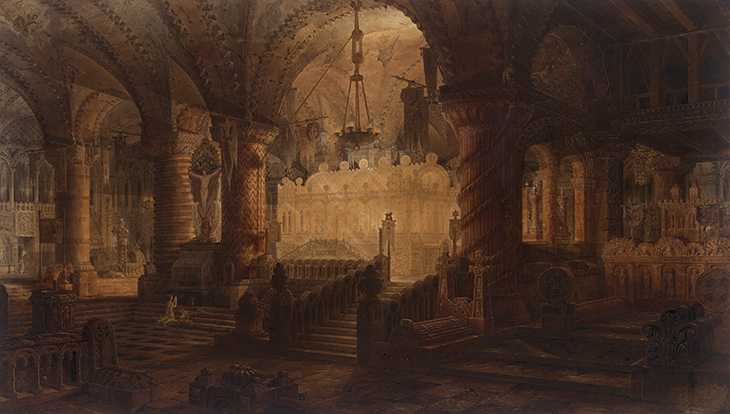
The visionary artist who saw into the mind of John Soane | Joseph Gandy's dramatic paintings turned John Soane's neoclassical designs into full-blown Romantic fantasies | Gillian Darley | 1 September 2021 | Apollo Magazine
13
posted on
04/08/2026 10:36:20 PM PDT
by
SunkenCiv
(TDS -- it's not just for DNC shills anymore -- oh, wait, yeah it is.)
Today i visited St Ellteyrn's church in Capel Llaniltern, Wales, A very small church packed with history and believed to be the burial site of Guinevere, king Arthurs wife. The postcode is CF5 6HF if you would like to visit. Resting Place of Guinevere, King Arthur's Wife! | 7:24
The Church Tourist | 11.6K subscribers | 16,763 views | April 9, 2026

14
posted on
04/10/2026 7:10:51 PM PDT
by
SunkenCiv
(TDS -- it's not just for DNC shills anymore -- oh, wait, yeah it is.)
Disclaimer:
Opinions posted on Free Republic are those of the individual
posters and do not necessarily represent the opinion of Free Republic or its
management. All materials posted herein are protected by copyright law and the
exemption for fair use of copyrighted works.
FreeRepublic.com is powered by software copyright 2000-2008 John Robinson
