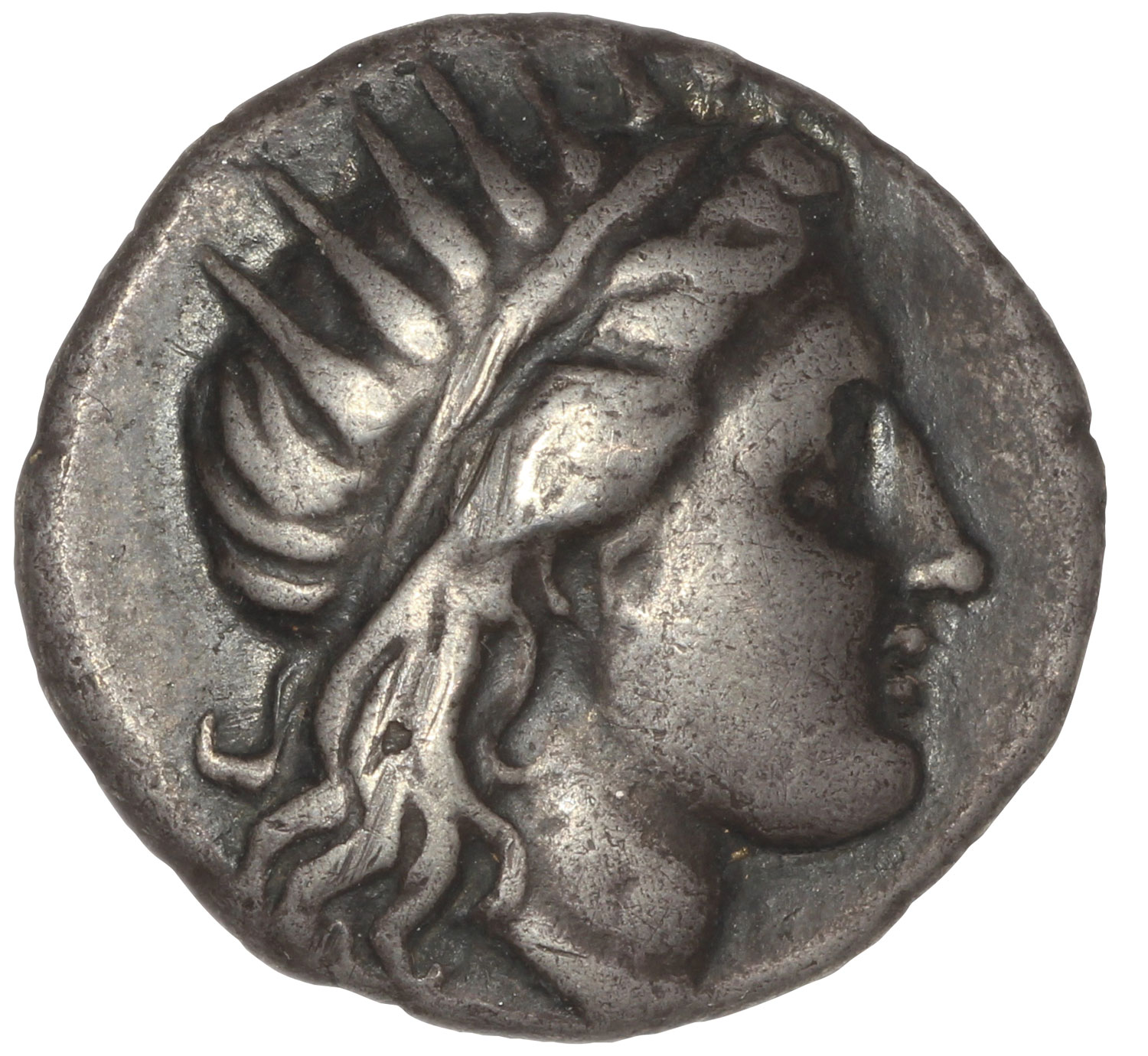
Coin showing Helios© The Trustees of the British Museum
Posted on 04/03/2026 7:01:37 AM PDT by SunkenCiv
The Greek city of Rhodes emerged victorious from a yearlong siege by the Macedonian noble Demetrius Poliorcetes in 304 b.c. To commemorate their city's resilience, the Rhodians built a towering bronze statue of the sun god Helios, their patron deity, who also appeared on their coinage. It took the local sculptor Chares 12 years to construct the Colossus of Rhodes, the tallest sculpture in the ancient world at some 120 feet. Chares created the statue using a revolutionary process known as casting in courses, which no other ancient sculptor is known to have employed. In order to cast each course, or level, of the Colossus in place, a huge earthen mound was built, enabling artisans to reach ever higher. They used metal bars to affix the bronze cladding to a stone core.
Just decades after its completion, an earthquake in 227 b.c. toppled the mighty sculpture, which broke off at the knees. Its ruins were apparently still lying on the ground into the first century a.d. By the late fourteenth century, none of the Colossus remained, but pilgrims discovered vestiges of ancient fortifications flanking the city's harbor and mistakenly identified them as parts of the statue. This led to spurious depictions of the Colossus straddling the harbor...
The dedicatory epigram on the statue's base, preserved in an anthology of Greek poems, records that the Colossus "crowned" the city, leading Badoud to surmise that it had been located on a hill. He believes the most probable site is a sanctuary dedicated to Helios that is thought to have sat atop a small hill in the city center. Although a fourteenth-century fortress now covers this spot, an inscription mentioning a sacred area of Helios, dedications made by his priests, and a marble head of the god have been found there.
(Excerpt) Read more at archaeology.org ...
Coin showing Helios© The Trustees of the British Museum
The rest of the Colossus of Rhodes keyword, sorted:
I was in Rhodes probably 4 times in 1958.Saratoga deployment...
From pix I’ve seen, it appears to be mostly covered in structures.
This led to spurious depictions of the Colossus straddling the harbor...
______________________
Despite lots of paintings from the recent past, the colossus was likely standing straight up and likely naked.
It would be somewhat similar, in posture and size to the Statue of Liberty.
Surely amazing!
mark
Yeah, they had it going on in ancient Rhodes.
This is one ancient wonder that it would be great to see rebuilt. It would be a great tourist attraction. It has been proposed over the years but unfortunately, the Greeks being the Greeks are too disorganized and debt-ridden to get it off the ground.
About ten years ago an architect was promoting his plan to build a much bigger tribute to the Colossus, with an interior space for a museum and other amenities.
It was far too ambitious. Just to build it might require reclamation of some seabed in order to support the construction infrastructure, and perhaps as its building side.
Oh, and a giant pile of money.
Rhodes is also close to the coast of Turkey, so any tourism would probably come from there and/or mostly benefit the Turkish mainland. I think there are a couple of topics in the above list.
a vid about the proposal:
https://www.youtube.com/watch?v=vM6_FoDrNeA
https://www.youtube.com/results?search_query=colossus+of+rhodes
The guy was obviously milking the job and chose an hourly wage rather than a quoted price for the project.
The “New Seven Wonders of the World,” following a 2007 global poll, are the Great Wall of China, Petra, the Colosseum, Chichén Itzá, Machu Picchu, Christ the Redeemer, and the Taj Mahal. These iconic landmarks were chosen for their cultural significance, architectural majesty, and lasting legacy.
Here are the New 7 Wonders of the World:
Great Wall of China (China): Constructed between the 7th century BC and 1644 AD, it is a vast defensive structure stretching thousands of miles.
Petra (Jordan): An ancient city built by the Nabataeans, famous for its structures carved directly into vibrant pink sandstone cliffs.
Colosseum (Italy): A massive Roman amphitheater, built in AD 72–82, renowned for gladiator contests and public spectacles.
Chichén Itzá (Mexico): A Mayan archaeological site in Yucatán known for the precise architectural design of the Kukulkán pyramid.
Machu Picchu (Peru): An Incan city from the 15th century, set high in the Andes mountains and known for its dramatic setting.
Christ the Redeemer (Brazil): A 30-meter tall Art Deco statue of Jesus Christ that overlooks Rio de Janeiro, completed in 1931.
Taj Mahal (India): A massive white marble mausoleum in Agra, built by Emperor Shah Jahan (c. 1632–1648) as a symbol of love.
Note: The Great Pyramid of Giza is recognized as an honorary candidate, as it is the only remaining wonder from the original 7 Ancient Wonders.

Christ the Redeemer at the top of Corcovado Mtn with Sugarloaf Mtn (center) and Guanabara Bay in the bgrnd.
Rhodes is beautiful. Where the statue once stood, there are two columns on the edge of the of the harbor.
If he was smart. The fact that his name is still known 2200 years later shows he was the best.
Disclaimer: Opinions posted on Free Republic are those of the individual posters and do not necessarily represent the opinion of Free Republic or its management. All materials posted herein are protected by copyright law and the exemption for fair use of copyrighted works.