Skip to comments.
Gortyn: Metropolis of Roman Crete [9:35]
YouTube ^
| March 27, 2026
| Scenic Routes to the Past (Garrett Ryan, Ph.D)
Posted on 04/03/2026 6:32:30 AM PDT by SunkenCiv
For a millennium, Gortyn was the most important city on Crete. Its ruins - largely unexcavated - are scattered across a picturesque landscape of stony hills and olive groves. Scenic Routes to the Past | 58.2K subscribers | 4,704 views | March 27, 2026
0:00 Introduction
0:34 Agios Titos
1:09 Law code of Gortyn
2:30 Acropolis
4:33 Unexcavated area
5:35 Two temples
6:48 Praetorium
7:18 Metropolitan basilica
8:11 Baths
(Excerpt) Read more at youtube.com ...
TOPICS: History; Science; Travel
KEYWORDS: boustrophedon; byzantineempire; crete; epicureans; epigraphyandlanguage; garrettryan; garrettryanphd; godsgravesglyphs; gortyn; hellenistic; romanempire
1
posted on
04/03/2026 6:32:30 AM PDT
by
SunkenCiv
To: StayAt HomeMother; Ernest_at_the_Beach; 1ofmanyfree; 21twelve; 24Karet; 2ndDivisionVet; 31R1O; ...
2
posted on
04/03/2026 6:33:14 AM PDT
by
SunkenCiv
(TDS -- it's not just for DNC shills anymore -- oh, wait, yeah it is.)
Transcript
Introduction
Gortyn, the most important city in Greco-Roman Crete, was founded early in the Iron Age, not far from the ruins of the great Minoan palace at Festos. Mentioned in the Iliad, it prospered through the classical and Hellenistic periods and became the capital of the Roman province of Crete and Sirenica. Though the city boasted at least six large basilica churches in the early Byzantine period, it was devastated by Arab raiders in the early 9th century and never recovered.
Agios Titos
The first building one encounters when entering the fenced portion of the site is the Basilica of Hagios Titos, the best-preserved early Christian church on Crete. Built during the reign of Justinian, it was maintained for centuries even after the era of raids. It was a three-eyed basilica with a cross dome plan possibly influenced by Hagia Sophia. The altar would have been in front of us here.
Law Code of Gortyn
Beside the Agora, which is only partially excavated, is the Odon, a building used for musical and rhetorical performances. The building dates to the first century BC and was restored in the reign of Trajan. It's best known, however, for incorporating a series of much older blocks into its foundations. Some of these blocks, originally part of a circular assembly building that stood on the Agora, were inscribed with a famous law code of Gortyn, the oldest legal code in Europe, with the exception of the famous Epicurean inscription of Dionysus at Oenoanda. This is the longest known Greek inscription; though written in the fifth century BC, it may contain laws that are centuries older. The style of the inscription, at least, is archaic, written in boustrophedon, left to right then right to left like an ox plowing a field. The code reassembled here details a fascinating range of laws covering everything from property rights to adultery.
Beyond the fenced area on the slopes of the acropolis are the rather scanty remains of the theater, showing characteristically Roman mortar and rubble construction.
Acropolis
And now looking up toward the summit of the Acropolis. The Acropolis was fortified early in the history of Gortyn. The current fortifications, built in the Hellenistic period, were neglected by the Romans. The most prominent building on the Acropolis is the so-called Castro, a Roman-era structure that included a hall cut deep into the native rock. The function of this space and the rest of the Castro is uncertain.
A quick panorama of the Castro. It reminds me of the so-called Red Hall in Pergamon, which was a basilica of the Egyptian gods. I wonder if this was something similar. It has typically Roman masonry, those long, thin bricks. Not many tourists come up here, but a whole lot of sheep must, to judge the amount of dung I've had to dodge in this place.
On the summit of the Acropolis stood a temple of Athena, first built in the 7th century BC and restored through the Roman era. The temple's altar was located on a terrace just beneath it, supported by huge buttresses. In late antiquity, a church replaced the temple.
A look from the Temple of Athena down toward the Basilica of Hagios Titos, its spiritual successor. This, I believe, was the terrace that supported the Temple of Athena's altar.
Unexcavated Area
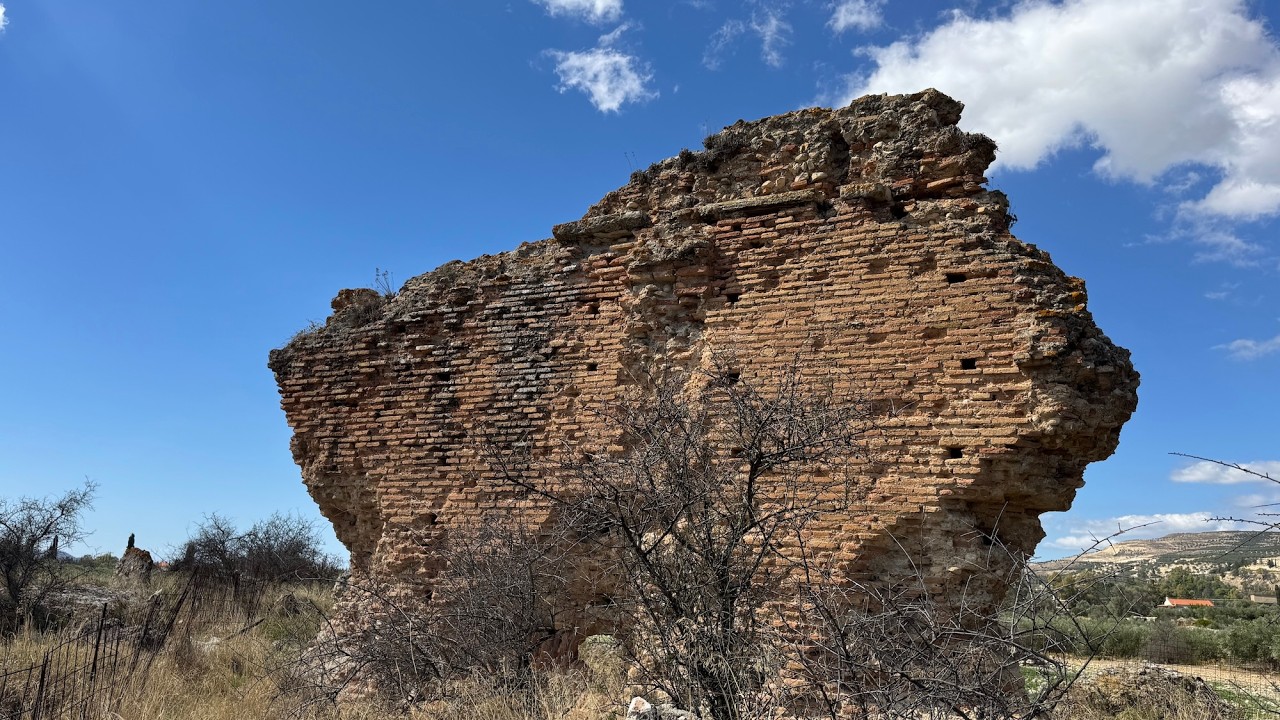
This olive tree, which has grown up around a Roman column, is thought to be about 1,600 years old. There are ruins throughout the olive groves around the site. The ground is absolutely littered with ancient bricks and roof tiles. Some ruins resemble eroded rock formations or abstract sculptures.
Among the few excavated buildings in this part of the city is a temple of the Egyptian deities, more specifically Isis, Kapus, and probably Anubis, built by a Roman benefactor in the early imperial era. Though the temple was relatively modest, it seems to have incorporated a crypt for initiation ceremonies.
A short distance away lay the Temple of Apollo Pithios, the most important sanctuary in Greek Gortyn. The original archaic temple was enlarged in the Hellenistic era when a monumental pronoun was built and inscribed with treaties dating to the second century BC between Gortyn, other Cretan cities, and the king of Pergamon. The monumental stepped altar dates to the Roman era. In late antiquity, the Temple of Apollo was converted into a three-eyed Christian basilica.
Beyond it was the smaller theater built in the Roman imperial era using Roman-style brick-faced concrete and used for contests associated with the cult of Apollo.
Praetorium
The Praetorium was the palace of the Roman governor of Crete and Sirenica. In its current form, it dates to the early second century. It was extended in late antiquity with the addition of a grand concrete audience hall. A private bath was attached to the complex. A nice heap of imported granite columns. This was a place built to impress.
Metropolitan Basilica
Here, bisected by the modern road, are the remains of Gortyn's Metropolitan Basilica, the seat of the bishop. It was an elaborate building with granite columns, marble, and tablet, and five aisles built in the late fifth century. It was renovated under Justinian. The apse was on this side. The altar was just below us here, and behind it, the synthronon where the assembled clergy sat during services. The Basilica was apparently destroyed by an earthquake in the late 8th century.
Baths
Only a small part of Gortyn has been revealed by archaeology. The city's largest ancient structure, an imposing Roman bath complex, remains unexcavated. The scale of the standing ruins is a reminder of how much remains to be discovered about Roman Crete's greatest city. We'll close with a panorama. Thanks for watching.
3
posted on
04/03/2026 6:34:44 AM PDT
by
SunkenCiv
(TDS -- it's not just for DNC shills anymore -- oh, wait, yeah it is.)
Disclaimer:
Opinions posted on Free Republic are those of the individual
posters and do not necessarily represent the opinion of Free Republic or its
management. All materials posted herein are protected by copyright law and the
exemption for fair use of copyrighted works.
FreeRepublic.com is powered by software copyright 2000-2008 John Robinson
