Posted on 03/08/2026 9:52:46 PM PDT by nickcarraway
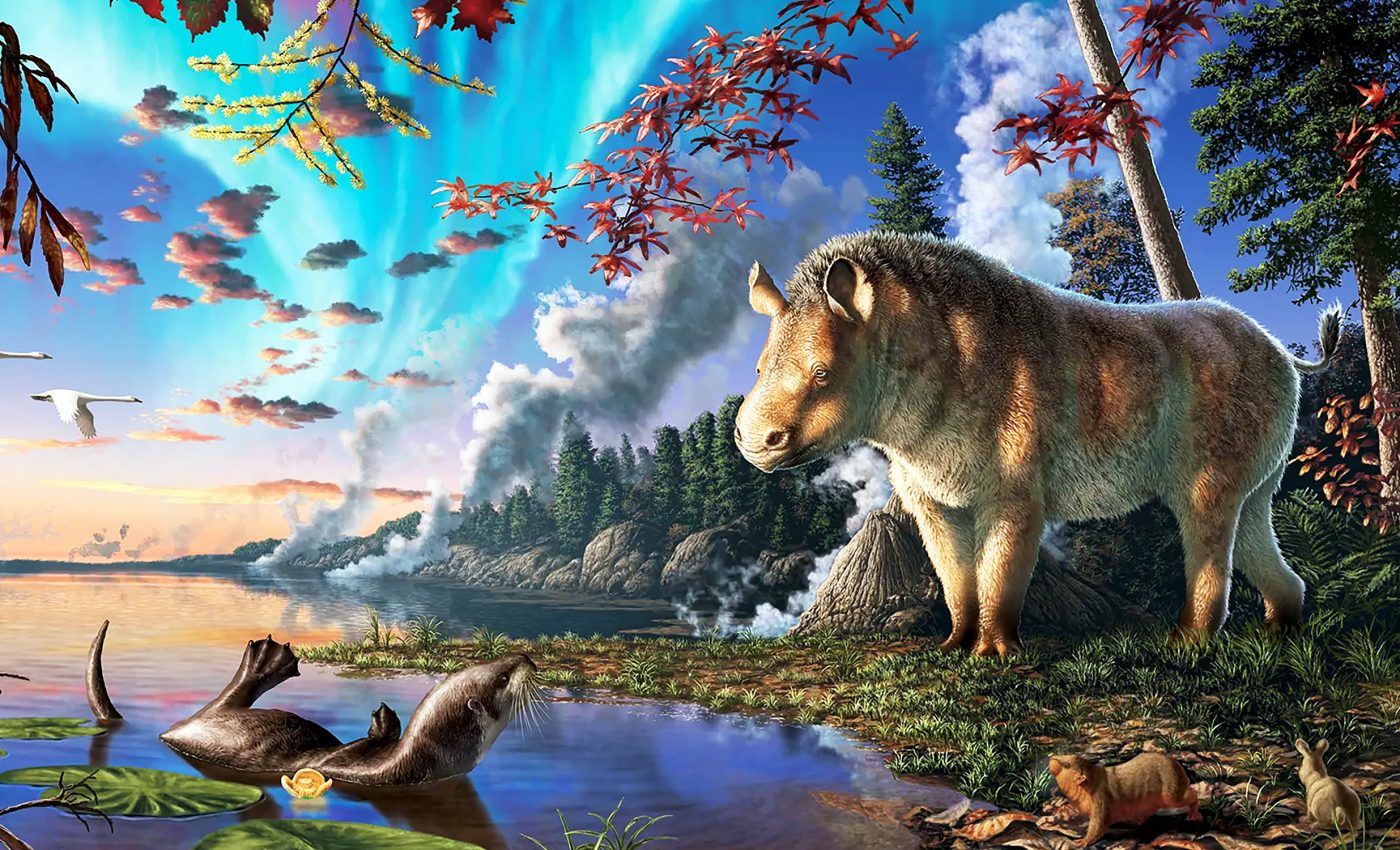
Deep within the frozen ground of Devon Island in Canada’s High Arctic, researchers found the nearly complete skeleton of a rhinoceros, Epiaceratherium itjilik, that lived there around 23 million years ago.
The discovery, made by a team from the Canadian Museum of Nature, reveals that rhinos once roamed much farther north than anyone imagined.
The fossils were found inside Haughton Crater, a 23-kilometer-wide impact site now locked in ice and silence. Millions of years ago, this same place held forests, lakes, and life.
The team named the new species Epiaceratherium itjilik, or “frosty rhino,” combining Latin and Inuktitut to reflect its Arctic home.
“Today there are only five species of rhinos in Africa and Asia, but in the past they were found in Europe and North America, with more than 50 species known from the fossil record,” said Dr. Danielle Fraser, head of palaeobiology at the Canadian Museum of Nature.
“The addition of this Arctic species to the rhino family tree now offers new insights to our understanding of their evolutionary history.”
How rhinos adapted to the Arctic
The rhino’s bones tell a story of adaptation and survival. Epiaceratherium itjilik was smaller and slimmer than today’s African rhinos. It had no horn and resembled the Indian rhinoceros in build.
The name “itjilik,” meaning “frost” in Inuktitut, came after consultation with Inuit Elder Jarloo Kiguktak from Grise Fiord, the northernmost Inuit community in Canada. He had visited the fossil site and guided the naming process to honor the region’s heritage.
The original discovery dates back to 1986 when Dr. Mary Dawson of the Carnegie Museum of Natural History collected several key bones. Those included parts of the skull, jaws, and teeth – enough to confirm it belonged to the rhino family.
Dawson, who passed away in 2020, was one of the first to explore Arctic fossils and is credited as a co-author of the study that finally gave the species its name.
Bones from Epiaceratherium itjilik
The quality of the fossil astonished the research team. “What’s remarkable about the Arctic rhino is that the fossil bones are in excellent condition,” said Marisa Gilbert, senior research assistant at the Canadian Museum of Nature.
“They are three dimensionally preserved and have only been partially replaced by minerals. About 75% of the skeleton was discovered, which is incredibly complete for a fossil.”
Gilbert joined several Arctic expeditions led by Dr. Natalia Rybczynski in the late 2000s. During those trips, the team uncovered another ancient species, Puijila darwini, a land-to-sea transitional seal ancestor.
With Epiaceratherium itjilik, their work now connects two different evolutionary stories – one about life adapting to ice, another about mammals spreading across continents.
How rhinos reached the Arctic
The fossil’s location added a new twist to the rhino family story. By studying 57 extinct and living rhino species, the scientists discovered that Epiaceratherium itjilik likely migrated from Europe to North America using a land bridge through Greenland.
Earlier studies claimed this route disappeared 56 million years ago, but this new evidence suggests the passage lasted far longer, possibly until the Miocene.
Dr. Fraser’s team used modeling to trace where and when rhino species appeared. Their analysis showed that the North Atlantic Land Bridge was still active during the time Epiaceratherium itjilik lived.
This finding rewrites part of mammalian migration history and points to a much later wave of animal movement between continents than anyone expected.
Protein clues from enamel
In 2025, another breakthrough pushed the story even further. Scientists managed to extract partial proteins from the rhino’s tooth enamel – an achievement once thought impossible for fossils this old.
The work, led by postdoctoral fellow Ryan Sinclair Paterson at the University of Copenhagen, has extended the timeline for recoverable evolutionary proteins by millions of years.
The research has also opened a new window into studying ancient mammals through their preserved biomolecules.
“It’s always exciting and informative to describe a new species,” said Dr. Fraser.
“But there is more that comes from the identification of Epiaceratherium itjilik, as our reconstructions of rhino evolution show that the North Atlantic played a much more important role in their evolution than previously thought.”
The ancient Arctic environment
The Haughton Crater once held lakes surrounded by temperate forest. Fossil plants show that birch and larch trees grew where ice now reigns.
Over time, cycles of freezing and thawing broke open buried layers, pushing ancient bones toward the surface.
That process, known as cryoturbation, helped preserve fossils like Epiaceratherium itjilik across a small area roughly seven square meters wide.
The Arctic may seem desolate now, but it continues to reveal traces of a greener past. Every discovery there adds a line to Earth’s history – one written in bone and ice.
Significance of Epiaceratherium itjilik This discovery does more than fill a gap in the fossil record. It reveals that the Arctic, often seen as lifeless, holds stories of resilience and adaptation.
Millions of years ago, a hornless rhino walked through forests that no longer exist. Its bones, now free from ice, hold a story about survival in changing worlds – and remind us that the coldest places can still hold the warmest histories.
The fossil of Epiaceratherium itjilik now rests at the Canadian Museum of Nature (prepared in collaboration with the Carnegie Museum of Natural History).
The study is published in the journal Nature Ecology & Evolution.
Well, to be accurate,
they did not actually “discover a 23 million year old rhinoceros”,
but they DID discover a skeleton of a rhinoceros
that died 23 million years age...
He must be hungry.
is that you Boehner?
I thought this article was about a Mitch McConnell sighting.

Not exactly a success story if it was found belly-up, eh?
It’s just napping.
It’s probably pining for the fjords.
I was happily reading this thread while finishing a late dinner, and you had to post a picture of this ugly creep with no barf alert or warning of any kind.
Fie upon you.
So since "rhinoceros" means "NOSE-HORNED", how does that work, exactly?
Did some other animal sneak up and steal its horn while it was asleep?
Did it lose its horn in a bad bet?
Inquiring minds need to know....
It identified as a rhinoceros. But its birth species was a pterodactyl.
It has an invisible nose horn.
This is my theory. When the rhinoceros was like this, there were no humans to name it. It was give the “nose-horned” name much later when it did have the horn. But this is the earlier version of the animal, so from our perspective today, we still call it a rhino.
Please tell me I’m not the only one singing Frosty the Rhino in my head.
😕
Wouldn’t it just be an Oceros?
🤔
You're not. Indeed, I had that stuck in my head almost immediately on reading the title, and it hasn't stopped yet. I'm trying to push it out with "Crazy Train" but so far no success.
> It has an invisible nose horn.
I sense a relationship between these two replies, though the exact nature of the relationship escapes me at the moment.
That would be a great Christmas special.
That makes sense. And it's a better theory than Anne Elk's theory of the brontosaurus.
Disclaimer: Opinions posted on Free Republic are those of the individual posters and do not necessarily represent the opinion of Free Republic or its management. All materials posted herein are protected by copyright law and the exemption for fair use of copyrighted works.
