Posted on 02/28/2026 2:43:30 PM PST by VRW Conspirator
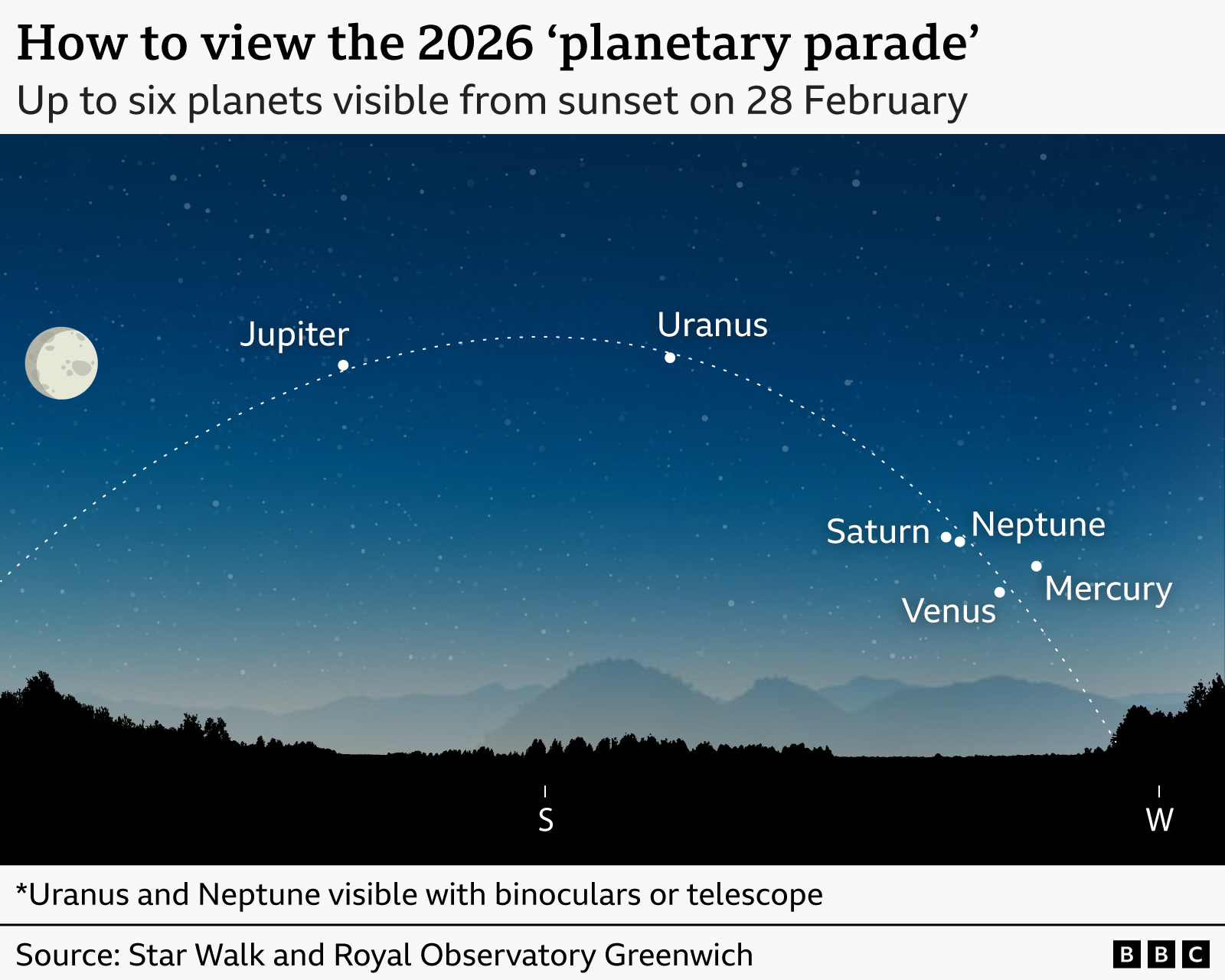
This weekend provides a rare treat for stargazers. Well, planets, to be more specific. Mercury, Venus, Neptune, Saturn, Uranus and Jupiter will will appear to line up on the horizon shortly after sunset on Saturday, Feb. 28. Four of the six planets will be visible to the unaided eye, while the other two will require a telescope. The rare celestial occasion, a planetary alignment or planet parade consists of three to five planets and can occur every few months to every few years. However a six or seven planet parade is more rare. Here’s what to know about Saturday’s “planet parade” and when your best chances of seeing planets in the sky will be. What is a planetary alignment? A planetary alignment is an astronomical event that occurs when several planets are positioned together closely on one side of the Sun at the same time. This can happen a few times a year, according to Star Walk, an astronomy and space guide app. There are different types of planetary alignments which depend on how many planets participate. They range from mini planetary alignment – three planets; small planetary alignment – four planets; large planetary alignment – five or six planets; great (full) planetary alignment – all Solar System planets (and Pluto sometimes). This upcoming alignment is a large planetary alignment.
(Excerpt) Read more at yahoo.com ...
Not exactly even if it is rare.
There was one a few decades ago that I remember going up to Lake Ontario to watch. Great viewing over the lake during the summer.
I am so sad to miss this! We are overcast and snowing right now...but hoping for clear skies later tonight!
-PJ
Thank you!
It was some years ago that from my porch at the colorado river, by needles, Jupiter was HUGE and Bright in the eastern sky, pretty awesome
I am completely underwhelmed by this. It is hardly an alignment when two of the planets can’t be seen without a telescope and the visual field of most telescopes would only get one or two of them. I haven’t seen Mercury since the 1970’s when I worked at farm labor and was standing around in the early morning before sunrise. Mercury is always so close to the sun that you don’t have much time before it drops below the horizon. Otherwise it is impossible to see because it is tiny and dim that the sun washes it out. Venus is pretty easy to see because it is the third brightest object in the night sky after the moon and Jupiter. They will be very close to each other and that will make them both difficult to see for more than a couple of minutes so you better have your telescope ready and pointing in the right direction.
As for Saturn and Neptune if you get them in the same shot as Mercury and Venus you would have a rare alignment of four planets while Uranus is over there and Jupiter is way over there. At most we are talking about 6 planets being above the horizon at the same time not really a planetary alignment.
Disclaimer: Opinions posted on Free Republic are those of the individual posters and do not necessarily represent the opinion of Free Republic or its management. All materials posted herein are protected by copyright law and the exemption for fair use of copyrighted works.