Posted on 02/11/2026 1:15:19 PM PST by MtnClimber
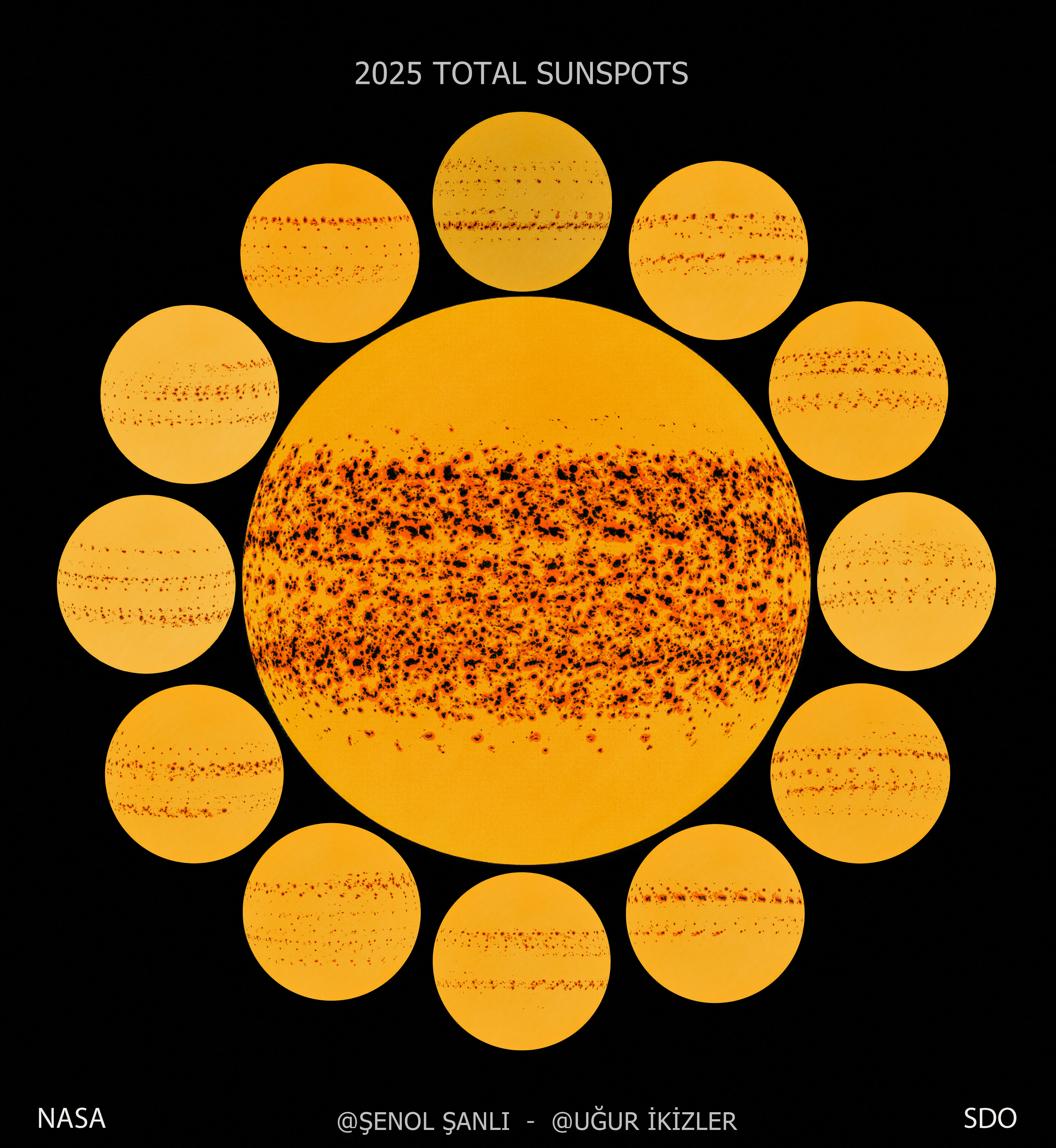
Explanation: How many sunspots can you see? The central image shows the many sunspots that occurred in 2025, month by month around the circle, and all together in the grand central image. Each sunspot is magnetically cooled and so appears dark -- and can last from days to months. Although the featured images originated from NASA's Solar Dynamics Observatory, sunspots can be easily seen with a small telescope or binoculars equipped with a solar filter. Very large sunspot groups like recent AR 4366 can even be seen with eclipse glasses. Sunspots are still counted by eye, but the total number is not considered exact because they frequently change and break up. Last year, 2025, coincided with a solar maximum, the period of most intense magnetic activity during its 11-year solar cycle. Our Sun remains unpredictable in many ways, including when it ejects solar flares that will impact the Earth, and how active the next solar cycle will be.
For more detail go to the link and click on the image for a high definition image. You can then move the magnifying glass cursor then click to zoom in and click again to zoom out. When zoomed in you can scan by moving the side bars on the bottom and right side of the image.
🪐 🌟 🌌 🍔
All those blemishes. Does this mean our sun’s a teenager?
The sun is a giant cheeseburger.
That is such an awesome picture. It Illustrates just how many sunspots there were during one year of the solar maximum.
My charcoal grill is calling me.
The periodicity of those spots (check out the bottom two rows) suggests that many of those are the same spot that persisted and just showed up at a slightly different position a month later. If that’s the case, the actual number of spots is maybe about one-twelfth of what we see in the composite.
Still a really cool picture, though.
Are “sunspots” uniformly distributed over the entire surface of the sun, or do they only appear so because we can observe them more readily closer to the equator?
The sun rotates and the rotational speed increases toward the equator. As the 11 year solar cycle progresses, sunspots tend to migrate from higher latitudes towards the equator. This is a pattern known as Spörer’s law. At the 11 year minimum the sun spots appear at higher latitudes, though never close to the N or S poles. As the 11 year cycle reaches maximum the sun spots migrate lower toward the equator. I think this is just from observations with no physics behind why it happens.
You make a good observation.

That image is very cool.
Disclaimer: Opinions posted on Free Republic are those of the individual posters and do not necessarily represent the opinion of Free Republic or its management. All materials posted herein are protected by copyright law and the exemption for fair use of copyrighted works.