Posted on 02/06/2026 12:30:14 PM PST by MtnClimber
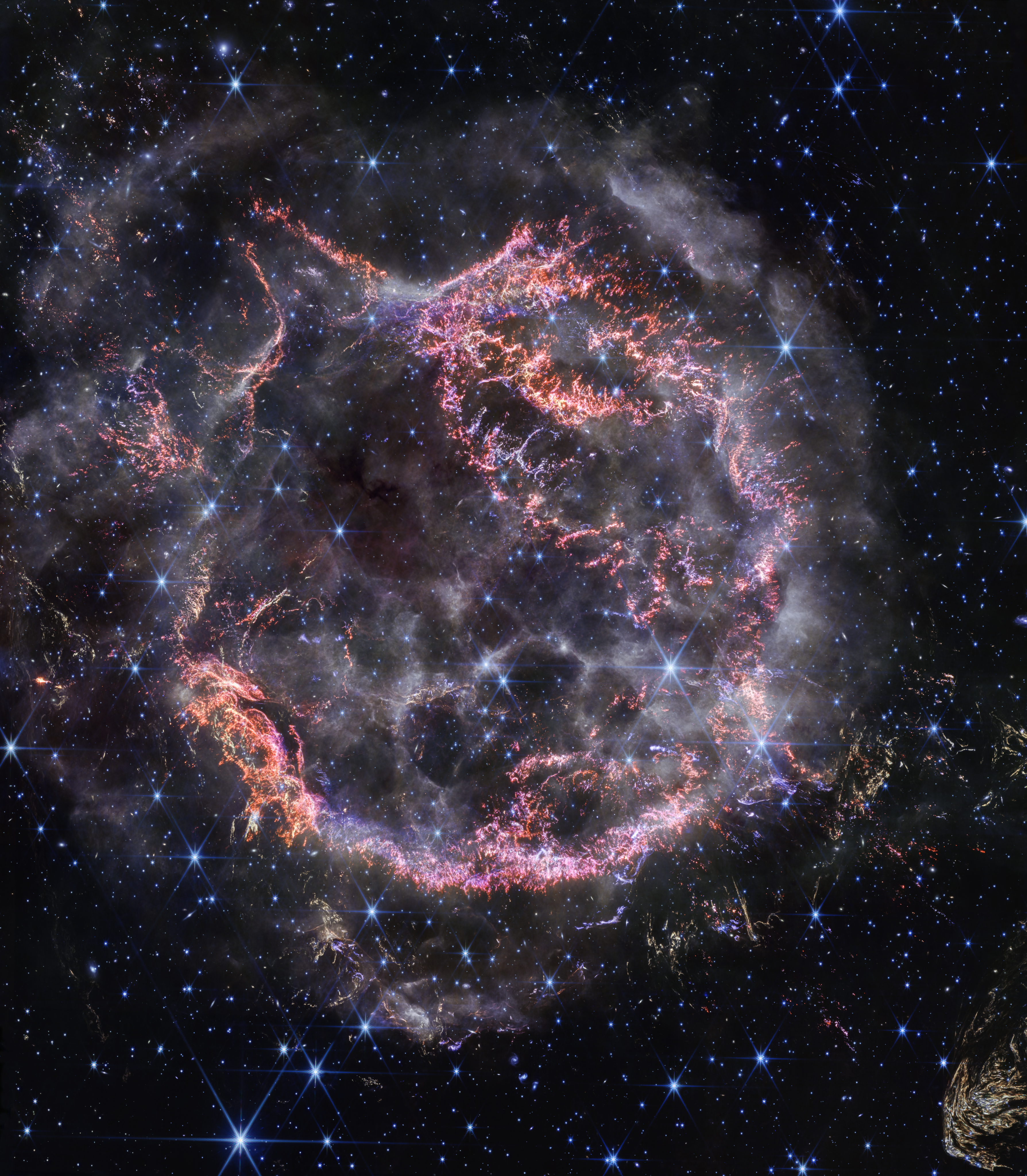
Explanation: Massive stars in our Milky Way Galaxy live spectacular lives. Collapsing from vast cosmic clouds, their nuclear furnaces ignite and create heavy elements in their cores. After only a few million years for the most massive stars, the enriched material is blasted back into interstellar space where star formation can begin anew. The expanding debris cloud known as Cassiopeia A is an example of this final phase of the stellar life cycle. Light from the supernova explosion that created this remnant would have been first seen in planet Earth's sky about 350 years ago, although it took that light 11,000 years to reach us. This sharp NIRCam image from the James Webb Space Telescope shows the still-hot filaments and knots in the supernova remnant. The whitish, smoke-like outer shell of the expanding blast wave is about 20 light-years across. A series of light echoes from the massive star's cataclysmic explosion are also identified in Webb's detailed images of the surrounding interstellar medium.
For more detail go to the link and click on the image for a high definition image. You can then move the magnifying glass cursor then click to zoom in and click again to zoom out. When zoomed in you can scan by moving the side bars on the bottom and right side of the image.
🪐 🌟 🌌 🍔
Cass-A was one of our favorite microwave radio targets for calibrating earth ground station antennas. It puts out a very strong signal.
Now THAT <...pause for effect...> is a Remnant.

I worked in the design of satellites for much of my career, but worked in sustainment of government facilities for a while. We used beacon channels on GEO satellites for calibration at that time.
We used them for tracking calibration also.
Some interesting satellites with very ‘strange” orbits were also available.
Yes, the polar satellites were a part of my development work and some part of ground site calibrations too. But GEO satellites were the main calibration sources.
Done blowed up real good.

IMO, a very underrated movie.
This isn’t the Carl Sagan TV series, but a movie. Very well made with an almost nonexistent budget. https://www.imdb.com/title/tt4477292/?ref_=tturv_ov_i
Thanks for the link.
Hmm...this page doesn’t exist. Try searching for something else.
Thanks!
Disclaimer: Opinions posted on Free Republic are those of the individual posters and do not necessarily represent the opinion of Free Republic or its management. All materials posted herein are protected by copyright law and the exemption for fair use of copyrighted works.