Posted on 02/04/2026 4:59:08 AM PST by MtnClimber
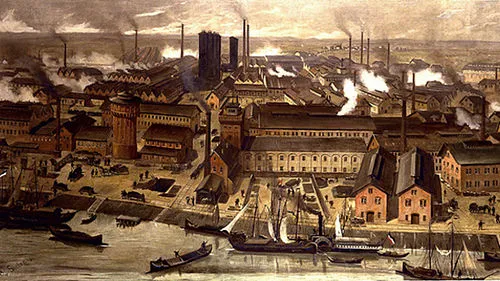
BASF plant in Ludwigshafen, 1881.
In its ‘Climate & Energy’ newsletter on Thursday, the Wall Street Journal’s report on Germany’s chemicals industry headlined ‘The Agonising Decline of One of Europe’s Core Industries’ reads less like an industry report than a forensic examination of an industrial autopsy. Once Europe’s formidable manufacturing powerhouse, Germany is now presiding over the steady dismantling of one of its most foundational industries – chemicals – under the combined weight of self-inflicted energy scarcity, climate moralism and geopolitical miscalculation.
In Politico’s view, the auto sector has already assumed the role of Exhibit A in Germany’s economic self-harm. But chemicals – the industry that quite literally underpins modern industrial civilisation – now stands exposed as Exhibit B. The collapse of chemicals manufacturing in Germany will be unsalvageable: when energy costs explode, feedstocks disappear and plants shut, financial investments and physical capital relocate not easily but in an irreversible rupture with previous arrangements.
The Industry That Built Modern Germany and the World
As Vaclav Smil authoritatively established, the four foundational materials of human civilisation are steel, cement, plastics and ammonia. But ammonia is the most fundamental because it sits upstream of life itself rather than merely infrastructure. Through synthetic nitrogen fertilisers enabled by the Haber–Bosch process, ammonia underwrites modern agriculture and thus the food supply for roughly half the world’s population, without which steel mills, concrete cities and plastic goods would be socially meaningless luxuries. A civilisation can endure with less concrete or fewer polymers, but it cannot survive the loss of fixed nitrogen – making ammonia not just an industrial input, but the metabolic backbone of modern human existence.
Germany’s rise as an industrial nation was inseparable from chemistry. Long before automobiles or machine tools defined its export prowess, German scientists and firms were pioneering breakthroughs in dyes, pharmaceuticals, fertilisers and industrial processes that transformed global production. The synthesis of ammonia via the Haber–Bosch process – enabling nitrogen fixation at scale – stands as one of the most consequential technological innovations in human history. It fed billions, powered agricultural productivity and anchored Germany’s early chemical supremacy.
From roughly 1870 to the First World War, the global chemicals industry was overwhelmingly dominated by Germany, with Britain a distant and increasingly worried second and the United States very much a latecomer. In the long arc of industrial capitalism, BASF and Imperial Chemical Industries stand as two of the defining titans of the chemicals revolution that reshaped Europe from the late 19th Century onward.
BASF was founded in 1865 on the banks of the Rhine at Ludwigshafen. Apart from BASF, Germany produced a remarkable constellation of world-leading chemical companies that, together, made the country the unquestioned global centre of industrial chemistry from the late 19th Century through much of the 20th. Founded in 1863, Bayer rose to prominence through synthetic dyes, then pharmaceuticals and agrochemicals. Its most famous early product, aspirin, symbolised the shift from chemistry as craft to chemistry as science-driven mass production. Hoechst (founded 1863) was BASF’s and Bayer’s great peer, excelling in dyestuffs, pharmaceuticals and industrial chemicals. Britain’s answer to German chemical supremacy arrived later and more defensively. Imperial Chemical Industries was formed in 1926 through the merger of four major British firms, explicitly to counter German dominance in chemicals that had become glaring during the First World War.
Germany’s rise as an industrial power with chemicals as the most important arrow in its quiver was not merely a national success; it was civilisational. Chemistry, more than textiles or steel, became the silent engine of modernity – transforming agriculture, medicine, warfare and manufacturing itself. This was not accidental. German chemical firms amassed deep intellectual property portfolios, established world-leading research laboratories and – somewhat ironically, with the hindsight brought about by the experience of Energiewende (energy transition) – benefited from an abundant supply of domestic sources of coal. For much of the 20th Century, chemicals were not merely another sector; they were the backbone of Germany’s export economy and technological prestige.
Europe as a whole followed a similar trajectory. From fertilisers to pharmaceuticals, polymers to speciality chemicals, the continent built an industrial base that assumed – as a matter of physical necessity – reliable access to low-cost energy. That assumption has now been abandoned. Once coal was displaced by abundant natural gas – first from the North Sea and later, far more decisively, from Russian pipelines – Europe’s energy-intensive chemicals industry achieved its modern scale and global competitiveness, with Germany at its centre. Russian pipeline gas, delivered reliably and at low marginal cost, became the keystone input that allowed European chemical producers to outcompete rivals despite higher labour and regulatory costs.
The rupture came not merely from “market volatility” but from the abrupt loss of that gas – following the destruction of the Nord Stream pipelines and the wider sanctions regime – which boomeranged as a structural surge in gas and food prices. That energy shock did not wound German chemicals temporarily; it removed the economic foundation on which the industry had been built, turning decline from a cyclical downturn into a permanent de-industrialisation process.
Chemical manufacturing is among the most energy-intensive activities known to modern economies. Natural gas is not merely a fuel; it is a feedstock, a reagent and an irreplaceable input in the production of ammonia, methanol and countless downstream products. To imagine a competitive chemicals sector without abundant, affordable gas is to imagine steelmaking without iron ore.
Yet Germany’s energy policy has done precisely that. The decision to dismantle nuclear power, throttle domestic fossil fuel production and sanction Russian gas – without credible substitutes – was undertaken as a moral crusade. Energy realism was sacrificed at the altar of climate virtue. The consequences were inevitable.
Energy prices surged far above those faced by competitors in the United States and the Middle East. Margin compression became chronic. Production cuts turned into permanent closures. Once massive chemical plants shut, they do not reopen. Capital is mobile; sunk costs are not. In chemistry, as elsewhere in the natural world, thermodynamics always wins. You cannot legislate away input costs.
Sanctions, Self-Harm and the Fertiliser Exception
The geopolitical dimension of Germany’s predicament only deepens the absurdity. Europe’s sanctions regime against Russia was implemented with moral fervour but economic naivety. Natural gas flows were severed without a replacement strategy that acknowledged scale, reliability or price. In the event, US LNG imports, at least three to four times more expensive than Russian piped gas, proved to be an expensive and partial substitute.
Even Brussels recognised the limits of ideological purity. Despite the sanctions, the EU remains a significant customer for Russian liquefied natural gas (LNG), having imported approximately €7.2 billion worth in 2025 despite plans to ban such imports by 2027. Russian fertiliser exports were quietly exempted from sanctions – an implicit admission that agricultural collapse is not a price voters will tolerate. Fertilisers are not optional; they are existential. The exemption stands as a tacit confession that Europe’s energy and industrial strategy is riddled with contradictions.
If fertilisers cannot be sanctioned because crops would fail, why was the upstream gas supply so casually sacrificed? The answer, of course, lies not in economics but in political symbolism. Fertiliser scarcity would have directly produced visible hunger. Chemical plant closures produce quieter decay – job losses, hollowed regions and de-industrialised supply chains.
Markets, unlike governments, respond to incentives rather than narratives. Faced with punitive energy costs and regulatory hostility, Europe’s chemical giants have begun relocating capital abroad. The United States, with its shale gas abundance and comparatively pragmatic industrial policy, has emerged as a prime destination. So too have parts of the Middle East, where feedstock costs reflect geological reality rather than moral aspiration.
The symbolism of Europe’s flagship chemical firms investing billions overseas while shuttering domestic plants should not be underestimated. This is not offshoring in search of marginal gains. It is capital flight from a policy environment that has rendered large-scale chemical production uneconomic. The Oxford Economics analysis cited in industry reports is blunt: chemicals are a keystone sector. Their decline cascades through pharmaceuticals, construction materials, agriculture and consumer goods.
Between 2019 and 2025 Q2, the European chemical sector’s output declined significantly. It has contracted by 30% in the UK, 18% in Germany, 12% in France and 7% in Belgium. Output levels have been hit by reduced price competitiveness due to higher gas and electricity prices than elsewhere, higher environmental and other regulatory costs and excess global capacity, largely driven by China.
Europe’s climate agenda increasingly functions as industrial policy in reverse. Carbon pricing, emissions trading and regulatory constraints are imposed domestically with little regard for global competitiveness. Production migrates to jurisdictions with lower costs and weaker constraints, often resulting in higher global emissions – the very outcome climate policy claims to oppose.
This is not merely a technical flaw. It is a conceptual failure. Policymakers conflate decarbonisation targets with economic strategy, assuming that “green” innovation will materialise on command and that intermittent renewables can substitute for dense, dispatchable energy at industrial scale. Chemistry exposes this fantasy mercilessly.
Europe’s Silent Unravelling
Germany’s predicament is not accidental. It is the logical outcome of deliberate choices. Nuclear phase-out, gas dependency without diversification, sanctions without contingency and climate regulation without competitiveness safeguards together constitute a blueprint for de-industrialisation. The tragedy is that this is unfolding in a country that once understood industrial ecosystems intimately. Germany knew that manufacturing excellence rested on ready access to energy resources, technical skill and export competitiveness. Today, it lectures the world on sustainability while dismantling the very industries that made its prosperity possible.
Europe more broadly is following the same path. High-energy industries are labelled “hard to abate” – bureaucratic shorthand for “politically inconvenient”. Instead of confronting physical realities, policymakers outsource production and import finished goods, congratulating themselves on territorial emissions reductions while global emissions rise.
The most sobering aspect of chemical industry decline is its irreversibility. Blast furnaces can sometimes be relit; vast chemical complexes rarely are. The specialised workforce disperses. Supply chains fracture. Intellectual capital migrates. Skilled communities hollow out. This is why industry warnings carry such urgency. Once Europe relinquishes large-scale chemical manufacturing, it forfeits strategic autonomy across medicine, food, defence materials and related advanced materials technologies. Dependence replaces resilience.
The WSJ’s reporting captures only the surface of this unravelling. Beneath it lies a deeper malaise: Europe has lost faith in its own industrial vocation. It prefers to regulate rather than produce, to moralise rather than compete. Yet the world does not pause for European introspection. The United States under the Trump administration is focused on re-industrialising with its energy dominance agenda along with tariff policy. Asia and the Middle East continue to expand capacity.
Europe alone seems determined to prove that prosperity can survive without production. It cannot.
Germany’s chemical reckoning is therefore not a sectoral story but a civilisational one. It illustrates what happens when political elites elevate symbolic virtue over material competence, when policy is shaped by narratives rather than real constraints and when energy is treated as an ethical problem rather than an economic necessity. The country’s chemical industry once symbolised the triumph of science, industry and energy harnessed in service of human progress. Its current decline symbolises something else entirely: the delusional triumph of ideology over physics and economics among policy elites. And, as ever, the twin disciplines will have the final word. As will chemistry.
Dismantling their industry while importing fanatical muslims. What could go wrong.
Reminds me of an old joke, what will Germany use for lighting after their “post modernization,” ... candles.
I was recently talking to a German guy who assured me that solar panels would be able to completely power Germany’s steel mills.
He didn’t mention the chemical industry. Maybe Germany will build windmills for that.
🤔
If they could design the perfect battery perhaps it could work.
An abject lesson in what virtue signaling political leadership gets you. We are not immune from it. Absent Trump we would be continuing on this same path.
He is high on drugs on that first. Was said German a STEM graduate? I’m guessing not. If yes, that’s extra scary.
As I like to say around here, you can’t power modern civilization on wind, solar, and unicorn flatulence. It simply cannot be done.
My old UK based company was bought by a German one.
I’ve kept in touch with a few people still there.
A complete train wreck.
11 engineers had to be hired to replace the superstar chief engineer who had been there for decades.
Nothing works very well or at all. Don’t ask me how the place stays open.
I understand tons of computers and related industrial equipment were bought. Probably in the millions range. Nothing is compatible and the guy in charge quit before that was discovered.
It wouldn’t surprise me if they tried some kind of solar powered nonsense as well.
> Was said German a STEM graduate? I’m guessing not. <
That would be my guess as well. I am a STEM graduate, and a curious person. So I asked that German for a bit of data, some numbers that would show how an entire steel industry can be powered by solar panels.
He got mad at me. And I didn’t get the data.
By the way, I grew up in the shadow of a steel mill. As a kid I’d watch trains filled with coal heading towards that mill. Mills are more efficient these days. But to think an array of solar panels can replace all the energy in coal is, well, a bit hard to believe.
Coal is concentrated sunlight.
Interesting and well-reasoned piece. Highlights another side of the impact of the Great Reset, Western Europe’s cultural suicide pact and enthusiastically embraced by Germany. Thank God Trump has pulled us back from the brink of a similar unwinding.
Germany's chemicals industry was doing great under leftist/commie/ open borders Angela Merkel. Russian piped in ultra-cheap natural gas, that cost Germany the equivalent of $27 per barrel oil. Putin's war on Ukraine ended this cozy deal. It was Germany that fed the Putin monster, that for many years had been using energy/natural gas cut-offs as a weapon, particularly during European winters. This weapon was never used on Germany.
AI>>>>>
Before 2022, the pattern was that Russia used transit disputes and cutoffs mainly against Ukraine and some Eastern European states, while maintaining flows to core Western customers like Germany, which is precisely why Eastern EU members opposed projects like Nord Stream—those projects allowed Russia to bypass them while keeping Germany supplied.
There is speculation that VW and others are going to leave Germany and move the HQ to the USA
Facts to a Leftists are like a crucifix to a vampire. They recoil in fear, lash out.
I’m about 25 miles from one of the biggest coal fired powerplants in the country.
https://en.wikipedia.org/wiki/Plant_Bowen
I’ve been there. I’ve seen the coal pile. I’ve seen a 100-car unit train delivering. I appreciate electricity coming out of the wall when I plug something in.
Does this German guy notice that nights are shorter in the Winter, and it is cloudier in the Summer?
Before WWI, The British viewed the Germans as we view the Chinese today - on the rise, and inevitable. Obviously, the wars slowed the Germans down. But they lost their lead in most areas over the last 50 years. Back in the 70’s, it was helpful or even required to learn German if going into Chemistry, and German or French if going into medicine. I wonder if this is true anymore.
Oh my. When the EU wants to move on from interfering in elections, legalizing migrants to sway elections, and criminalizing conservative parties, to a more final solution, who will manufacture the Zyclon b if the Germans aren’t available to do it?
Net Zero Suicide
When talking with my German friends I make it a point not to discuss anything of substance. The Krauts are totally brainwashed, as usual.
Disclaimer: Opinions posted on Free Republic are those of the individual posters and do not necessarily represent the opinion of Free Republic or its management. All materials posted herein are protected by copyright law and the exemption for fair use of copyrighted works.