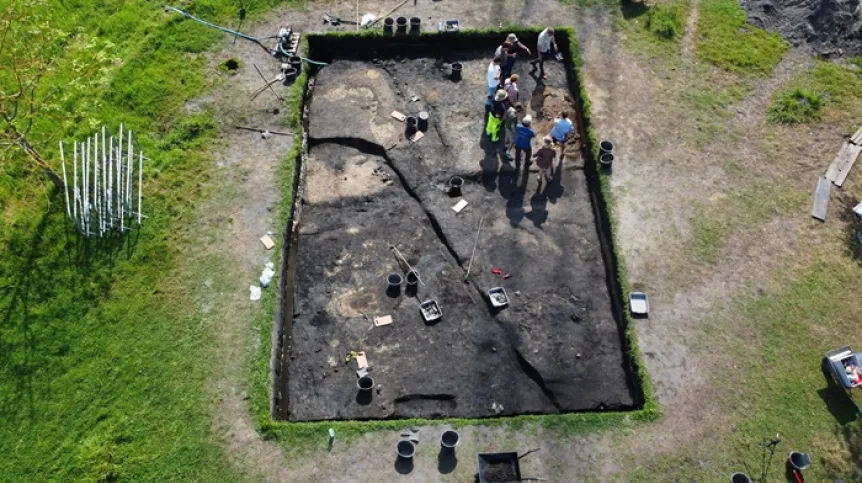
Excavations in Wolin, August 2025 (mb/awol)PAP/Marcin Bielecki
Posted on 01/22/2026 11:53:57 PM PST by SunkenCiv
According to a Science in Poland report, traces of four unusual huts dated to the eleventh or twelfth century have been uncovered on an island in the Baltic Sea near the coast of Poland. Researchers were excavating an area once known as Srebrne Wzgórze on the northern edge of the medieval town, where there had been a market and craft workshops, when they unearthed the huts. “They are platforms made of clay and sand, surrounded by a ditch,” said Wojciech Filipowiak of the Polish Academy of Sciences. “Some have a hearth, some have an oven,” he added. Pottery, animal bones, Norwegian whetstones, glass beads, and metal objects were also recovered. “We have not seen structures like this from this period in Wolin before,” Filipowiak explained. “We previously thought the town grew from the center. Now it seems that perhaps the center was occupied by Slavic people, and on Srebrne Wzgórze, at a distance sufficient for establishing contact, Scandinavians appeared,” Filipowiak suggested. He thinks that remains of the town’s original port, dated to the ninth or tenth century, may rest under the huts. To read about the submerged remnants of an eleventh-century fort that collapsed on an island in western Poland, go to "A Familiar Face."
(Excerpt) Read more at archaeology.org ...
Excavations in Wolin, August 2025 (mb/awol)PAP/Marcin Bielecki
My exes mother grew up in a fishing village in Dournanez, France. There was a 2nd century roman fish salting facility just above the bay, you could see the foundations very clearly almost 2000 years later.
Wow, thanks!
The level of industrial activity in the Roman Empire is often missed or even ignored because the ruins are a bit dull. Lots of mining, lots of ceramic production (roof tiles, along with various prefab tiles for other purposes such as heating ducts and floor shims), lead, iron, and other processing, and of course the ports needed to move everything.
At its peak the Roman Empire — basically the Med basin, varying sized parts of the Near East, and Western Europe — had an estimated 50 to 100 million people living in it. Massive production and massive consumption. And the reach of Roman trade was enormous, so there are Roman-era and -affiliated ruins well outside Roman rule.
https://www.alamy.com/stock-photo-roman-ruins-at-douarnenez-finistre-brittany-france-38414805.html
https://search.brave.com/search?q=douarnenez%20france%20roman%20ruin
Disclaimer: Opinions posted on Free Republic are those of the individual posters and do not necessarily represent the opinion of Free Republic or its management. All materials posted herein are protected by copyright law and the exemption for fair use of copyrighted works.