
Posted on 01/10/2026 12:17:36 PM PST by MtnClimber
Explanation: Jupiter reaches its 2026 opposition today, January 10. That puts our Solar System's most massive planet opposite the Sun and near its closest and brightest for viewing from planet Earth. In fact, captured only 3 days ago this sharp telescopic snapshot reveals excellent details of the ruling gas giant's swirling cloudtops, in light zones and dark belts girdling the rapidly rotating outer planet. Jupiter's famous, persistent anticyclonic vortex, known as the Great Red Spot, is south of the equator at the lower right. But two smaller red spots are also visible, one near the top in the northernmost zone, and one close to Jupiter's south pole. And while Jupiter's Great Red Spot is known to be shrinking, it's still about the size of the Earth itself.
For more detail go to the link and click on the image for a high definition image. You can then move the magnifying glass cursor then click to zoom in and click again to zoom out. When zoomed in you can scan by moving the side bars on the bottom and right side of the image.
Pinging the APOD list
🪐 🌟 🌌 🍔
Jupiter has a large red spot because the Jovians are demonstrating their solidarity with the workers, peasants and progressives everywhere.
The Great Red Spot is a lot less great than it used to be. It is half the size it used to be just in my lifetime.
Global warming....and SUVs....
Trump should annex it...make TGRS great again!
Yes, Trump, go big or go home! lol
Nice!
It must be Global Warming or Climate Change.

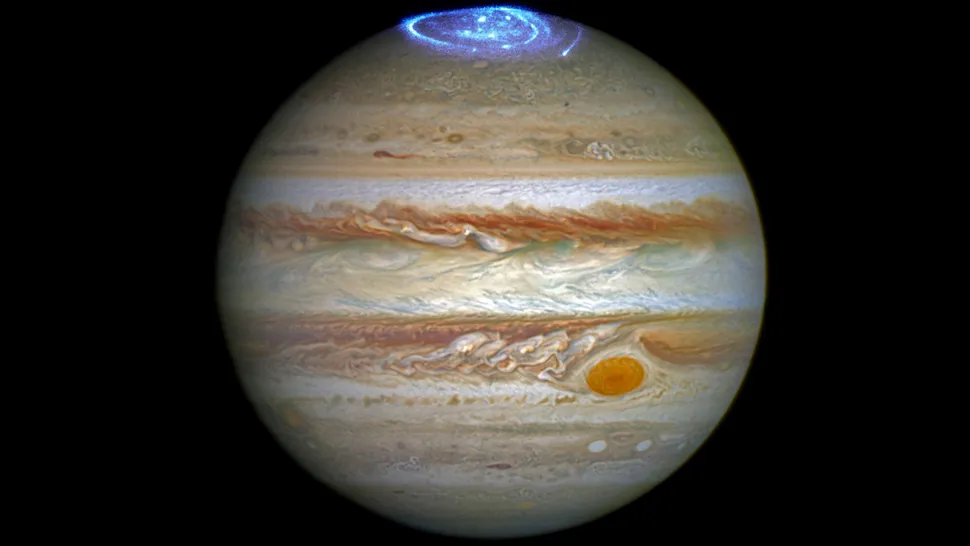

I love that Great Red Spot. It’s as if Mars is playing on Jupiter.
And Earth can fit into that red spot.
Jupiter’s Great Red Spot is a long-lived high-pressure storm,
winds over 200 mph, rotating counter-clockwise,
called an anticyclonic storm, larger than Earth.
The red color could be due to phosphine which has
four atoms of phosphorus (detected 11/2019),
or due to ammonia, ammonium hydrosulfide, and water
forming reddish materials, possibly tholins.
That’s what the Jovian people want you to think.
Exactly, comrade!
“The Great Red Spot is a lot less great than it used to be. It is half the size it used to be just in my lifetime.”
Your comment made me look up the historical sizes. I recall it has changed recently, but it’s been going on for a long time.
From Grok:
Has the size of Jupiter’s Red Spot changed over the past 100 years?
Searching the web
18 results
Browsing web page
Yes, the size of Jupiter’s Great Red Spot has decreased significantly over the past 100 years, based on historical observations and recent measurements. Here’s a breakdown of the key trends and data points:In the late 19th century (around 1879), the spot’s long axis measured approximately 39,000 km.
sci.news
This was during a period of more consistent larger sizes, though detailed records from the early 20th century (around the 1920s–1930s) are less precise but indicate it remained over 30,000 km in length.
By the 1970s–1980s, Voyager missions in 1979 captured it at roughly 23,000 km along its major axis, showing early signs of contraction.
In 1995, Hubble observations measured the long axis at about 21,000 km (13,020 miles).
science.nasa.gov
By 2009, it had shrunk to around 17,900 km (11,130 miles).
science.nasa.gov
In 2014, it was under 16,500 km.
esahubble.org
As of 2017, the width (shorter axis) was reported at 16,350 km, with the spot becoming more circular over time.
en.wikipedia.org
Recent data from 2024 indicates the current size is about 14,000 km, continuing the shrinking trend while also showing some short-term fluctuations and wobbling.
sci.news +1
Unofficial reports from 2025 suggest it may have dipped to around 12,000 km at times, though this could reflect temporary variations.
reddit.com
Overall, the spot has lost more than half its length since the early 20th century, transitioning from an elongated oval to a more compact, nearly circular shape.
planetary.org
The rate of shrinkage has accelerated in recent decades, though the exact cause remains under study—it may involve interactions with surrounding jets or internal dynamics.
news.yale.edu
18 web pages
Disclaimer: Opinions posted on Free Republic are those of the individual posters and do not necessarily represent the opinion of Free Republic or its management. All materials posted herein are protected by copyright law and the exemption for fair use of copyrighted works.
