Posted on 01/09/2026 3:00:11 PM PST by nickcarraway
Long before submarines and modern ocean exploration, Alexander the Great embarked on an underwater expedition that blurred the line between history and legend.
Beyond his military conquests, he constantly sought the unknown, from frozen northern deserts to mysterious islands, pushing himself into territories where no one else dared to venture. One story, preserved in the Pseudo-Callisthenes Alexander Romance, recounts an extraordinary underwater odyssey, blending daring, ingenuity, and mythical creatures that seem to leap from the page. Even in the realm of myth, few tales capture the adventurous spirit of Alexander like this one.
A journey in the dark: Northern deserts and the mysterious island
After leaving the familiar lands of Persia, Alexander led his army into northern deserts—territories unknown and feared. For ten days, the men marched across barren sand, seeing neither animals nor plants, only the endless horizon and unchanging sky. At times, the sun vanished entirely, leaving them in a cold, shadowed world.
Despite these harsh conditions, Alexander pressed on, driven by curiosity and ambition. Eventually, the army reached a coastal region unlike any other, where an island rose up from a strange, uncharted sea. Its sudden appearance stirred both excitement and apprehension. Alexander did not wait for his men to investigate. True to his bold nature, he ordered the construction of small boats to explore the island’s shores.
Brave soldiers swam to land, but danger lurked: giant crabs emerged from the water, their claws spanning as tall as a man. Some soldiers perished, dragged into the sea by the crushing pincers. Warnings from his men did not deter Alexander; he saw not threat but opportunity, treasure, and adventure.
Grecian Delight supports Greece
On the island, Alexander’s party discovered a colossal crab whose shell contained seven enormous pearls, shimmering like captured stars. Fascinated, Alexander believed these treasures came from the deepest reaches of the sea, far beyond the grasp of ordinary humans. Determined to claim them, he devised a daring plan: to descend into the underwater world and retrieve the pearls himself.
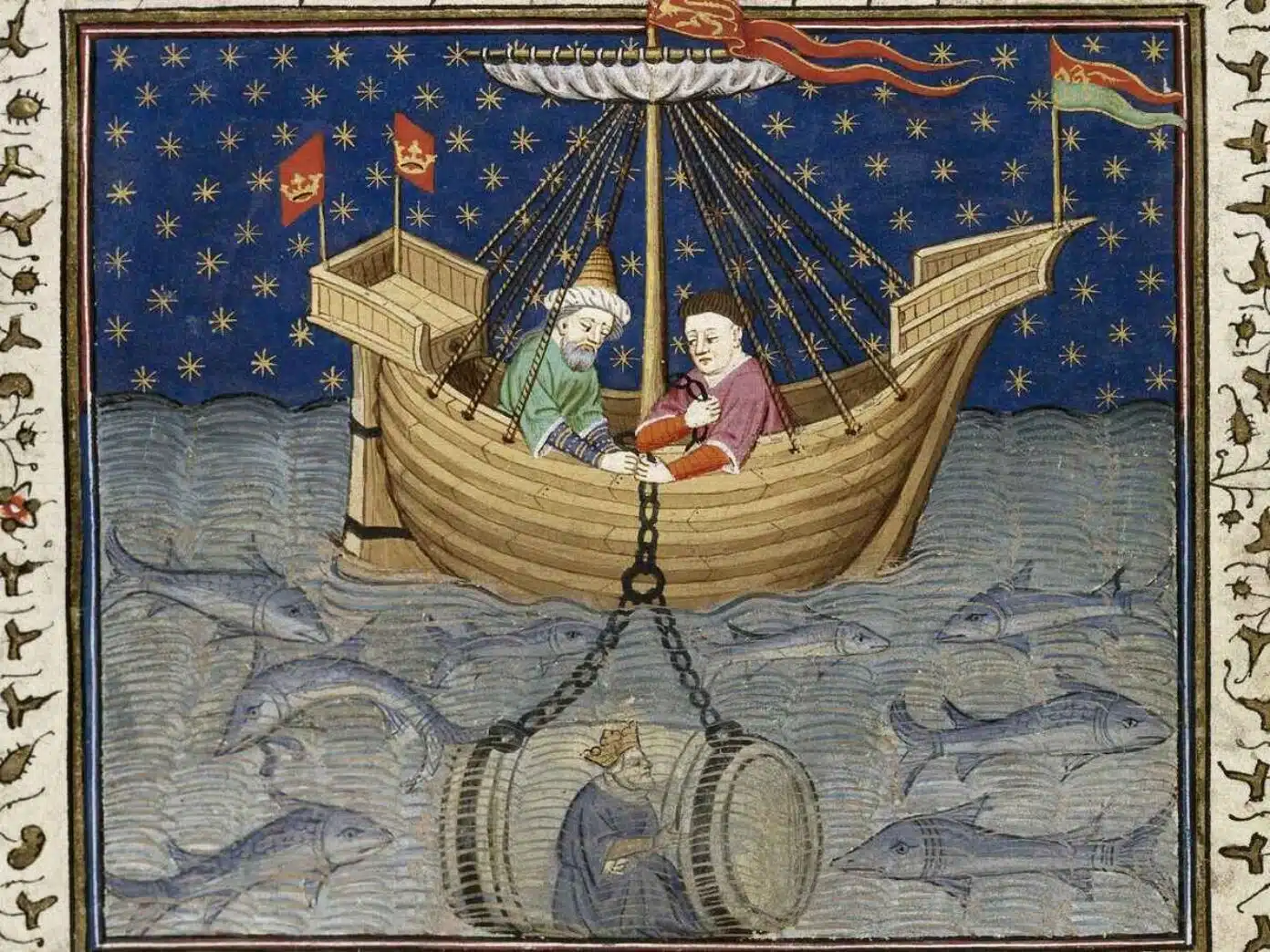
The primitive submarine: Early Greek underwater innovation The story introduces a remarkable invention: a primitive submarine. Engineers constructed a large iron cage enclosing a thick glass jar, reinforced to withstand water pressure. A hand-hole at the bottom allowed Alexander to retrieve treasures from the seabed. A massive chain, 308 cubits long, controlled descent and retrieval, while soldiers above followed precise instructions. This device functioned as an early underwater vessel, combining principles of air retention, protective enclosure, and controlled mobility.
This primitive submarine reflects a genuine tradition of underwater experimentation in Ancient Greece. Diving bells and air-holding vessels were used for brief submersion. Aristotle mentions sponge divers using simple helmets to remain underwater for short periods, and by the 4th century BC, Greek sponge divers employed weighted leather helmets and breathing tubes, staying submerged for several minutes to collect sponges.
Greek engineers, likely including students of Archimedes, also experimented with submerged reconnaissance and simple underwater devices for sieges or coastal defense. Alexander’s underwater adventure, therefore, represents a mythical embellishment of real Greek ingenuity, blending legend with plausible early technology.
The underwater adventure: Crabs, pearls, and giant fish
On the first descent, Alexander’s cage reached 120 cubits, roughly 180 feet. A passing fish brushed against it, jolting the vessel and forcing the soldiers to pull him back. Undeterred, he tried again, only to face the same interference. On the third attempt, he plunged to 308 cubits (462 feet), descending into an alien underwater world. Countless fish surrounded him, their scales flickering in the filtered light. The sea, alive with movement, seemed to both challenge and welcome him.
Suddenly, a giant marine creature appeared—described as a massive “fish” by the storyteller, though modern readers might imagine a whale or other large marine mammal. It seized the cage, carrying Alexander, his men, and the boats a full mile toward the shore. The creature’s immense strength crushed the iron cage, yet Alexander emerged alive, awed and humbled. Falling to his knees, he praised divine providence for his survival. The story dramatizes the meeting of human ingenuity with the raw power of nature, while the hero ultimately prevails.
Even before the dive, Alexander had displayed remarkable problem-solving skills. Constructing a cage capable of withstanding water pressure, complete with air access and a hand-hole, reflected an understanding of engineering principles far ahead of his time. While the tale stretches plausibility, it suggests that ancient storytellers were already aware of concepts such as air retention, pressure, and underwater exploration long before they became realities in Europe.
Alexander the Great confronted the unknown underwater odyssey with courage and caution
The underwater odyssey continued the legendary theme of Alexander personally facing danger. From the northern deserts to caverns, from the island of giant crabs to the depths of the sea, he confronted the unknown himself. He did not delegate risk but embraced it. Each challenge heightened suspense, blending natural observation, imagination, and heroic action. After surviving the ordeal, Alexander reflected: “Stop, Alexander, attempting the impossible; in searching the depths, you might also lose your own life.”
He immediately ordered the army to leave the island and continue their march. This moment adds a human touch to an otherwise incredible tale, showing that even heroes must exercise judgment. It underscores the fine line between courage and recklessness, and how careful reflection often follows even the boldest feats.
Biologically, the story incorporates plausible elements. Giant crabs exist, with some species reaching leg spans of up to three meters, and deep-sea creatures naturally inspire awe and fear in human observers. Pearls, though produced by mollusks rather than crabs, symbolize wealth and rarity, linking natural observation with legendary reward. Even the “giant fish” could represent a real marine mammal, such as a whale, lending a measure of plausibility to an otherwise extraordinary adventure.
Legacy of Alexander the Great’s underwater expedition
Alexander’s underwater odyssey fits seamlessly into his broader legacy as an explorer-hero. Each adventure, from the northern deserts to the exotic islands, reinforces his character: courageous, inventive, and fearless. He faces danger firsthand, overcomes impossible odds, and emerges with treasures, knowledge, and awe-inspiring stories. The narrative reads like a historical epic blended with a mythic adventure, filled with monsters, treasures, and legendary feats at every turn.
The tale captures the imagination because it combines action, suspense, and ingenuity. Alexander dives into the unknown, confronts mysterious creatures, survives extraordinary peril, and emerges triumphant—all while demonstrating his signature daring. The story reminds readers that true adventure lies in exploring uncharted realms, confronting extreme challenges, and pushing beyond ordinary limits.
Even today, the story resonates because it presents exploration as both thrilling and human. Alexander acts, survives, reflects, and moves forward. The underwater episode inspires awe while following a logical sequence of preparation, danger, and outcome, allowing readers to experience the pulse of the story as if they were part of the expedition.
Finally, the tale of Alexander, the giant crabs, the seven pearls, and the underwater cage endures as one of the most remarkable episodes of the Alexander romance. Readers cannot help but imagine themselves alongside him, witnessing the clash of human ingenuity with the immense power of nature.
mark
bkmk
He also didn't massacre Greeks in Central Asia.
Dan Carlin is covering Alexander the Great currently, in his series “Mania for Subjugation “.
It currently comprises three 4 hour podcasts. So far.
Excerpt reads a bit like the inspiration for Jules Vernes “20,000 Leagues under the Sea”.
Well that’s a tall tale.
The above story is a fanciful tale made up long ago, but just a tale, not a fact - by the time the glass tube descend over 60 fathoms the air inside would have become stale and beginning to consist of mostly CO2. Whoever was inside would be dead long before the tube was retracted.
Disclaimer: Opinions posted on Free Republic are those of the individual posters and do not necessarily represent the opinion of Free Republic or its management. All materials posted herein are protected by copyright law and the exemption for fair use of copyrighted works.
