Skip to comments.
Mystery of the Roman Amphora in Rio de Janeiro Bay [2:38]
YouTube ^
| August 7, 2021
| James Lynch Explorer
Posted on 12/26/2025 7:38:34 PM PST by SunkenCiv
Roman Amphora were discovered in 1975 buried in the sediment deep in the bay of Rio de Janeiro. Renowned scientists Sir Robert Marx, Dr. Harold Edgerton, Dr. Elizabet Will and I believe the Romans may have arrived in the New World over a thousand years before Columbus, and we are out to prove it. Mystery of the Roman Amphora in Rio de Janeiro Bay | 2:38
| 802 subscribers | 1,056 views | August 7, 2021

Bay of Jars Robert Marx [YouTube search]
(Excerpt) Read more at youtube.com ...
TOPICS: History; Science; Travel
KEYWORDS: ancientnavigation; bayofjars; clivecussler; ggg; godsgravesglyphs; robertmarx; romanempire
1
posted on
12/26/2025 7:38:34 PM PST
by
SunkenCiv
[Music]
Here's the drawings I made with the Roman wreck, and right here is the pinnacle that was sticking almost to the surface that the Roman ship hit. The history books all say Christopher Columbus discovered the New World. I don't believe that. I have a theory that the Romans arrived here 2,200 years ago, long before Christopher Columbus, and we have proof of that.
I'm James Lynch. I'm an explorer. I've been going into the deepest jungles and the deepest waters in South America for the last 40 years, looking for answers to mysteries and unexplained phenomena.[Music]
I'm still convinced that a big part of the wreck is covered over, which is great because that means nobody could have stolen, robbed, or plundered the site while we haven't worked on it all these decades. There is no doubt at all that it's a Roman wreck. When I went to Brazil in the Bay of Guanabara, I found intact Roman amphoras and lots and lots of broken ones. I joined Bob in 1983 when we were diving on this Roman wreck, or what we believe to be a Roman wreck, in Guanabara Bay.
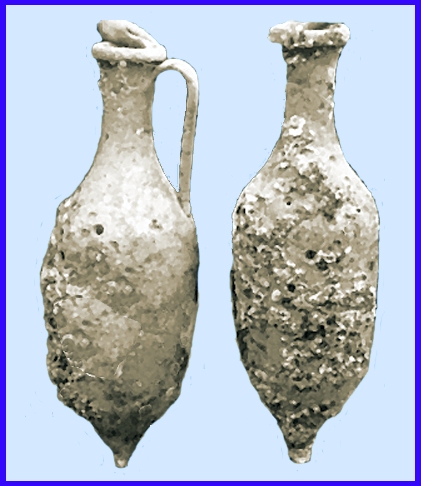
These are two necks of these Roman amphoras that we found at the Bay of Guanabara. These were called the five-gallon storage jugs of antiquity. The work was going forward really well until we had political problems in Brazil, and the project had to stop right there. We've sat on this for decades now; we have to go back. The evidence is there; we've seen it.[Music]
James and I want to go back and continue where I left off all those years ago. We have to bring all the pieces of this puzzle together in a way that is accepted by archaeologists today.[Music]
I want to solve the riddle of the Roman wreck, and I can't go to my grave until that's being taken care of. We'll prove that a Roman vessel entered Guanabara Bay 2,200 years ago and sunk there. If we can prove what we believe is true, it'll change history.YouTube transcript reformatted at textformatter.ai
2
posted on
12/26/2025 7:41:00 PM PST
by
SunkenCiv
(NeverTrumpin' -- it's not just for DNC shills anymore -- oh, wait, yeah it is.)
Keywords: bayofjars, robertmarx:
3
posted on
12/26/2025 7:41:27 PM PST
by
SunkenCiv
(NeverTrumpin' -- it's not just for DNC shills anymore -- oh, wait, yeah it is.)
[much earlier on FR] [Photo from Professor Legner Faculty Homepages]
 |
The Brazilian find was made forty years ago or thereabouts, by Robert Marx, who's a great diver (or was) but without academic credentials. Since "academice credentials" means, in part, indoctrination into the nonsense of isolationism, it's difficult at best to find someone who will dive in a remote location as in where the ancient (?) wreck was found near the coast of Brazil.
|
Romans in rio? | Science Frontiers #28 | Jul-Aug 1983 In 1976, diver Jose Roberto Texeira salvaged two intact amphorae from the bottom of Guanabara Bay, 15 kilometers from Rio de Janeiro. Six years later, archeologist Robert Marx found thousands of pottery fragments in the same locality, including 200 necks from amphorae.
Amphorae are tall storage vessels that were used widely throughout ancient Europe. These particular amphorae are of Roman manufacture, circa the second century B.C. Much controversy erupted around the finds because Spain and Portugal both claim to have discovered Brazil around 1500 A.D. Roman artifacts were distinctly unwelcome. More objectively, the thought of an ancient Roman crossing of the Atlantic is not so farfetched. Roman wrecks have been discovered in the Azores; and the shortest way across the Atlantic is from Africa to Brazil -- only 18 days using modern sailing vessels. (Sheckley, Robert; "Romans in Rio," Omni, 5:43, June 1983.)
|
The Roman Amphora -- Learning from Storage Jars | Elizabeth Lyding Will | Biblical Archaeology Review Just how far did the Romans go? Is there a Roman ship off the Azores, as some say? Are there thousands of Phoenician and Roman amphora fragments on Salt Island in the Cape Verdes, as reported by the underwater salvor Robert Marx? Is the "Rio Wreck," at the bottom of Guanabara Bay near Rio de Janeiro, Brazil, a Roman ship that in ancient times was blown off course?
Twice a year London's Sunday Times phones me to ask if I know anything more about the Rio Wreck. The highly publicized amphoras Robert Marx found in the ship are in fact similar in shape to jars produced in kilns at Kouass, on the west coast of Morocco. The Rio jars look to be late versions of those jars, perhaps datable to the third century A.D. I have a large piece of one of the Rio jars, but no labs I have consulted have any clay similar in composition. So the edges of the earth for Rome, beyond India and Scotland and eastern Europe, remain shrouded in mystery. |
4
posted on
12/26/2025 7:45:59 PM PST
by
SunkenCiv
(NeverTrumpin' -- it's not just for DNC shills anymore -- oh, wait, yeah it is.)
To: StayAt HomeMother; Ernest_at_the_Beach; 1ofmanyfree; 21twelve; 24Karet; 2ndDivisionVet; 31R1O; ...
5
posted on
12/26/2025 7:47:14 PM PST
by
SunkenCiv
(NeverTrumpin' -- it's not just for DNC shills anymore -- oh, wait, yeah it is.)
6
posted on
12/26/2025 7:51:47 PM PST
by
SunkenCiv
(NeverTrumpin' -- it's not just for DNC shills anymore -- oh, wait, yeah it is.)
To: SunkenCiv
7
posted on
12/26/2025 8:08:50 PM PST
by
ansel12
((NATO warrior under Reagan, and RA under Nixon, bemoaning the pro-Russians from Vietnam to Ukraine.))
To: SunkenCiv
The history books all say Christopher Columbus discovered the New World.
Oh, heck. When I was in elementary school in the 1970s, we were using history books from the 1950s. Even then Leif Erikson was credited with beating Columbus. Columbus gets credit with making it stick. If you get there, and die and no one back home knows . . . no credit. If you get there, shrug your shoulders, and go back and no one knows what you found . . . no credit. If you think you found India, but found Hispaniola, but Portugal, England, Holland, and France are racing to check it out? Credit, and a bunch of cities, countries and a day named after you.
8
posted on
12/26/2025 8:34:08 PM PST
by
Dr. Sivana
("Whatsoever he shall say to you, do ye." (John 2:5))
To: SunkenCiv
9
posted on
12/26/2025 8:56:30 PM PST
by
TigersEye
(The primary Democrat/leftist strategy is "Create maximum chaos every which way you can.")
To: SunkenCiv
I took photos in Pompeii of two recovered Roman Amphora sitting on a stone ledge. After taking the photos, a site worker ran over yelling that I wasn’t supposed to be in that area.
10
posted on
12/26/2025 9:39:55 PM PST
by
jonrick46
(Leftniks chase illusions of motherships at the end of the pier.)
To: Dr. Sivana
It was Columbus that caused migration and colonization the Americas.
11
posted on
12/27/2025 5:43:58 AM PST
by
Vaquero
(Don't pick a fight with an old guy. If he is too old to fight, he'll just kill you. )
To: Vaquero
12
posted on
12/27/2025 6:00:37 AM PST
by
Vaduz
(?.)
To: SunkenCiv
Have the descendants of the original natives been DNA tested for the presence of Roman genes?
13
posted on
12/27/2025 12:20:15 PM PST
by
JimRed
(TERM LIMITS, NOW! Finish the damned WALL! TRUTH is the new HATE SPEECH! )
To: SunkenCiv
14
posted on
12/27/2025 12:28:00 PM PST
by
PeterPrinciple
(Thinking Caps are no longer being issued, but there must be a warehouse full of them somewhere)
To: ansel12
The name “bay of Jars” (in Portuguese) was on at least one map in the middle of the 19th century, so, unless the guy making the claim of salting the site has a time machine, complete BS. The accusation against Marx was likewise BS.
15
posted on
12/27/2025 5:06:26 PM PST
by
SunkenCiv
(NeverTrumpin' -- it's not just for DNC shills anymore -- oh, wait, yeah it is.)
To: JimRed
There are indiginous people they found with blue eyes.
To: jonrick46
😊 Over the years tourists at Pompeii have carried things off and managed to get them out of the country. I’m glad they’re taking things more seriously.
17
posted on
12/27/2025 7:40:48 PM PST
by
SunkenCiv
(NeverTrumpin' -- it's not just for DNC shills anymore -- oh, wait, yeah it is.)
Disclaimer:
Opinions posted on Free Republic are those of the individual
posters and do not necessarily represent the opinion of Free Republic or its
management. All materials posted herein are protected by copyright law and the
exemption for fair use of copyrighted works.
FreeRepublic.com is powered by software copyright 2000-2008 John Robinson
