Skip to comments.
Pantheon Inside and Out: Hidden Rooms Now Open [8:20]
YouTube ^
| December 16, 2025
| Darius Arya Digs
Posted on 12/19/2025 5:42:39 PM PST by SunkenCiv
Behind the Pantheon lies a hidden world long closed to the public. In this episode, I explore the newly opened grottoni—the vaulted service spaces that were part of a structural solution to a fault in the southern end of the rotunda construction. We trace how these hidden rooms functioned in antiquity, how they evolved alongside the Pantheon’s transformation into a Christian church, and how they were directly adjacent to the Basilica of Neptune. Today, these forgotten spaces have been reimagined as a museum, revealing the Pantheon not as a frozen monument, but as a living building shaped by two thousand years of use, belief, and adaptation. Pantheon Inside and Out: Hidden Rooms Now Open | 8:20
Darius Arya Digs | 35.1K subscribers | 32,707 views | December 16, 2025

Pantheon vids from Darius
Explore the secret rooms of the Pantheon [11:00] [01/09/2024]
(Excerpt) Read more at youtube.com ...
TOPICS: History; Science; Travel
KEYWORDS: dariusarya; godsgravesglyphs; pantheon; romanempire
Navigation: use the links below to view more comments.
first 1-20, 21-22 next last
YouTube transcript reformatted at textformatter.ai
You know the Pantheon. It's the best preserved ancient Roman monument, the best temple from imperial times. What you don't know is the Gratton. And these are structural rooms behind the Rotunda that serve to shore up the backside of the Rotunda wall. Now it's a site that you can visit every day. Let's go explore this new experience to understand better the Imperial world. I've already shown you these gratoni spaces in a previous video, but now we can visit the site on a daily basis with a new museum installation. You get a separate ticket and enter here in the back.
You've stepped inside the graton spaces, the grotto as they became known, structural rooms constructed to support the rotunda on the south side of the Pantheon. Here we can view a space that's been converted into a chapel containing the 7th-century icon that used to be on display inside the Pantheon when it was first converted into a church: Santa Maria ad Martes in 609. It's rarely on public display, but we can admire it here. We walk under some massive arches and then the area is narrow as we pass behind the bulge of the apses of the adjacent building, the Basilica of Neptune.
We ascend the modern staircase or take the elevator into the larger upper rooms in which the museum has been installed. The walls and the vaulting are the impressive remains of the grotto radial vaults butting up against the southern end of the Pantheon rotunda that had some structural failings during its construction. All right, with this new museum space, you've got examples of Christian Rome. You've got examples of medieval Rome. You've got examples of how they constructed it and its placement within the Campus Martius. It's a great experience. It's didactic. It's accessible. It's extraordinary.
And then where are we? We're in the actual physical spaces. Look at this. We're inside the Gratton on two floors. This is a masterful presentation of all this information. It's a place you need to come and visit. These views of Jizandi's famous plasto of Rome show us the porch and the rotunda of the Pantheon as well as the Grattoni spaces and the adjacent Basilica of Neptune, a large hall that was probably part of the Baths of Agrippa. A neighborhood plan helps set the scene. This close-up plan clearly shows the Pantheon porch, rotunda, and the graton spaces neatly wedged in right behind the rotunda, followed by the Basilica of Neptune Hall.
The reconstruction drawing by Gors Jedan and his model help put it in perspective, as does the model of the Pantheon that shows us what is preserved today of the Grattoni and the small portion of the Basilica of Neptune. So right now I'm inside the so-called Basilica of Neptune, but it's been gobbled up by modern buildings. This was an enormous hall that was part of the bath complex of Agrippa that's going to be rebuilt in the Hadrianic period as you have the rebuilding of the Pantheon.
So directly behind this building, this apt is going to encroach upon the graton. To understand the Basilica of Neptune, let's now walk behind the Gratton spaces and into the remains of the Basilica of Neptune that directly abuts the Gratton Hall and look at the original ground level. And we can admire the interior architectural features with some anesallosas of the column. Here we can see the dolphin and the trident features of the frieze that help us identify this as the Basilica of Neptune, originally built by Agrippa who won the sea battles of Naulochus in 36 BC and of Actium in 31 BC for Augustus.
Inside, the museum has a display of some of the original fragments of the entablature that we can admire at eye level. There are also impressive videos that show imaginative reconstructions of the Basilica of Neptune with its once impressive vaulting as well as marble veneered walls. The statue base in the niche was once filled with a colossal statue of Neptune or maybe Hadrian. Truly, this was a masterpiece in the Campus Martius that mirrored the decoration of the Pantheon itself.
Other videos help us envision the Campus Martius, that floodplain of Rome that changes over time. Here we see images of the area before the construction of the Augustan age buildings. We just see the Theater of Pompey and the Largo Argentina temples. We can really get a good sense of the Pantheon as it stands today from the porch to the rotunda. And now this accurate view of the Gratoni Hall as well as the preserved remains of the Basilica of Neptune.
The museum also displays these two nearly identical carved slabs that were originally placed in the porch or pronaos of the Pantheon. They were discovered in 1874. They had been reused as steps. Let's look at this important collection of brick stamps that date from the reign of Trajan to the reign of Hadrian.
The Pantheon burned down in 110. So it is now certain that these manufacturer stamps underline that the reconstruction of the building started under Trajan, if not the design of his famous architect Apollodorus of Damascus. And the Pantheon was completed then in the reign of Hadrian. One of the most frequently appearing stamps is that of Capitanis Favore, Aquilius Acidius, and Portidius Agustales of the Trojanic Hadrianic era. There are also brick stamps from the reigns of dimmission of the severs that refer to the periods of restoration.
In fact, the Dimianic Pantheon replaced a grippless Pantheon that was then destroyed in 110 to be replaced by the Pantheon we have up today. The Oculus opening in the dome allowing sunlight created a sort of interior sundial. Although we are not sure about Agria's original Pantheon, the Trojanic Hadrianic one displays all kinds of stunning experiences, in particular on the solstices and the equinoxes. The only problem with the displays today is that they refer to the sky of the 21st century and not that of the original sky when the Pantheon was designed in the 2nd century AD. So the light shows of today were not those of 1900 years ago. Stay tuned for some new scholarship on where the light would strike the interior spaces as originally intended.
The Crettoni Museum space also displays some interesting artifacts from the Christian era, beginning with the impressive marble chaborium, the canopy-like structure over the altar, and it dates to 750 to 850. Here's an early 6th century marble screen slab. Here's a fresco fragment of the 12th to 13th centuries from the main chapel dedicated to St. Thomas, later replaced by the tomb of King Umberto I. We have a 13th century decorative panel for a tomb or a wall. Portion of a fresco from the 14th century from the main chapel. Here's a tomb slab of Kola Deao dating to 1410. A 15th century fragment by Innocent VI of a Presbyterian enclosure. A fascinating 17th century alms box reusing an ancient altar. There are 17th century tombs. There's an inscription from Clemens the 11th of 1718. There's an original edicule that held the icon dating to 1711 and an 18th century tabernacle. There are 18th and 19th century busts of cardinals in the canon of Santa Maria at Martises. And the rooms also house a lot more from the church and from the Basilica of Neptune.
It's amazing to consider such an impressive museum space originally used just for structural purposes now gives us a really good look at Roman engineering and architecture at the same time. This is quintessential high empire in its building. And now it's time to exit.
We go from the grotto into this tight little space to go inside the Pantheon. One of the great experiences you get when you're in the back rooms. Unbelievable. Look where we are, from the Gaton into the Pantheon. What an experience.
Thanks for joining me inside the Pantheon, behind the Pantheon to those hidden, unexplored spaces. You can follow me on YouTube, Instagram, and X. It's always Darius Arya Digs. We'll see you somewhere ancient in Rome and throughout the Mediterranean.
1
posted on
12/19/2025 5:42:39 PM PST
by
SunkenCiv
More from the Pantheon keyword, sorted:
2
posted on
12/19/2025 5:45:16 PM PST
by
SunkenCiv
(NeverTrumpin' -- it's not just for DNC shills anymore -- oh, wait, yeah it is.)
To: StayAt HomeMother; Ernest_at_the_Beach; 1ofmanyfree; 21twelve; 24Karet; 2ndDivisionVet; 31R1O; ...
3
posted on
12/19/2025 5:45:52 PM PST
by
SunkenCiv
(NeverTrumpin' -- it's not just for DNC shills anymore -- oh, wait, yeah it is.)
YouTube’s “a grippless Pantheon” s/b “Agrippa’s Pantheon”.
4
posted on
12/19/2025 5:46:46 PM PST
by
SunkenCiv
(NeverTrumpin' -- it's not just for DNC shills anymore -- oh, wait, yeah it is.)
To: SunkenCiv
Fascinating. I found the video hard to watch. The guy seems to be in love with his face. He pans his camera around, supposedly showing the gratin spaces, but careful to keep himself in the foreground at all times.
5
posted on
12/19/2025 6:19:39 PM PST
by
jimtorr
To: SunkenCiv
6
posted on
12/19/2025 6:30:41 PM PST
by
Albion Wilde
(To live free is the greatest gift; to die free is the greatest victory. —Erica Kirk)
To: SunkenCiv
I subscribe to Darius’s videos, and have already watched this one. Since I’ll never manage to get there, I enjoy his walks to the various parts of the city and the work being done in the forum. I started watching his old videos, but there’s 10 years worth, and I’ll likely never get through them all before I die.
7
posted on
12/19/2025 6:41:21 PM PST
by
mass55th
(“Courage is being scared to death, but saddling up anyway.” ― John Wayne)
To: SunkenCiv
Thanks for finding and posting this video — very interesting material showing many aspects of the Pantheon I never knew existed.
To: Chewbarkah; Albion Wilde
9
posted on
12/19/2025 7:49:27 PM PST
by
SunkenCiv
(NeverTrumpin' -- it's not just for DNC shills anymore -- oh, wait, yeah it is.)
To: mass55th
Thanks. I don’t imagine I’ll get there either. I like the concision and articulation of his presentations. Plus, I got to use concision in a sentence for the first time. 😁
10
posted on
12/19/2025 7:50:59 PM PST
by
SunkenCiv
(NeverTrumpin' -- it's not just for DNC shills anymore -- oh, wait, yeah it is.)
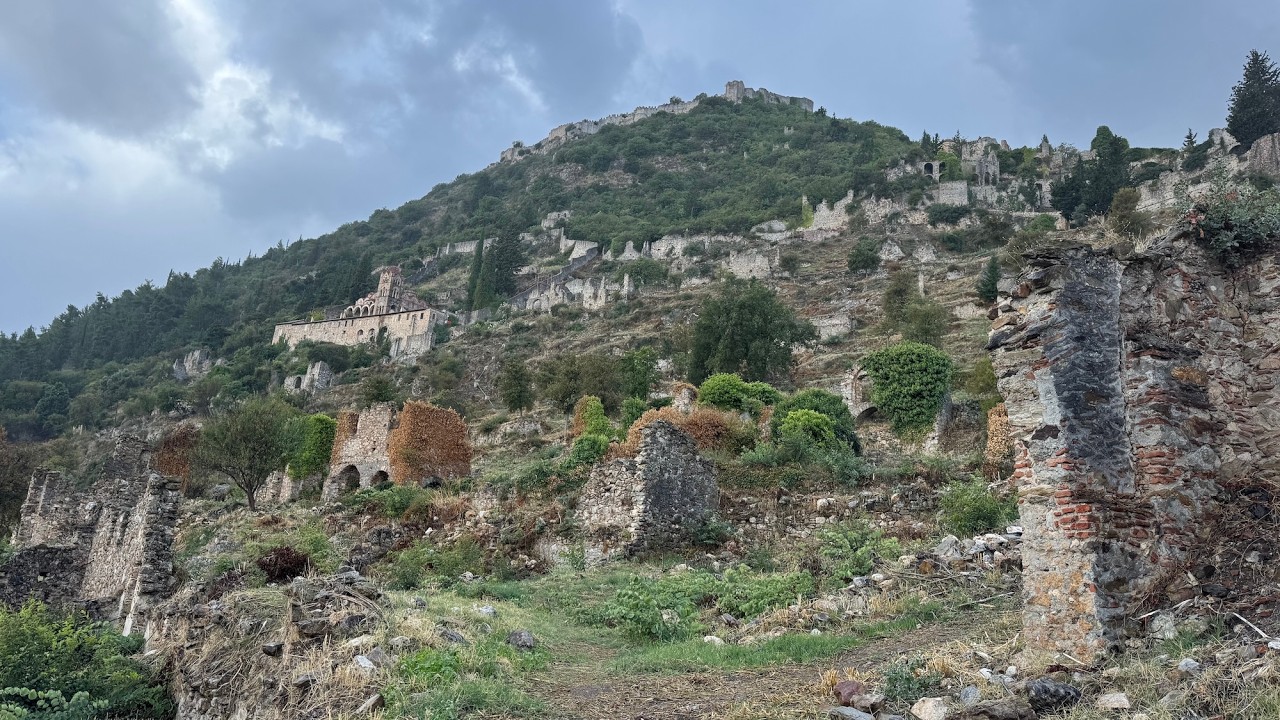
From 1349 to 1460, Mystras was capital of the Byzantine Despotate of the Morea. The ruins of its palaces and churches are among the most evocative sights in Greece. Mystras: final outpost of Byzantium | 8:45
Scenic Routes to the Past | 50.9K subscribers | 1,476 views | December 19, 2025
0:00 Introduction
1:42 Pantanassa
3:42 Brontochion
4:44 Metropolis
6:34 Palace Complex
7:31 Hagia Sophia
7:59 Castle
YouTube transcript reformatted at textformatter.aiIntroduction
For a century, Mistras or Mistra was the capital of the despotate of Mora, an autonomous Byzantine principality that covered most of the Peloponnese. The despots were princes of the Paleologan dynasty, often sons or brothers of the emperor in Constantinople. As the Ottomans closed in, Mistras became one of the last beacons of Byzantine culture, famed for the skills of its court artists and scholars, including the great Platonist Gistus Plethon.
Though never on the scale of Thessaloniki or Constantinople, Mistras was a substantial city with a population of more than 40,000. Byzantine rule survived until 1460, seven years after the fall of Constantinople. Thereafter, despite another brief era of prosperity under the Venetians, Mistras slowly declined, becoming a virtual ghost town by the 19th century.
Despite its proximity to Sparta, Mistras has no ancient history. The first structure on the site was a castle built in 1249 by the Frankish prince William de Vardas.
Most of the extant structures, however, were built under the Byzantine despots. Walls of that era divide Mistras into upper and lower towns. Most people lived in the lower town, but the rich resided in the upper town near the palace of the despots.
Although most of the houses in Mistras are now very ruinous, seven Byzantine churches are still preserved. Let's climb up to see a few of those churches. That climb is not for the faint of heart, but the views aren't half bad.The Churches of Mistras
The Pantanassa church, begun in the mid-14th century and renovated in the 15th, shows an interesting blend of Western and Byzantine influences. The middle register of the exterior had pointed Gothic arches, as does the bell tower. Just above, however, is the elaborate brickwork typical of late Byzantine churches.
A better look at those Gothic arches. Let's go inside. I couldn't talk inside, but I'm sure the frescoes spoke for themselves. They're often described as among the finest products of late Byzantine art.
Onward and upward. The huge monastic complex known as the Brontochion had two churches, both still extant. The first church, Hagi Theodoroy, is remarkable chiefly for the finesse of its stonework. The other, more impressive church was Panagia Hodegetria. And there it is. This was the most architecturally sophisticated church at Mistras, apparently inspired by contemporary work at Constantinople.
The interior is especially remarkable, and we'll go inside now. A few frescoes survive, for the marble slabs that once lined the walls are long gone. Notice how bright the interior is.Metropolis
The most important church in Mistras was the Metropolis, the cathedral built in 1291 and renovated many times. Metropolis has a rather odd plan with three aisles, as in a Western-style basilica, but a Greek cross plan crowned by a dome. This is the result of a 15th-century renovation which added a second story and the dome. The frescoes we'll see inside are mostly Byzantine but heavily restored inside the Metropolis.
No matter how much time you spend at Mistras, you never quite get accustomed to the breathtaking beauty of the place. Don't slip, though. An especially impressive collection of ruined houses is here. And off to our right, another astonishing view of the Eurotas Valley.Palace Complex
We are now approaching the palace complex. This plaza, almost the only large level place in Mistras, was the city's most important public place. The highlight just behind it was the palace of the despots. Begun by William de Vardas, it was extended and modified by a series of Byzantine rulers. It had two long wings. One contained the kitchens and private rooms of the rulers. The other had the chief public rooms, including the great throne room. Twice, in 1408 and 1415, the emperor himself held court. One more overview of the palace: the throne room was in the wing to our left.Hagia Sophia
Hagia Sophia was the palace church of the despots. The frescoes are obliterated, but part of the marble floor is well preserved.Castle
Finally, we reach the castle built by the Franks in the 13th century. Though restored several times, the plan never changed. The view was and is magnificent, taking in the Eurotas Valley and the mountains that guarded both ancient Laconia and Mistras, the final bastion of Byzantine Greece. One final panorama with a rainbow for good measure.
11
posted on
12/19/2025 8:10:44 PM PST
by
SunkenCiv
(NeverTrumpin' -- it's not just for DNC shills anymore -- oh, wait, yeah it is.)
To: SunkenCiv
"Plus, I got to use concision in a sentence for the first time."
🤣🤣🤣
12
posted on
12/19/2025 8:36:14 PM PST
by
mass55th
(“Courage is being scared to death, but saddling up anyway.” ― John Wayne)
To: SunkenCiv
I gotta go back...I love the marvel that the Pantheon is. The videos are probably better and explain more but I want to SEE it.
Soi many new places being opened like the Emperor’s tunnel at the Coliseum and parts of the Domus Aureus...
Just not sure how safe it is anymore between the cultural diversity and the throbbing volcanoes...
13
posted on
12/20/2025 3:02:10 AM PST
by
Adder
(End fascism...defeat all Democrats.)
To: SunkenCiv
Agrippa That was one very cool dude!
14
posted on
12/20/2025 7:12:50 AM PST
by
GingisK
To: GingisK
Augustus and Agrippa would make a great buddy movie, nice costume drama. 🎭
15
posted on
12/20/2025 7:45:18 AM PST
by
SunkenCiv
(NeverTrumpin' -- it's not just for DNC shills anymore -- oh, wait, yeah it is.)
To: Adder
If I ever get to Italy, it’s one of my must-sees.
16
posted on
12/20/2025 7:47:06 AM PST
by
SunkenCiv
(NeverTrumpin' -- it's not just for DNC shills anymore -- oh, wait, yeah it is.)
To: jimtorr
Because he’s not an uh- and um- kind of guy, he does a lot of his narration on the fly (I suspect) which minimizes the amount of editing he has to do later, and doesn’t have to edit in a separate soundtrack. I also like that he gets to the point. One common failing of YouTubers is how they spend time developing a splash intro, then another two minutes telling the viewer information that was in the title.
17
posted on
12/20/2025 8:04:51 AM PST
by
SunkenCiv
(NeverTrumpin' -- it's not just for DNC shills anymore -- oh, wait, yeah it is.)
To: SunkenCiv
Are they still waiting for the proper length columns for the portico to be delivered?
And RE: “concision,” isn’t that what a mohel is for?
To: Paal Gulli
19
posted on
12/20/2025 12:28:25 PM PST
by
SunkenCiv
(Kudos to the Admin Moderator, reason: "Randspam" [ 4354167 ])
To: SunkenCiv
20
posted on
12/20/2025 7:39:51 PM PST
by
GingisK
Navigation: use the links below to view more comments.
first 1-20, 21-22 next last
Disclaimer:
Opinions posted on Free Republic are those of the individual
posters and do not necessarily represent the opinion of Free Republic or its
management. All materials posted herein are protected by copyright law and the
exemption for fair use of copyrighted works.
FreeRepublic.com is powered by software copyright 2000-2008 John Robinson
