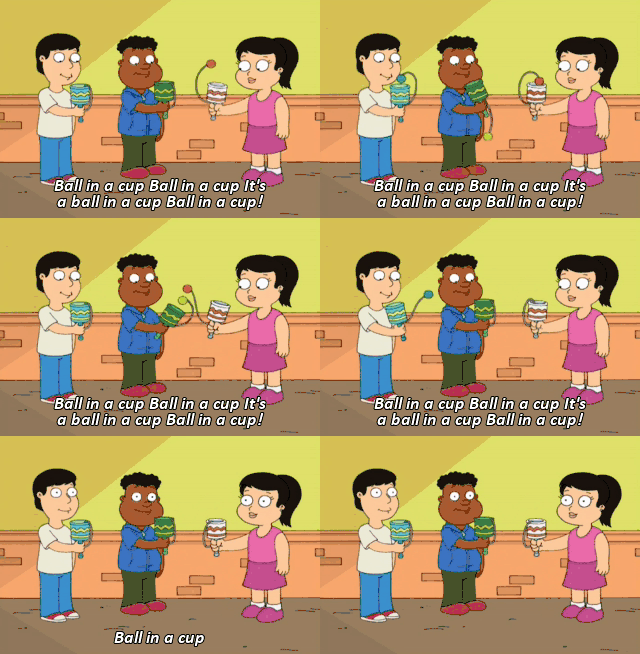
Oh, we understand it. Many of us even played it. We just don't care for it. We don't care for "ball in a cup" either.
Posted on 11/15/2025 7:42:28 PM PST by DoodleBob
Soccer may be the world’s most popular sport, but in the U.S., its rise to mainstream status has been anything but smooth. Despite steady growth, the game still faces hurdles that have slowed its acceptance, from cultural disconnects and stiff competition from other major sports to challenges in youth development and infrastructure.
While more Americans are embracing the sport, breaking into the country’s deeply rooted sports culture remains an uphill battle. The question isn’t whether soccer can thrive in the U.S., but what it will take to finally cement its place among the nation’s biggest sports.
16. Resistance to Adopting International Soccer Culture
While American soccer fans have embraced some aspects of international soccer culture, there’s resistance to fully adopting foreign traditions. This includes a hesitancy to incorporate non-English chants and a wariness of hooliganism. The desire for an “authentic” soccer experience sometimes leads to misguided attempts at replicating negative aspects of European fan culture.
15. Oversaturation of Sports Market in America
The American sports landscape is already crowded with established leagues like the NFL, NBA, MLB, and NHL. Soccer faces stiff competition for viewership, sponsorships, and talent. With limited time and resources, many sports fans are reluctant to add another major sport to their regular viewing habits.
14. Time Zone Differences for International Matches
Major international soccer tournaments often occur at inconvenient times for American viewers due to time zone differences. The 2022 World Cup in Qatar, for instance, had matches kicking off as early as 5:00 AM EST, making it challenging for U.S. fans to watch live. This scheduling conflict reduces engagement and hinders the sport’s growth in America.
13. Difficulty in Developing Technical Skills
American youth soccer often focuses on repetitive cone drills rather than dynamic, game-like scenarios that emphasize decision-making. This approach hinders the development of crucial technical skills needed for high-level play. Shifting to more engaging training methods could significantly improve player development and competitiveness.
12. Lack of Soccer-Specific Infrastructure
Despite recent progress, America still lags behind in soccer-specific infrastructure. While MLS teams are building more dedicated stadiums, like NYCFC’s upcoming Etihad Park in Queens, the overall number remains limited compared to other sports. This shortage of proper facilities hinders player development and fan engagement, potentially slowing soccer’s growth in the US.
11. Stigma of Soccer Being a “Kids’ Sport”
Soccer in America often struggles to shed its image as primarily a youth activity. Many adults view it as a sport for children, not a serious professional endeavor. This perception limits soccer’s growth and appeal among older demographics, hindering its ability to compete with established American sports leagues.
10. Preference for High-Scoring, Action-Packed Games
Americans tend to favor sports with frequent scoring and constant action. NBA games average over 220 points, while NFL games typically see 40-50 points. Soccer’s low-scoring nature, often with 1-0 or 2-1 results, doesn’t align with this preference for high-octane entertainment that keeps viewers engaged throughout.
9. Absence of College Soccer Pipeline to Pros
Unlike other American sports, college soccer doesn’t serve as a significant pipeline to professional leagues. The NWSL’s recent elimination of the college draft further weakens this pathway, making it harder for young talent to transition to the pros. This lack of a clear developmental route discourages many aspiring players.
8. Limited Success of U.S. Men’s National Team
Despite recent improvements, the USMNT’s international performance remains inconsistent. In 2025, they’ve won two friendlies but face tough competition in the CONCACAF Nations League and Gold Cup. Their FIFA ranking of 16th reflects progress, but they still lag behind soccer powerhouses, dampening widespread enthusiasm.
7. Complex Rules and Officiating for New Fans
Soccer’s rules, particularly offside and advantage, can be confusing for newcomers. The sport’s continuous play and reliance on referee discretion often lead to controversial calls, frustrating American viewers accustomed to clear-cut rulings and video reviews in other sports. This complexity can deter casual fans from fully engaging with the game.
6. Insufficient Media Coverage and TV Deals
Despite recent progress, soccer still lacks comprehensive media coverage in the U.S. The 2025 MLS Media Day showcased efforts to increase visibility, including a new docuseries on Apple TV+. However, compared to other major sports, soccer’s media presence remains limited, hindering its growth and mainstream appeal.
5. Perception of Soccer as a “Foreign” Sport
Soccer is often viewed as a “foreign” sport in America, with over 60% of American sports enthusiasts showing no genuine interest. Despite its global popularity, soccer struggles to compete with established American sports like baseball, football, and basketball. This perception hinders its acceptance as a mainstream sport in the U.S.
4. Lack of Homegrown Soccer Superstars
While MLS has produced talented players, the U.S. lacks a true homegrown soccer superstar to captivate the nation. The most promising young talent, like Christian Pulisic, often leaves for European leagues early in their careers, hindering the development of local icons that could inspire widespread interest in the sport.
3. Scheduling Conflicts with Other Major Sports
Major League Soccer faces significant scheduling challenges, competing for viewers with established American sports leagues. The MLS season overlaps with the NFL, NBA, and MLB, making it difficult to attract consistent audiences. Additionally, international tournaments and breaks disrupt the MLS schedule, further complicating efforts to build a loyal fanbase.
2. Absence of Promotion and Relegation in MLS
Major League Soccer’s closed system lacks the excitement of promotion and relegation found in European leagues. Without the threat of demotion or the thrill of ascension, MLS teams have less incentive to improve, and lower-division clubs are denied pathways to the top. This structure limits competitiveness and fan engagement, hindering soccer’s growth in America.
1. Pay-to-Play Youth Soccer System
The pay-to-play model in American youth soccer creates a significant barrier to entry for many talented young players. With average annual costs of $1,188 per child, families unable to afford these fees are often excluded from high-level youth soccer programs. This system limits the talent pool and hinders the development of potentially elite players from diverse socioeconomic backgrounds.
I went to 6th, 7th and 8th grades in southern Italy (Navy brat) and they taught us the metric system in school. We all learned it and then promptly forgot most of it not long after returning to the States.
I have films from my father playing rugby in 1955 in Japan when he was stationed there flying off aircraft carriers with the marines
I knew another one of the guys who was in the film.
I went to a rugby game where my brother in law was playing. Tough stuff. Fun. The guys were fun.
2 yellows equal 1 red. I know, rarely does a player get a second yellow, but it does happen once in a while.
These aren't interceptions of great skill. The quarterback just sucks. No one wants to watch a quarterback get picked off repeatedly. There's a number of interceptions, I'd say five by one quarterback, where fans would stop watching a football game.
And no one wants to watch interceptions that rarely, if ever, lead to scores.
Marathon runners are fit. So are swimmers, cyclists, gymnasts, etc. No one is watching those at any level close to football, baseball, hockey, etc.
Babe Ruth was fat. Fans couldn't get enough of him.
Some friends in college were part of a Rugby club. They had bumper stickers: “Give Blood - Play Rugby”.
Ok, fair enough, but people seem to want soccer to be played by football’s rules. I’m sorry, but they are two different games. There’s a tendency in this country to reject everything that isn’t American. I get that, but at the same time, when I was a kid and watched Pele play, it thrilled me. The same happens when I watch Messi. He teaches his teammates how to play the game better every time he steps on the field. I think the American soccer game has a long way to go, but it is improving.
Oh, we understand it. Many of us even played it. We just don't care for it. We don't care for "ball in a cup" either.
Yes, because he was good at his game. Someone commented on the physique of soccer players, so I commented. Well, I happen to be attracted to men without a lot of flab. Babe had a gut, but I could never be attracted to him.
Tennis players have nice physiques too. Makes it more fun to watch. I’m sure all the men who watch beach volleyball aren’t watching it just because the sport is so fascinating. It’s ok to appreciate the athletic figure.
Silly fun. Love it
I can see we won’t agree about soccer and it’s worthiness. Fine with me.
In college, I remember the guys that played rugby were often well rounded guys. Fun to hang out with.
That’s right
Adding to Post 80 by Stosh
Get rid of the penalty cards leading to ejections and go to a penalty box like hockey. Allow fighting penalties.
Get rid off the shifting offside line. Go to a zone like hockey. Once the ball is in the zone, there is no offside.
Allow unlimited substitutions. Give them three or more lines like hockey so they only need to conserve energy until their next line change, instead of conserving energy for 90 minutes.
Post the official clock.
Stop the clock when the ball is out of play.
Increase or decrease the size of the net as needed to make the game competitive.
Get rid of shootouts. Go into overtime and stop the clock after every scoreless minute to remove one player from each team. Each restart has the ball placed in the center with all players on their half outside the center circle until the whistle blows.
In fact, they won’t be happy until American culture itself is destroyed and replaced by Marxism.
Just like they ruin everything else.
So in other words, don’t play soccer according to soccer rules. Change the rules so Americans *maybe* would want to watch it. Got it.
17.) Gamblers aren’t as interested in soccer.
18.) Soccer is harder to rig than other sports.
On a side note, Coventry won the FA cup in 1987.
Disclaimer: Opinions posted on Free Republic are those of the individual posters and do not necessarily represent the opinion of Free Republic or its management. All materials posted herein are protected by copyright law and the exemption for fair use of copyrighted works.