Posted on 01/27/2025 11:07:54 PM PST by nickcarraway
Both engines of the Jeju Air plane that crashed last month contained duck remains, according to a preliminary report on Monday (Jan 27), with authorities still trying to determine what caused the deadliest air disaster on South Korean soil.
The six-page report released by South Korean authorities a month after the crash said both engines of the Boeing 737-800 jet contained DNA from Baikal Teals, a type of migratory duck that flies to South Korea for winter in huge flocks. But the report provided no initial conclusions about what may have caused the plane to land without its landing gear deployed, and why flight data recorders stopped recording in the final four minutes of the flight.
The Jeju Air flight from Bangkok on Dec 29 overshot Muan Airport's runway as it made an emergency belly landing and crashed into an embankment containing navigation equipment, called localisers, killing all but two of the 181 people and crew members on board. "After the crash into the embankment, fire and a partial explosion occurred. Both engines were buried in the embankment's soil mound, and the fore fuselage scattered up to 30-200m from the embankment," the report said, providing some new pictures of the accident site.
(Excerpt) Read more at channelnewsasia.com ...
It’s also not uncommon for aircraft to hit them. In a company even makes their antennas breakaway so as to cause less damage on the inevitable strikes.
https://www.millardtowers.com/blog/localizers-and-frangibility
They also do retrofits to remove the berms and out in towers then use mmodern signals processing to send out the correct patterns.
https://www.millardtowers.com/blog/miramar
These berms are everywhere again it is expected that aircraft stop within the overrun area or do a power on go around. It would be irrelevant there is always other stuff to hit past the end of the overrun area at 140+ knots it does not matter what you hit. They landed long after floating in ground effect at 200 knots they only slowed to 150 ish before they left the over run area they were dead regardless.
If you look at the Google earth for that airport even if they had the elevated tower system which they would have hit at 150 knots , right after that is the perimeter wall that’s K rails of concrete again at 140+ knots not survivable, then if they was not there is dense forest running at ground level at 100+ mph or knots it doesn’t matter which into a forest with a airframe full of fuel is also not survivable. Once they left the runway over run area they were always going to come apart badly.
“Frangible” is missing from your immutable position.
Thank you for this information!
‘APU out of service and granted a flight waver for it until it coild be repaired.’
I have studied the Miracle on the Hudson and one of the things CPT Sullenburger did was start APU it was out of sequence from the procedure and he was investigated for it.
This incident looked similar.
No it’s in there second link, that company makes break away towers. They replace the berm with breakaway towers and modern signals processing. Hitting breakaway towers at 150+ kn is still a problem. There is no requirement to go to breakaway towers the berms are used all over the world. If you are leaving the over run area at anything over walking speeds you are having a major incident.
Look at the satellite views the perimeter walls are K rails to keep heavy vehicles out of the airport think a certain religion that like to use trucks to do bad things. Now look at the distance from that mound even if it was breakaway towers to the airport boundary security wall it’s a few hundred feet they would have hit those K rails at over 100kns you think an airframe stands any chance when it hits a 4 foot tall solid concrete K rail at high speed, so even if those were not there and it was just chain link fence you have a forest across the two lane road , skidding into full sized trees at 100+ also not going to end well. The pilots simply landed too long to be in a survivable stopping distance before leaving the area that’s assured to be free of obstacles. Out of curiosity how many hours of pilot in command do you have?
Yes typical procedure is to attempt a windmill restart immediately after a flame out. Then you use the APU for bleed air restart. If they deployed both fire suppression systems after a double bird strike windmill was out and so would APU bleed air of the APU was down as non op. On a 737 not having the APU or one good engine means you are down to back up instruments on the DC bus, no hydraulics, which means no flaps, slats , rudder or spoilers. You do have manual reversion on the elevators and alierons, gravity gear down but not assured lock. The brake accumulators hold 6 full activations of the service brakes but no nose wheel steering that’s on the stand by hydros with the rudder which needs 400hz AC from at least one source the APU being the last resort. The lack of RAT turbine means with out an APU you are dead stick with a dual engine flame out.
That they dropped the gear and touched down at least half way down the runway they could have used the accumulators to service brake to a halt in the remaining run out distance. With gear up they lost their last line of braking the spoilers were non op when the hydraulics went same for thrust reverse.
Seems if that was practical it would have been designed and implemented by now. Bottom line is it isn’t.
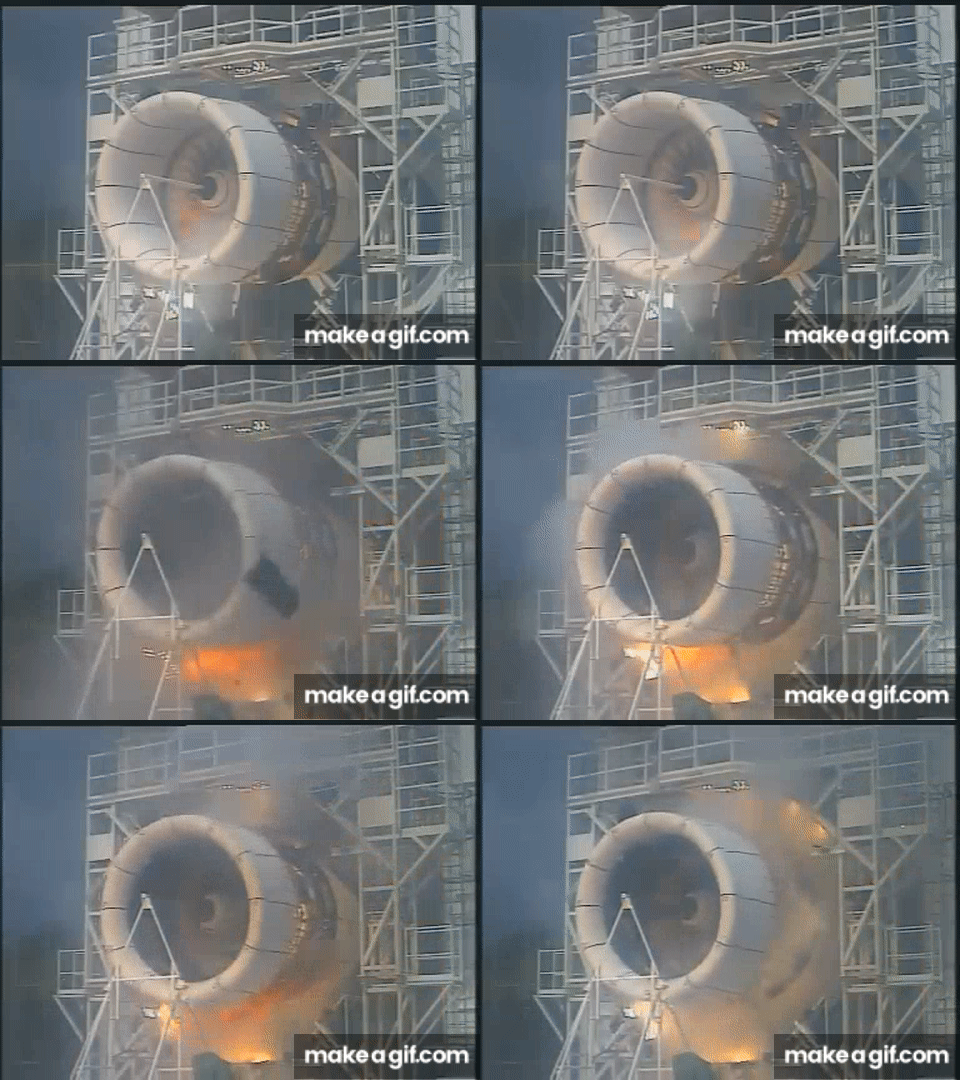
Aircraft engines are already designed to take a certain amount of bird strike. The FAA even has a “chicken cannon” that it uses to shoot whole birds at hundreds of mph into running jet engines to certify them as compliant with the strike minimums. They shoot birds up to goose size into engines. Trouble is when you hit a flock of birds and they simply overwhelm the engines ability to chew up bird parts and the mass causes blades to fail starting a cascade of failure deep into the core of the engine.
No pilot in command time, but I did stay in a Motel 6.
I have deployed my reserve parachute successfully 6 times, which I take great satisfaction in reflecting upon from time to time.
I should be nonchalantly eating an apple as I speak with you.
Keep your airspeed up!
Know what I mean hoss?
What is disturbing is that they were setup and aligned to land on Runway 1.
They executed a go-around and then declared the Mayday Bird Strike.
Procedure is that if you take a bird strike on final approach, you just come in and land. You do not go around.
From the ground video that shows the bird strike, the plane is setup with flaps down and what may be gear down.
“Did somebody step on a duck”?
Well aware of the testing... Retired from DoD acquistion and aircraft DT&E and OT&E. I’ve seen some bad results when things go wrong and some beyond dumb ass ideas trying to resolve a problem.
I’ve read that the localizer antenna foundation at US airports must be at the surrounding soil elevation, I.e., no concrete structure above the soil line. And the antenna structure itself must be a frangible design to give way in any collision with an aircraft.
Obviously, the pilots didn’t see “Sully”.
You should track all the engine designers down and let them know what dunces they are.
Bird strikes probably are far more frequent than you might imagine.
The FAA says US air carriers experience around 10,000 bird strikes a year. Comes to about 27 every day. Roughly 85% of those are on take-off or landing. LaGuardia has the most bird strikes reported, largely because it started out as a seaplane base.
The vast majority go unreported because the crew doesn’t notice when it happens*, or when they get on the ground and inspect it there’s no visible damage done, and they’d sooner not have to fill out the paperwork.
* Engines in or on the tail obviously would be impossible to see from the cockpit (without external cameras). Most jet airliners have swept main wings, and if the plane has engines on its wings (which most do), they’re well behind the cockpit windows and flight deck crewmembers would have to make an effort to look that far back. Puddle-jumping prop-jobs are different but it would be unusual if anybody in the cockpit of a jet happened to be looking when a bird flew into an engine or struck a wing.

Was the dna from the same duck?
Disclaimer: Opinions posted on Free Republic are those of the individual posters and do not necessarily represent the opinion of Free Republic or its management. All materials posted herein are protected by copyright law and the exemption for fair use of copyrighted works.