Posted on 12/29/2023 12:44:08 PM PST by Red Badger
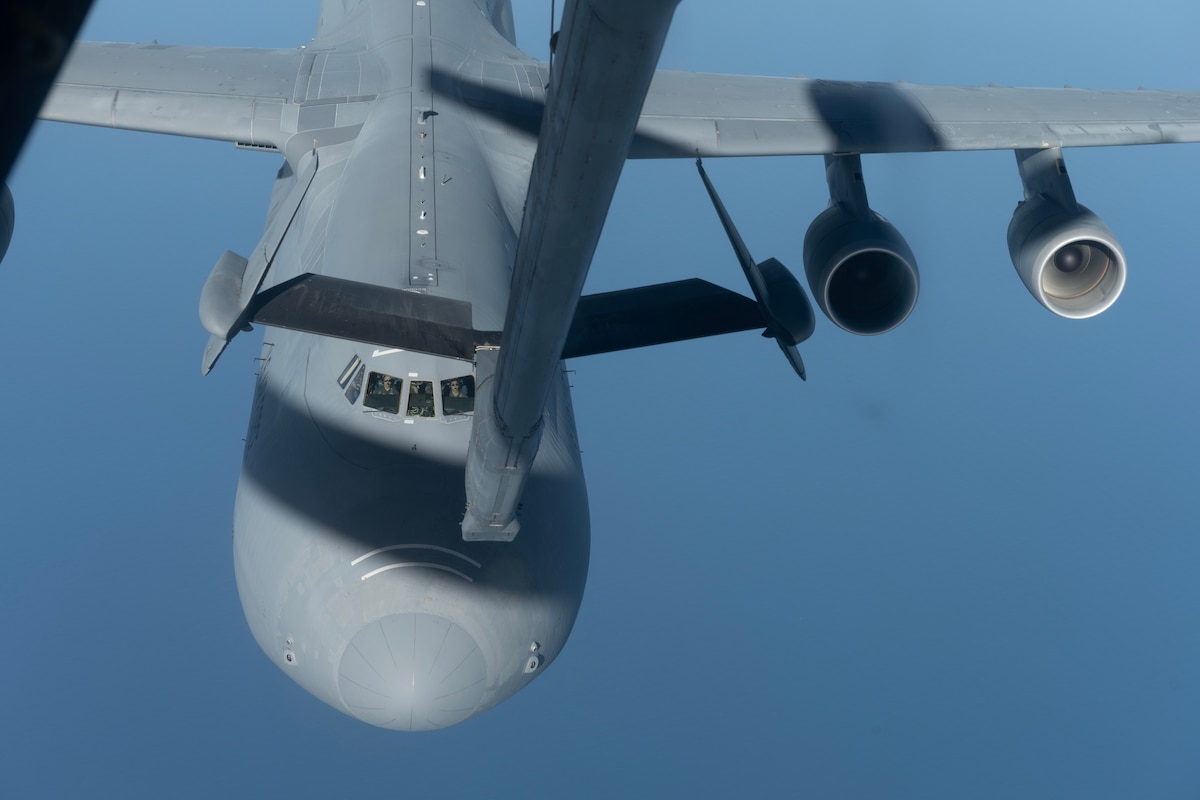
TRAVIS AIR FORCE BASE, Calif.— An aircrew from the 22nd Airlift Squadron conducted a reverse flow air refueling training with a C-5M Super Galaxy and a KC-10 Extender over Northern California and Oregon, Dec. 12, 2023.
The reverse refuel is a proof of concept, designed to maintain readiness in emergency situations to prevent loss of a tanker aircraft.
U.S. Air Force Maj. Justin Wilson, 22nd Airlift Squadron chief of standards and evaluations and evaluator C-5M Super Galaxy evaluator pilot, operates a C-5M in an aerial refueling track over Northern California and Oregon, Dec. 12, 2023. An aircrew with the 22nd Airlift Squadron performed a reverse flow air refueling proof of concept with a KC-10 Extender. The reverse refuel is designed to maintain readiness in emergency situations to prevent loss of a tanker aircraft. (U.S. Air Force photo by Senior Airman Alexander Merchak)
“By using a C-5 as a huge floating gas station, it allows more tankers to be positioned for offloading to fighter or mobility aircraft, versus having to use one tanker to refuel another, which takes away a tanker asset from the mission,” said U.S. Air Force Maj. Justin Wilson, 22nd AS chief of standards and evaluations and C-5M evaluator pilot. “This allows more tanker aircraft in the theatre and extends their range or orbit time.”
According to Wilson, this was the first time the C-5M was used like this since its initial testing and certification. By conducting tests on this procedure, the aircrew successfully gathered data points that can be utilized in the future to enhance the range and capabilities of a tanker aircraft.
“By doing reverse air refueling, the aircraft is getting lighter at a quicker rate than if you were just flying normally, so the aircraft flies a little different,” said Wilson. “The real difference is when it comes to the flight engineers.”
“To execute the reverse air refuel, we made amendments to two of our normal checklists,” said Tech. Sgt. Robin Ogg, 60th Operations Group C-5M senior evaluator flight engineer. “These changes were in the flight engineer’s fuel panel configuration to set us up to give fuel versus receiving it.” An Airman sits in the flight deck of a military aircraft U.S. Air Force Tech. Sgt. Robin Ogg, 60th Operations Group C-5M Super Galaxy senior evaluator flight engineer, monitors flight equipment prior to flight at Travis Air Force Base, California, Dec. 12, 2023. An aircrew with the 22nd Airlift Squadron performed a reverse flow air refueling proof of concept with a KC-10 Extender. The reverse refuel is designed to maintain readiness in emergency situations to prevent loss of a tanker aircraft. (U.S. Air Force photo by Senior Airman Alexander Merchak)
An in-flight refuel normally consists of a KC-10 or KC-46A Pegasus delivering fuel to another aircraft. In this exercise, the C-5M aircrew reversed the process with the help of a KC-10.
“This mission on the C-5 meant showcasing precision, teamwork, flexibility, and adaptability,” said Ogg. “It highlighted the importance of trust and coordination within the team, emphasizing everyone's crucial role. The experience left me with a deep sense of pride and accomplishment.”
The C-5M offloaded 23,500 pounds of fuel in approximately thirty minutes to the KC-10.
AVIATION PING!...................
Is a tanker refueling another tanker?
Not understanding the utility of this, unless it’s to refill the KC-10 so it can refuel more fighters/bombers without having to send it down the gravity well. Would that save time, maybe? Would the transfer rate be fast enough to justify it?
Yes................
Hopefully they can bump that up faster the 150 GPM.
Air refueling is cool and all, but I personally don’t have a multi-hour ass to sit in a fighter cockpit that long to go through multiple tanks.
Looks like the C-5M can be configured to be a bulk fuel hauler that can deliver on land and now in the air. The C-5 cannot be configured with refueling boom so it has to transfer gas to a plane that does, in the air.
What if the mission needs two tankers, but you only have one because the enemy took one out?
You can refuel the remaining tanker in flight, so it can then refuel the rest of the planes.
Nice to see a Technical Sergeant being the point of concept spokesman!
Is there a tanker to fill the tanker which is filling the tanker?
why not have the tanker refueler just take over refueling the jets!!?? seems like a waisted double handling to me....
why not have the tanker refueler just take over refueling the jets!!?? seems like a waisted double handling to me....
unless of course thats a bigger bird and can refuel several tankers, then its sensible...
If the enemy is taking out tankers, gas ain’t yer problem.
That's not a lot of fuel but it was just a proof of concept.
I remember from my instrument days that an F-4D could hold 12,000 pounds internally and that's the most the gauge would read, but it could carry more fuel in external tanks (which did not show up on the gauge) for a total of about 20,000 lbs.
No. In this experiment, a C-5 cargo plane transferred fuel to a tanker.
Sounds like the C-5 is basically a flying fuel bladder; this would allow more tankers to stay in the area (or support other areas). Could also help keep tankers in the sky when some get shot down.
23.5 kgal/30 mins is about ~ 800 gallons/minute. Not bad for proof-of-concept demonstration.
Just checked...
Centerline tank - 600 gallons
Wing tank - 370 gallons
Wing tank - 370 gallons
1340 gallons @ 6.47 JP4 weight per gallon
= 8,700 lbs
https://tailspintopics.blogspot.com/2013/06/things-under-wings-f4h-f-4-phantom.html
23,500# is about 5,000 gallons.
I’m used to dealing in water flow.
Disclaimer: Opinions posted on Free Republic are those of the individual posters and do not necessarily represent the opinion of Free Republic or its management. All materials posted herein are protected by copyright law and the exemption for fair use of copyrighted works.